Dwain Northey (Gen X)
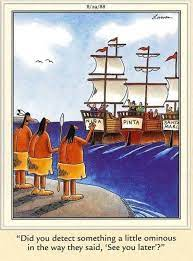
In 1937, Congress and President Franklin D. Roosevelt made Columbus Day, October 12, a national holiday. Originally conceived as a celebration of Italian American heritage largely because of lobbying by the Knights of Columbus, a Catholic fraternal and charitable organization. It was moved to the second Tuesday in October in 1971. For many Indigenous peoples, Columbus Day is a controversial holiday. This is because Columbus is viewed not as a discoverer, but rather as a colonizer. His arrival led to the forceful taking of land and set the stage for widespread death and loss of Indigenous ways of life.
The holiday was portrayed to school children throughout the 20th Century as celebrating the ‘man’ that discovered America and proved that world wasn’t flat. ‘In 1492 Columbus sailed the Ocean Blue’ we all remember the story… October 12, 1492, is of enormous significance in Western history: It is the day when explorer Christopher Columbus completed his journey across the Atlantic Ocean and landed in the “New World.” What Columbus actually reached on that October day was an island he named San Salvador that is now part of the Bahamas.
So, it seems that the history we were taught in elementary school was complete B.S.. It turns out that Columbus was in reality a terrible human being.
This is from Vox article.
1) Columbus kidnapped a Carib woman and gave her to a crew member to rape
Bergreen quotes Michele de Cuneo, who participated in Columbus’s second expedition to the Americas (page 143):
While I was in the boat, I captured a very beautiful woman, whom the Lord Admiral [Columbus] gave to me. When I had taken her to my cabin she was naked — as was their custom. I was filled with a desire to take my pleasure with her and attempted to satisfy my desire. She was unwilling, and so treated me with her nails that I wished I had never begun. I then took a piece of rope and whipped her soundly, and she let forth such incredible screams that you would not have believed your ears. Eventually we came to such terms, I assure you, that you would have thought she had been brought up in a school for whores.
2) On Hispaniola, a member of Columbus’s crew publicly cut off an Indian’s ears to shock others into submission
Hispaniola, now divided between the Dominican Republic and Haiti. NASA/JPL/SRTM
After an attack by more than 2,000 Indians, Columbus had an underling, Alonso de Ojeda, bring him three Indian leaders, whom Columbus then ordered publicly beheaded. Ojeda also ordered his men to grab another Indian, bring him to the middle of his village, and “‘cut off his ears’ in retribution for the Indians’ failing to be helpful to the Spaniards when fording a stream.” (Bergreen, 170-171)
3) Columbus kidnapped and enslaved more than a thousand people on Hispaniola
According to Cuneo, Columbus ordered 1,500 men and women seized, letting 400 go and condemning 500 to be sent to Spain, and another 600 to be enslaved by Spanish men remaining on the island. About 200 of the 500 sent to Spain died on the voyage, and were thrown by the Spanish into the Atlantic. (Bergreen, 196-197)
4) Columbus forced Indians to collect gold for him or else die
Columbus ordered every Indian over 14 to give a large quantity of gold to the Spanish, on pain of death. Those in regions without much gold were allowed to give cotton instead. Participants in this system were given a “stamped copper or brass token to wear around their necks in what became a symbol of intolerable shame.” (Bergreen, 203)
5) About 50,000 Indians committed mass suicide rather than comply with the Spanish
Bergreen explains, page 204:
The Indians destroyed their stores of bread so that neither they nor the invaders would be able to eat it. They plunged off cliffs, they poisoned themselves with roots, and they starved themselves to death. Oppressed by the impossible requirement to deliver tributes of gold, the Indians were no longer able to tend their fields, or care for their sick, children, and elderly. They had given up and committed mass suicide to avoid being killed or captured by Christians, and to avoid sharing their land with them, their fields, groves, beaches, forests, and women: the future of their people.
6) 56 years after Columbus’s first voyage, only 500 out of 300,000 Indians remained on Hispaniola
Population figures from 500 years ago are necessarily imprecise, but Bergreen estimates that there were about 300,000 inhabitants of Hispaniola in 1492. Between 1494 and 1496, 100,000 died, half due to mass suicide. In 1508, the population was down to 60,000. By 1548, it was estimated to be only 500.
Understandably, some natives fled to the mountains to avoid the Spanish troops, only to have dogs set upon them by Columbus’s men. (Bergreen, 205)
7) Columbus was also horrible to the Spanish under his rule
Bartolomé de Las Casas, one of the primary chroniclers of Columbus’s crimes. Antonio Lara
While paling in comparison to his crimes against Caribs and Taino Indians, Columbus’s rule over Spanish settlers was also brutal. He ordered at least a dozen Spaniards “to be whipped in public, tied by the neck, and bound together by the feet” for trading gold for food to avoid starvation. He ordered a woman’s tongue cut out for having “spoken ill of the Admiral and his brothers.”
Another woman was “stripped and placed on the back of a donkey … to be whipped” as punishment for falsely claiming to be pregnant. He “ordered Spaniards to be hanged for stealing bread” (Bergreen, 315-316). Bergreen continues:
He even ordered the ears and nose cut off one miscreant, who was also whipped, shackled, and banished from the island. He ordered a cabin boy’s hand nailed in public to the spot where he had pulled a trap from a river and caught a fish. Whippings for minor infractions occurred with alarming frequency. Columbus ordered one wrongdoer to receive a hundred lashes — which could be fatal — for stealing sheep, and another for lying about the incident. An unlucky fellow named Juan Moreno received a hundred lashes for failing to gather enough food for Columbus’s pantry.
8) Settlers under Columbus sold 9- and 10-year-old girls into sexual slavery
This one he admitted himself in a letter to Doña Juana de la Torre, a friend of the Spanish queen: “There are plenty of dealers who go about looking for girls; those from nine to ten are now in demand, and for all ages a good price must be paid.”
9) Indian slaves were beheaded when their Spanish captors couldn’t be bothered to untie them
Benjamin Keen, a historian of the Spanish conquest of the Americas, noted that multiple sources confirmed accounts of “exhausted Indian carriers, chained by the neck, whose heads the Spaniards severed from their bodies so they might not have to stop to untie them.”
I for one am happy that we have stopped celebrating this historical despot and hope that Indigenous Peoples are celebrated for the enumerable contributions they made to this nation and the genocide remembered for the brutal carnage that our forefathers set upon them.
 Esoteric Meandering Shouting Into the Void
One response to “Historical Correction”
Thanks for this, I’m a big history fan.
LikeLiked by 1 person