Well, shoot: Curse words have been through a lot of doggone stages to get to where they are today. Mark Twain once said that “under certain circumstances, profanity provides a relief denied even to prayer,” and people have been swearing as long as they’ve been praying. What is considered “cursing” or “swearing” has always depended on what was taboo at that point in time, whether it be blasphemous or simply crude. These off-limits words and topics have shifted over time, too. Here’s a brief look at the history of cursing, from A to Z… or “arse” to “zounds!”
The Original Curse
Why do we call forbidden terms “curse” or “swear” words? It’s likely the English terms evolved from the Bible, where “swearing” was sometimes used to refer to false promises or lies, such as when someone claims to do something that is not possible. These were considered vain oaths, and this “swearing” would sometimes be made in God’s name. Some of the earliest expletives were phrases referencing religion, such as “by God’s bones,” “God’s nails,” or really anything to do with God that wasn’t a literal and sincere oath.
Frequently, curse words originated from the combination of two or more taboo words pushed together in a way that obscured the literal meaning, creating a new slang term in the process. For instance, “gadzooks” was a curse used in place of “God’s hooks,” and by the 1600s, the word “zounds” — a shortening of “God’s wounds” — appeared in William Shakespeare’s Othello and King John. In the 19th century, people in Ireland used “bejabbers” as a way to get around saying “by Jesus.”
The Rise of the Four-Letter Word
The phrase “four-letter word” was first used as a euphemism for swear words in the 1920s, and for good reason: Of the approximately 84 commonly used American English swear words, 29 of them have four letters, including some of the most popular. “Damn,” for instance, appeared as a verb as early as the 13th century, meaning “to condemn,” and was used as an exclamation starting in the 17th century.
The “F-word,” meanwhile, was preceded by a different four-letter word in the 10th century: “sard,” which described the same intimate act. The common myth that today’s F-word derived from an acronym, either “fornication under consent of the king” or “for unlawful carnal knowledge,” is untrue. Instead, the expletive may come from the Middle Dutch “fokken,” Norwegian “fukka,” or Swedish “focka,” all of which mean several things, including “to copulate.” Another theory supported by the Dictionary of Slang and Unconventional English and The Roots of English: A Reader’s Handbook of Word Origin tracks the word back to the Indo-European term “peuk,” meaning “to prick.” According to the Oxford English Dictionary, the first recorded use of the modern F-bomb was in 1503, in a Scottish poem, though the word was likely used even earlier. In 1965, the F-word became an official part of the English lexicon when it was included in The Penguin Dictionary.
The four-letter word beginning with “sh” has had several meanings through the years. According to the Old English Dictionary, it was used to mean “an obnoxious person” starting in 1508, although the early version of the word wasn’t four letters; it began as the Old English curse “scite.” In Latin, “scite” means a very different thing: shrewdly, cleverly, or skillfully. By 1934, when it was used in Henry Miller’s novel Tropic of Cancer, the modern, four-letter version of the word had evolved to essentially mean “stuff,” regardless of quality.
Swearing Goes to Hollywood
By the 20th century, the explosion of mass media brought curse words to the mainstream. Filmmakers even had to fight to get the now-classic line “Frankly, my dear, I don’t give a damn” into Gone With the Wind. Producer David O. Selznick told regulators, “This word as used in the picture is not an oath or a curse. The worst that could be said of it is that it’s a vulgarism.”
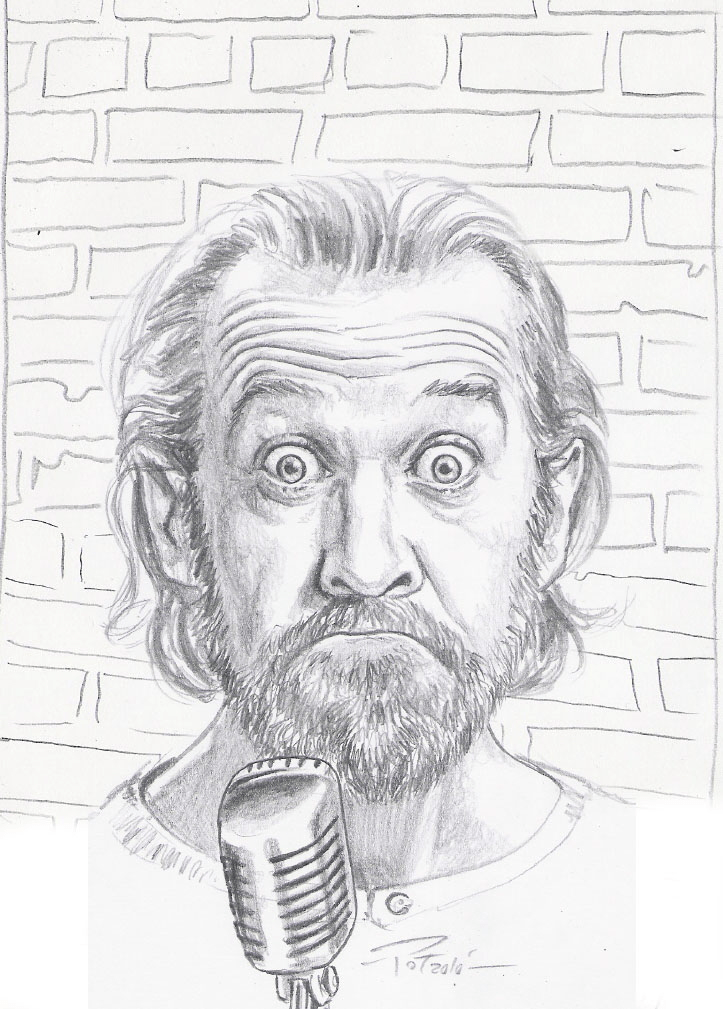
Comedian Lenny Bruce was arrested multiple times in the 1960s for “obscenity” for using explicit language, and in 1972, George Carlin was arrested for performing his “Seven Dirty Words You Can’t Say on Television” act, even though he wasn’t on television at the time (he was performing at Summerfest in Milwaukee, Wisconsin). A year later, Carlin’s routine was played on the radio, which led to a series of court cases about what language should be banned from broadcast radio and TV. In 1999, the CBS series Chicago Hope brought the first scripted curse word to network TV when actor Mark Harmon said “sh** happens.” (Prior to this, swearing on TV was limited to cable television.) Today, the film industry’s Classification and Rating Administration decides just how many of those naughty words it takes to add up to an R-rating.
 Esoteric Meandering Shouting Into the Void