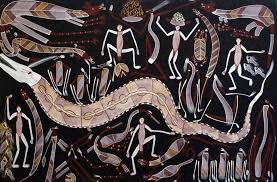
Australians are the world’s oldest continuous living culture.
What is the oldest continuous culture in the world? Some might say it’s the Egyptians, since they’ve been kicking around for several thousand years, or perhaps the Indians living along the Indus River Valley — one of ancient history’s greatest (and least-known) civilizations. However, the real answer lies far away from these centers of ancient wonder, in the Land Down Under, among that continent’s first peoples — the Aboriginal Australians. A study in 2016 by an international team of researchers gathered genomic data that showed this group first arrived on the continent some 50,000 years ago, after leaving Africa about 70,000 years ago.
However, it’s worth noting that Aboriginal peoples are far from a homogenous unit. After the first peoples arrived on the continent, they quickly spread across Australia, forming isolated pockets that developed independently of one another. By the time Europeans arrived en masse in the late 18th century, some 200 nations of Aboriginal Australians — each with their own language — lived throughout the continent. But that diversity goes beyond just tribes or nations; a study in December 2023 concluded that Aboriginal peoples have high levels of genetic diversity compared to European or Asian populations.
Unfortunately, Aboriginal Australians continue to struggle compared to non-Indigenous Australians, and experience an eight-year shorter life expectancy, poorer health and educational outcomes, and other ill effects stemming from colonialism and mistreatment. But if the past 75,000 years have taught us anything, it’s that Aboriginal Australians are a resilient culture, and they aren’t going anywhere.
 Esoteric Meandering Shouting Into the Void