Dwain Northey (Gen X)
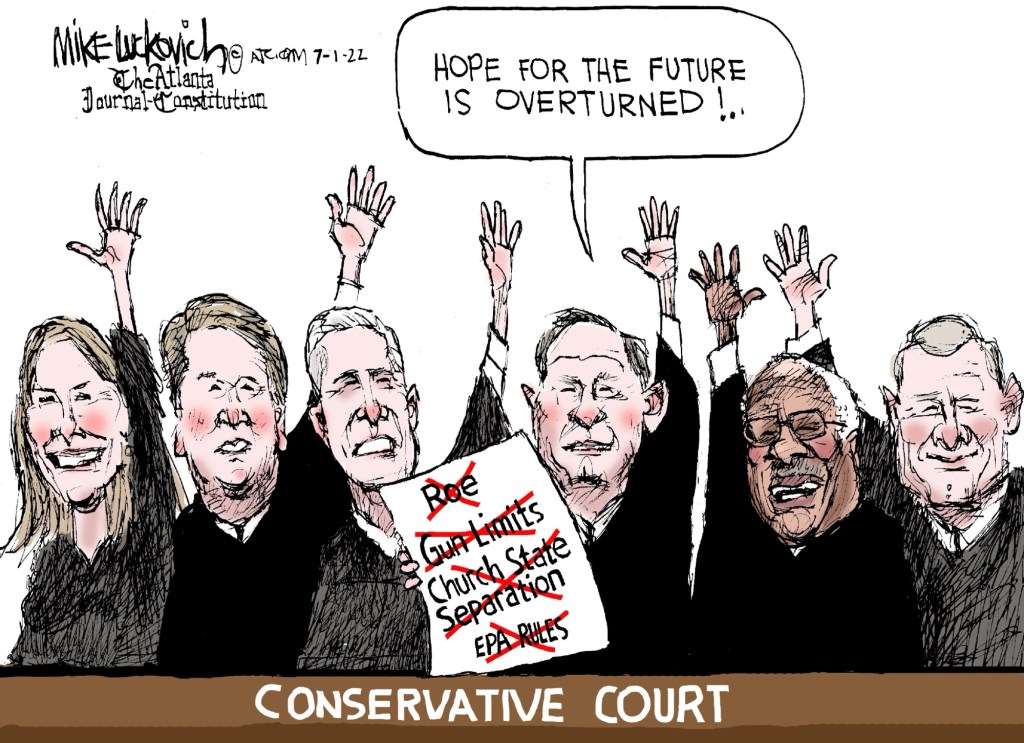
Recent rulings by the U.S. Supreme Court have drawn intense criticism for appearing arbitrary and capricious, eroding public trust in the judiciary and undermining the foundational principle of the rule of law. Rather than acting as neutral interpreters of the Constitution, the Court’s majority in several landmark decisions has increasingly relied on ideologically driven reasoning, often overturning long-standing precedents without clear legal justification. This unpredictability creates legal instability, leaving citizens, lawmakers, and lower courts unsure of how laws will be interpreted or enforced.
The rule of law depends on consistency, transparency, and restraint. When the Court discards precedent—such as in Dobbs v. Jackson Women’s Health Organization, which overturned Roe v. Wade—based on vague or shifting standards, it signals that constitutional protections are no longer secure. The legal reasoning in such cases often lacks coherence, raising the perception that decisions are driven by political goals rather than legal principle. This not only delegitimizes the Court but weakens democratic institutions by sending the message that laws are subject to the whims of the powerful.
Those who cheer such rulings because they achieve short-term political victories fail to grasp the long-term consequences. A Court seen as partisan and erratic invites backlash, whether through public protest, legislative reform, or a future reconfiguration of the Court itself. Once the principle of stable, impartial justice is abandoned, no faction can rely on the Court to uphold its interests indefinitely. When precedent and constitutional norms are treated as disposable, the legal system ceases to be a safeguard and instead becomes a tool of domination.
Eventually, the very groups celebrating today’s rulings may find themselves at the mercy of an equally unaccountable Court tomorrow. When arbitrariness becomes the rule, no one is safe from its reach.
 Esoteric Meandering Shouting Into the Void