Dwain Northey (Gen X)

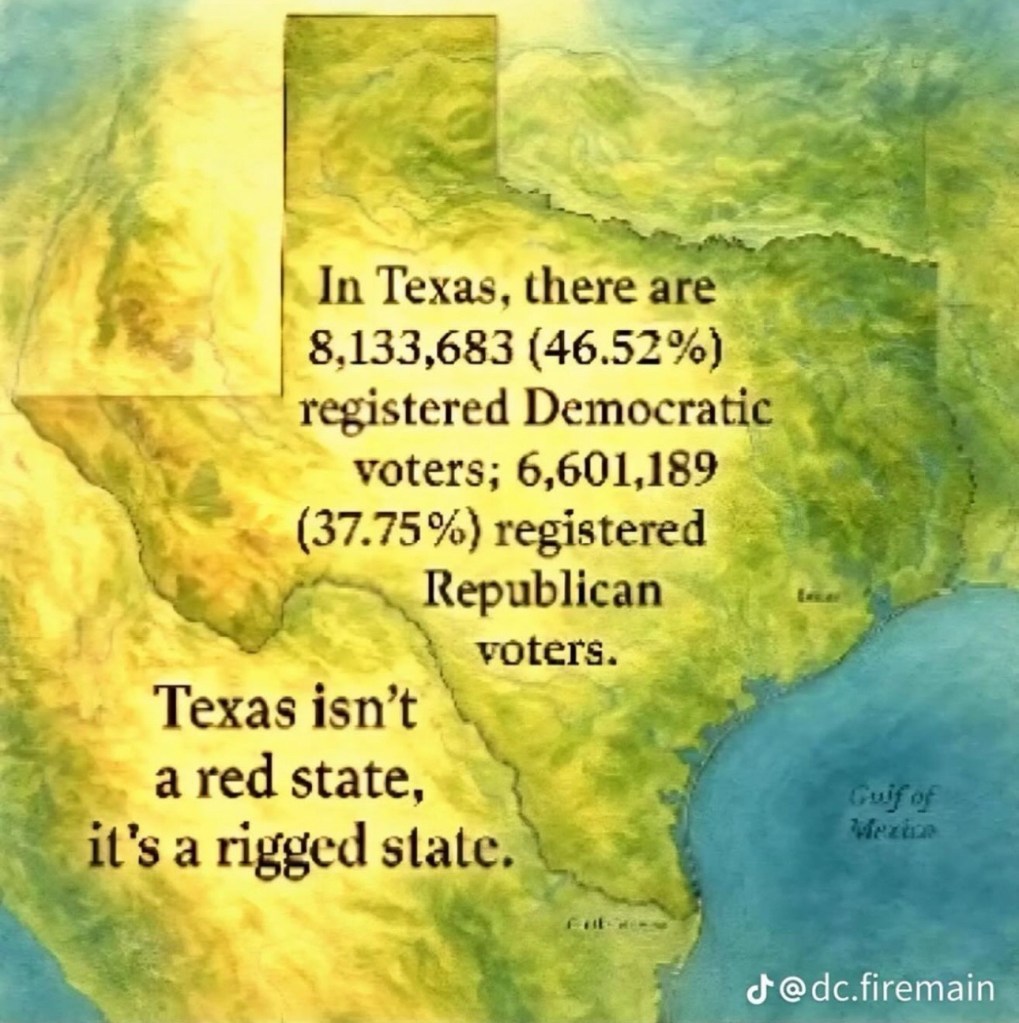
For decades, the GOP has been perfecting the art of bending, breaking, and outright rewriting the rules to keep themselves in power—especially when the voters don’t naturally line up in their favor. Their strategy is simple: if the will of the people threatens their grip, change the system so the people’s will doesn’t matter. And nowhere is this clearer than in the way they manipulate representation at both the state and federal level.
Take Texas. The state has 38 U.S. House seats, yet only 13 are held by Democrats. This lopsided imbalance doesn’t reflect the actual political makeup of Texas, which is far more evenly divided than Republicans want you to believe. Through aggressive gerrymandering, they’ve carved up districts so that Democratic-leaning urban centers—especially those with high concentrations of Black and Latino voters—are diluted and divided, ensuring Republicans hold more seats than their vote share would ever justify. This isn’t a quirk of politics; it’s a deliberate suppression of voices they’d rather not hear, particularly outspoken representatives like Jasmine Crockett, who refuses to play quiet in the corner.
Georgia is another example. The state has 14 U.S. House seats, with only five held by Democrats, despite the fact that Georgia’s voters have shown a willingness to elect Democrats statewide—twice, in the case of their U.S. Senators, Raphael Warnock and Jon Ossoff. Clearly, the popular will leans more Democratic than the congressional map suggests. Yet the GOP keeps the House delegation skewed heavily Republican through maps that pack minority voters into as few districts as possible, silencing their influence elsewhere.
When Republicans pull these stunts, they treat it as perfectly legal and even noble—a “defense of election integrity” or “protecting fair representation,” as they like to say. But when the shoe is on the other foot, their fainting couches get a workout. If a state like California, Illinois, or New York—where Democrats dominate—were to redraw districts mid-decade to squeeze out more Democratic seats, the GOP would howl about “unconstitutional power grabs” and “attacks on democracy.” The hypocrisy is almost impressive in its consistency.
The truth is, the GOP’s rule-changing habit extends beyond gerrymandering. They’ve backed voter ID laws designed to disproportionately impact Black, Latino, and low-income voters, purged voter rolls with suspicious accuracy in heavily Democratic areas, and shortened early voting periods where Democratic turnout is highest. Their fear isn’t that the system is broken—it’s that it might actually work as intended, giving equal weight to every vote.
By keeping districts carved in their favor and silencing dissenting voices, Republicans have managed to hold onto power even in states where demographic shifts should be moving the political balance. They don’t want a level playing field; they want a field they own, referee, and occasionally move the goalposts on mid-game.
The GOP doesn’t win by convincing the majority—they win by making the majority irrelevant. And until those tactics are dismantled, they’ll keep playing the same game, clutching their pearls when challenged, while quietly rewriting the rules to ensure that their minority rule remains the law of the land.
 Esoteric Meandering Shouting Into the Void