Dwain Northey (Gen X)
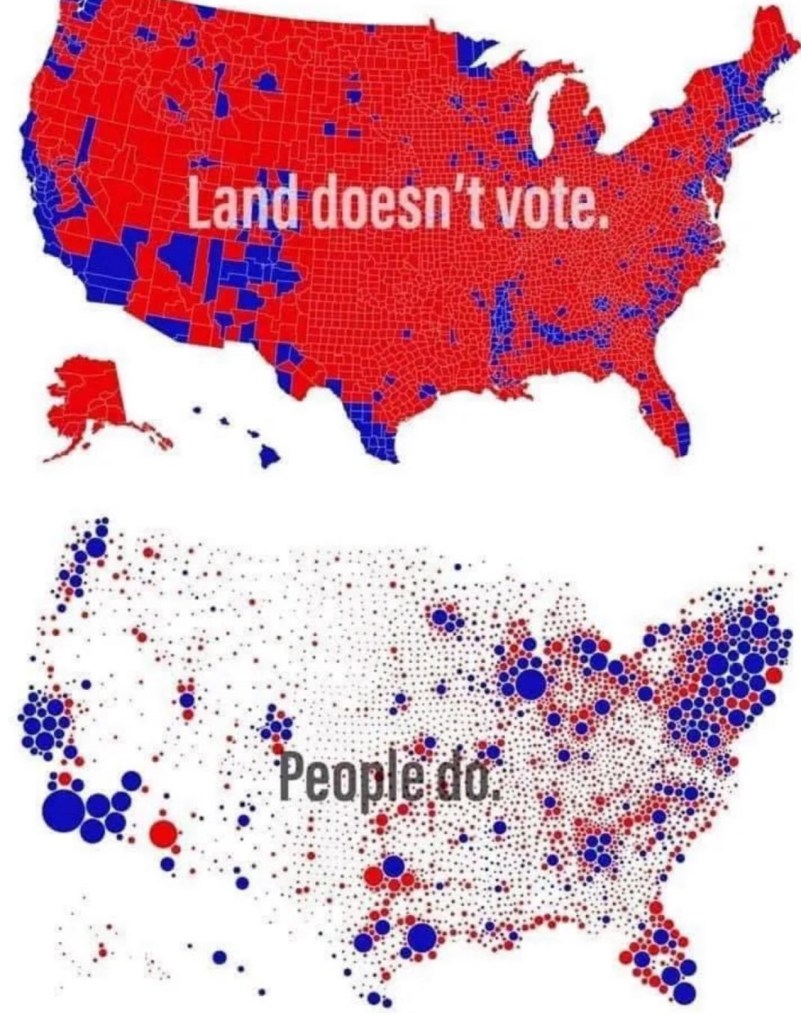
When Americans look at voting maps on election night, especially the ones splashed across cable news, the picture can be very misleading. Those maps are usually shaded red and blue by county or by state, and at first glance they often give the impression that Republicans dominate the country. Vast swaths of the map glow in red, while the areas marked in blue seem like small islands scattered across the coasts and a handful of urban centers. But here’s the catch: maps show area, not population—and in a democracy, it’s people who cast ballots, not acres of farmland or square miles of prairie.
This is where the illusion comes in. States such as Wyoming, Nebraska, and the Dakotas sprawl across thousands of square miles, but they are sparsely populated. A single New York City borough or a chunk of Los Angeles County contains more people than entire Great Plains states combined. Yet when maps are shaded by area, those huge but lightly populated regions overwhelm the visual impression, giving the appearance that Republican votes are far more dominant than they actually are.
The distortion becomes even clearer when you look at county-level maps. Rural counties tend to lean Republican, and there are thousands of them, each covering broad geographic areas. Urban counties, which lean Democratic, are geographically tiny but packed with millions of voters. On a conventional map, the urban centers look like small blue dots surrounded by an ocean of red, even though those dots represent huge concentrations of actual ballots.
Political scientists often use cartograms—maps that resize regions based on population rather than land area—to correct this distortion. When you view a cartogram of the United States after an election, the country looks completely different: cities expand like balloons, rural states shrink dramatically, and the true balance of voter power emerges. Suddenly, it’s obvious that Democrats aren’t confined to a few islands, nor are Republicans overwhelmingly dominant simply because they “own” more land.
This misperception isn’t just cosmetic. It shapes political psychology. When people see a sea of red across the map, they can assume Republicans have an iron grip on the electorate, when in reality elections are often decided by razor-thin margins in key states. The truth is that land doesn’t vote—people do. And where those people live matters far more than the number of square miles they occupy.
 Esoteric Meandering Shouting Into the Void