Dwain Northey (Gen X)
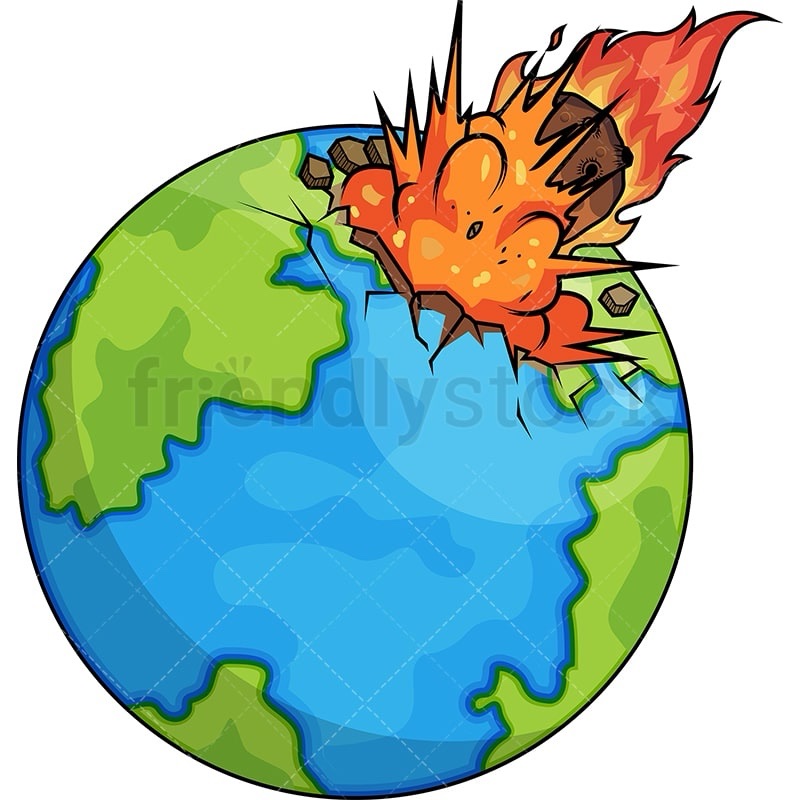
The cosmos does not owe humanity a promise of safety. We live on a fragile rock orbiting an average star in a galaxy filled with chaotic forces beyond our control. While Earth has survived for billions of years, history reminds us that planetary disasters are not hypothetical—they are inevitable given enough time. Looking at the next hundred years, the most plausible intergalactic or cosmic threats come not from distant galaxies, but from far closer to home: asteroids, comets, and other celestial debris crossing Earth’s orbital path.
Asteroids and Near-Earth Objects (NEOs)
The most immediate concern for planetary safety comes from near-Earth objects. Tens of thousands of asteroids pass within striking distance of our planet every year. Most are harmless pebbles that burn up in the atmosphere, but some are big enough to flatten cities or destabilize the global climate. NASA and the European Space Agency track over 30,000 NEOs, but estimates suggest that hundreds of thousands remain undiscovered. The dinosaurs did not see their killer coming 66 million years ago, and without constant surveillance, we might not either.
An asteroid roughly 50–100 meters wide—smaller than many football stadiums—could destroy a major city. The 1908 Tunguska event in Siberia, caused by an object no larger than 60 meters, flattened over 800 square miles of forest. A 300–500 meter impactor would be capable of regional destruction, collapsing economies and killing millions. And anything larger than one kilometer across could trigger a global catastrophe—crop failures, mass extinctions, and what scientists call an “impact winter.”
Known Potential Threats
Several asteroids have stirred public fear. In 2029, Apophis—a 370-meter-wide asteroid—will pass closer to Earth than many satellites. Scientists now know it will miss us, but it will be a stark reminder of how close cosmic roulette can get. In 2089, asteroid 2025 FA22 was once thought to pose a slim threat, though calculations show it will sail safely past. The real danger is from the undiscovered objects, the ones hiding in the sun’s glare or beyond our detection systems.
Cosmic Wildcards
Beyond asteroids, the universe harbors other forces that could reshape life on Earth. Supernova explosions, while rare, could bathe the planet in lethal radiation if one occurred within a few dozen light-years. Gamma-ray bursts—highly energetic beams from collapsing stars—could strip away Earth’s protective ozone layer, leaving life vulnerable to solar radiation. Thankfully, the odds of such an event in the next century are low, but not zero.
Another possibility comes from interstellar visitors. In recent years, objects like ‘Oumuamua and comet Borisov have entered our solar system from deep space. These wanderers remind us that intergalactic debris is not just science fiction. A larger rogue body, poorly tracked, could one day cross paths with Earth.
Humanity’s Response
The silver lining is that for the first time in history, humanity has the tools to defend itself. Missions like NASA’s DART, which successfully nudged the asteroid Dimorphos in 2022, prove we can alter the path of small celestial bodies. Expanding planetary defense—through telescopes, impactors, or even nuclear deflection—will be critical if we hope to avoid catastrophe.
The Next 100 Years
So, will Earth face an extinction-level event in the next century? The odds are small, but the potential consequences are so severe that ignoring the risk would be reckless. A city-destroying impact is far more likely than a global cataclysm, but both remain on the table. Meanwhile, cosmic events like supernovae and gamma-ray bursts remain unlikely but possible.
In short, the universe is not a gentle backdrop to human history—it is a restless, violent, and indifferent force. The next hundred years may pass uneventfully, or they may deliver a reminder that our survival depends on vigilance, preparation, and humility before the cosmos.
 Esoteric Meandering Shouting Into the Void