Dwain Northey (Gen X)
The Panopticon Presidency: Orwell Would Be Proud (and Terrified)
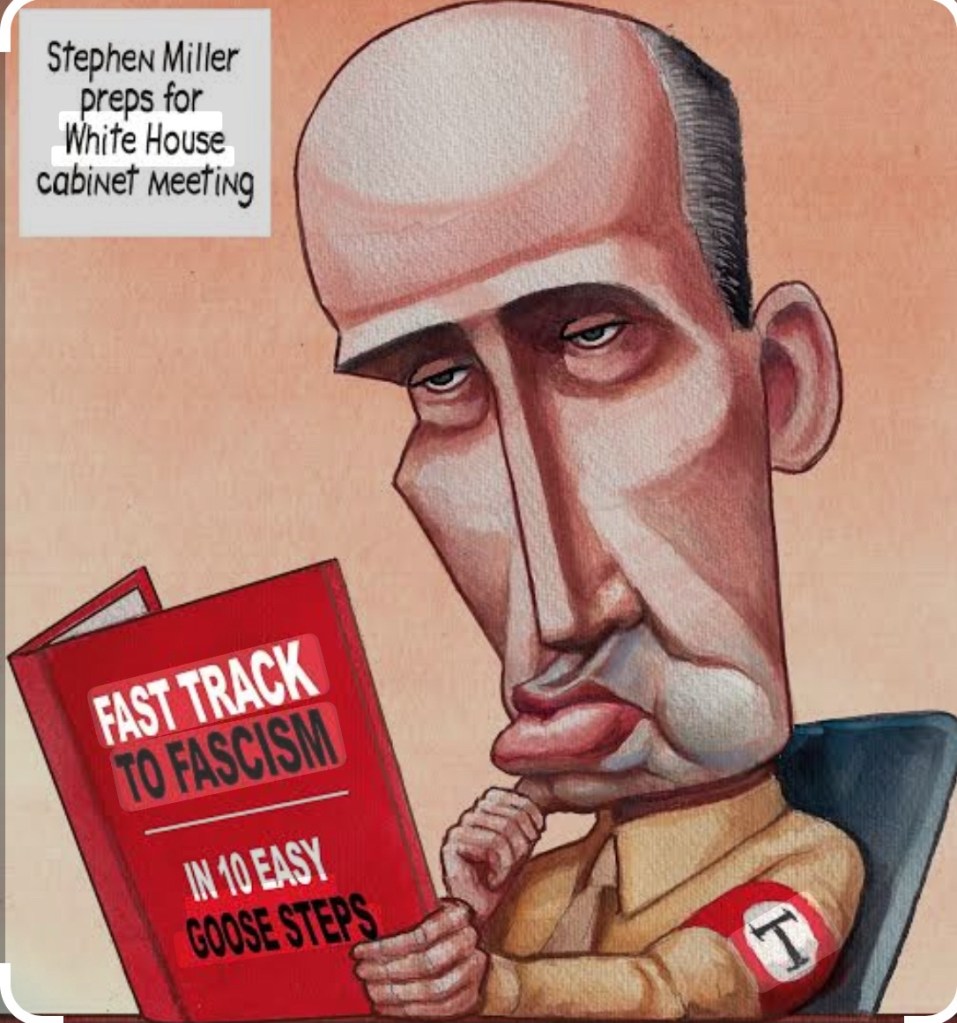
If Jeremy Bentham’s Panopticon was the “perfect prison,” then George Orwell’s 1984 was the instruction manual for turning that prison into a nation. Both were meant as warnings—cautionary tales about surveillance, control, and psychological domination. Unfortunately, when it comes to the modern American right, particularly under the mango-tinted messiah and his pallid sidekick Stephen Miller, those warnings look more like blueprints.
Let’s be clear: Donald J. Trump has almost certainly never heard of the Panopticon, unless he’s confusing it with a fancy new golf course in Dubai. Reading 1984? Please. That would require staying awake longer than two pages without pictures. But Stephen Miller—oh, he’s read it. He’s the kind of guy who reads 1984 and roots for Big Brother. He probably underlined the parts about obedience and control and thought, “Now this is governance!”
Bentham’s Perfect Prison
The Panopticon, as Bentham imagined it, was elegant in its cruelty: a circular prison where inmates never knew when they were being watched, so they behaved as if they always were. Constant visibility. Constant self-policing. You didn’t need walls of force when you could build walls of fear. The genius—and horror—of the Panopticon was that it turned surveillance into a state of mind.
Orwell’s Perfect State
Orwell took that same psychology and scaled it up to the size of a nation. 1984’s Big Brother isn’t watching everyone all the time—but everyone believes he might be, and that’s enough. Thoughtcrime, Newspeak, the rewriting of history—these weren’t just tools of repression. They were instruments of self-censorship. People learned to police their own minds, to love their captor, to fear even their own thoughts. It wasn’t just a dystopia—it was an obedience factory.
Enter the Modern Panopticon: The Trumpist Edition
Now, imagine that structure of control translated into a reality-TV dictatorship. You have the showman-in-chief who thrives on attention and chaos, and his ideological enforcer who understands that fear is the currency of compliance. The Trump-Miller approach isn’t about policy—it’s about power optics. They don’t need to put cameras in every room when they can convince people that “antifa” is lurking behind every bush and that “deep state” agents are reading your Facebook posts. It’s paranoia as public policy.
Every authoritarian needs their Panopticon. For Trump, it’s the omnipresent media echo chamber, where his followers watch him watching them watching him—a perpetual feedback loop of loyalty and rage. For Miller, it’s the bureaucratic machinery of surveillance, immigration raids, and speech policing dressed up as “law and order.” Together, they’re not building literal prison walls; they’re building psychological ones.
Big Brother Would Approve
Trump’s America flirts with Orwellian control every time the administration attacks journalists as “enemies of the people,” threatens to use the military against protesters, or demands blind allegiance over truth. It’s a police state dressed up in patriotism, a Panopticon powered by social media instead of stone walls. The true genius—or tragedy—is that half the inmates are cheering while the walls go up around them.
In the End
The Panopticon and 1984 both describe systems where people surrender freedom not because they’re forced to, but because they’re trained to. And that’s exactly the kind of obedience the Trump machine thrives on. So yes, while Donald himself couldn’t define “Panopticon” if it were engraved on a golf ball, his administration has certainly absorbed the concept. After all, it’s not about knowing the theory—it’s about living it. And under the watchful eye of Big Don and Little Brother Miller, the American experiment looks more and more like a rerun of a dystopia we were all warned to avoid.
 Esoteric Meandering Shouting Into the Void