Dwain Northey (Gen X)
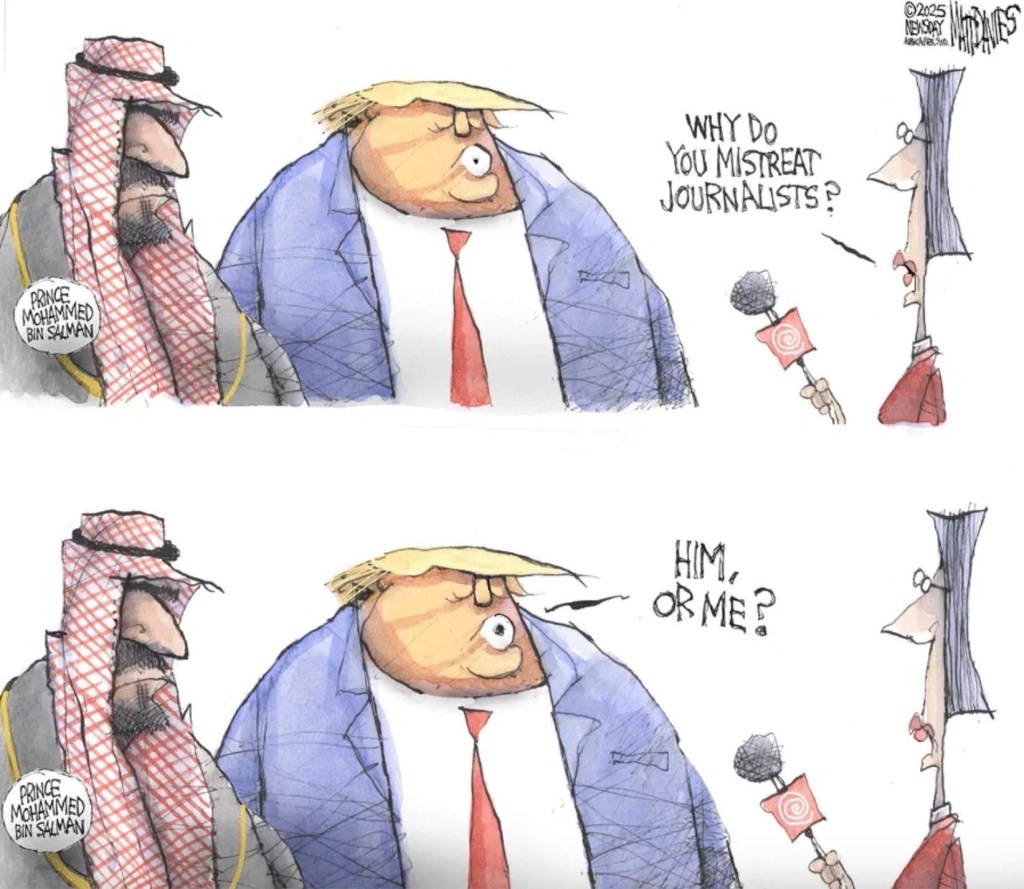
Donald J. Trump is never happier than when he’s orbiting someone profoundly questionable.
It’s practically a cosmic principle.
A celestial alignment.
A spiritual calling, even.
You look back at old photos—the social-era Trump, the disco-era Trump, the “I definitely own this casino even though I don’t” era Trump—and the pattern is unmistakable: place him in a room full of ethically radioactive figures, and suddenly he lights up like a kid at Disney World.
Now, to be clear, we aren’t saying anything about anyone’s guilt or innocence—this is satire, after all—but the optics? Oh, the optics. The man seems to radiate joy in settings where any normal person would be checking for exit routes, hand sanitizer, or subpoenas.
Take, for example, those infamous photographs from the party circuit of yesteryear—the ones with people whose reputations aged like milk left out in July. Trump never looked happier.
The smile!
The glow!
The unspoken “I am truly among my people.”
It’s like watching a rare bird return to its natural habitat.
And then there’s this week’s episode of “Trump in the Oval Office: Who Will He Defend Today?”
A gripping drama in which the President of the United States, instead of defending American values, democracy, or basic decency, chose to defend… well, let’s call him the Crown Prince With the Unfortunate International Incident.
There was Trump, sitting in the Oval Office, beaming like he’d just won a golf tournament he sponsored himself, explaining—at great, excited length—why the journalist who was murdered in a brutally literal way should not be discussed, questioned, or mentioned because to do so would be “unfair” to the prince.
Never mind the CIA.
Never mind U.S. intelligence.
Never mind global outrage.
Donald was having the time of his life.
Ah, loyalty—his favorite currency, right after money and flattery.
And of course, in true Trumpian form, he couldn’t defend a foreign leader accused of a horrifying act without also attacking our own press. Because what is Trumpian loyalty without a little domestic hostility? He denounced American journalists with the same gusto he uses on his teleprompter when it dares scroll too slowly.
It’s almost poetic, in a morally upside-down way:
When confronted with a choice between standing with American journalists or a foreign leader implicated in the unaliving of one… he practically dove across the room to hug the latter.
There’s something almost introspective about it, if you tilt your head sideways and squint:
Why does Donald look happiest around people whose reputations could peel paint?
Why is his emotional thermostat set to “thrilled” whenever he is near someone facing accusations that would make a Bond villain blush?
Why is he never more alive, more radiant, more spiritually fulfilled than when he’s defending the indefensible?
Call it bad luck.
Call it questionable judgment.
Call it a lifelong habit of preferring the company of the flamboyantly notorious.
Call it satire.
But whatever you call it, the man beams—absolutely beams—when he’s in the orbit of people decent leaders would sprint away from.
And if that isn’t the most Trumpian introspection imaginable, I don’t know what is.
 Esoteric Meandering Shouting Into the Void