Dwain Northey (Gen X)
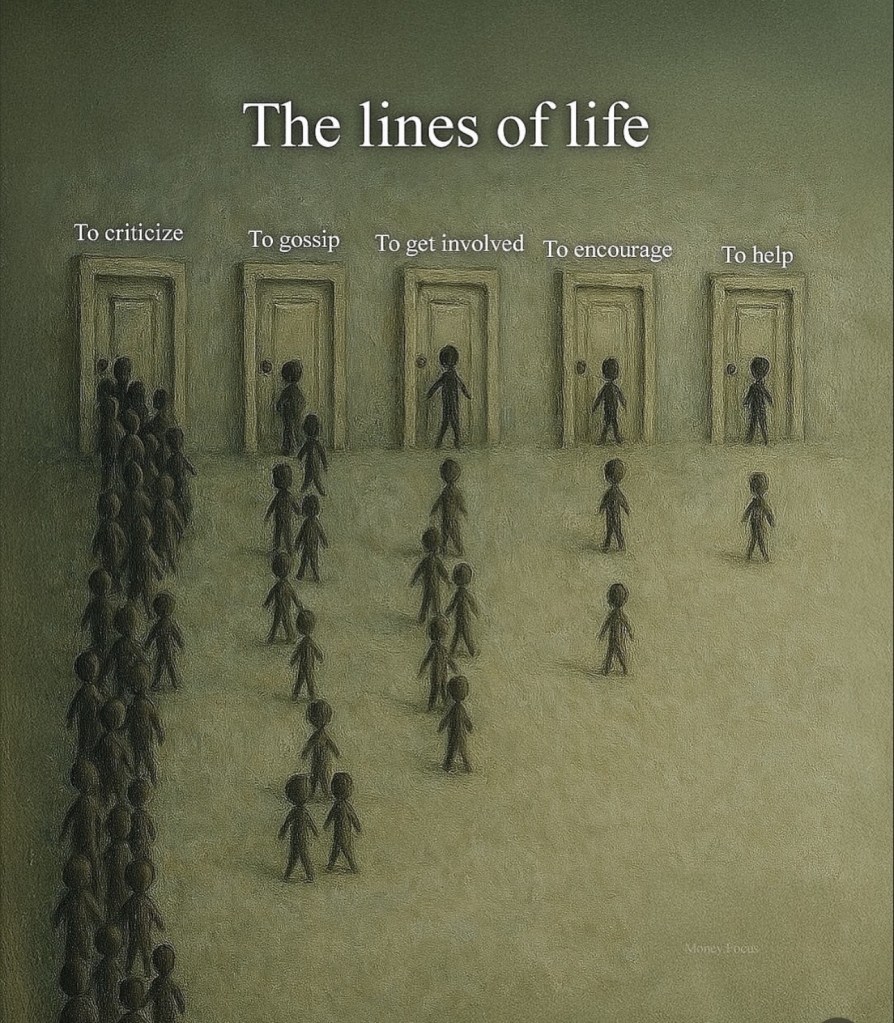
The Lines We Stand In
Human beings like to believe we are endlessly diverse, infinitely complicated, too unique to be placed into boxes or categories. Yet, whenever life presents a situation that requires action—real, inconvenient, possibly uncomfortable action—we tend to sort ourselves with remarkable predictability. It’s as if the world draws invisible lines on the ground, and without even realizing it, most of us walk to the same familiar places: the observers, the critics, the gossipers, the avoiders… and finally, the very small line of people who actually step forward to help.
When something happens—a crisis, an injustice, a person simply struggling—there are always more people willing to talk about it than to do something for it. Gossip is safe; helping is not. Commentary costs nothing; compassion demands time, effort, vulnerability. So across history and across cultures, the pattern repeats: the longest line is always the line of those who stand back with folded arms, ready with opinions but not with hands.
Then there’s the middle group—the ones who refuse to engage in gossip or criticism but still don’t step in. They are not harmful, but they are also not helpful. They float in a kind of neutral space, perhaps wishing someone would intervene, but convincing themselves it should be someone “more qualified” or “more involved.” They aren’t villains, just human. They don’t want to make things worse, but they also don’t want to assume responsibility. Their line is quieter, but it’s still far longer than the one that actually makes change.
And then—there’s the smallest line of all.
The helpers. The upstanders. The people who break from the crowd, who are willing to risk being uncomfortable, judged, or inconvenienced. These are the ones who wade into the messy middle, who understand instinctively that the world only changes when somebody chooses to do something rather than merely narrate it. They are rare not because humans lack goodness, but because goodness takes effort, and effort takes courage.
Unfortunately, this is not a modern phenomenon. This is who we’ve been for as long as we’ve been human. Ancient stories, religious texts, historical accounts—they all describe the same dynamic: the many who watch and comment, and the few who step in. We’ve built civilizations, technologies, and systems of staggering complexity, yet our social instincts are still shockingly primitive. When faced with a situation that demands action, we still gravitate toward our ancient roles.
But acknowledging this isn’t hopeless—it’s honest. And honesty is the first step toward change. Because the truth is, every person has the ability to choose a different line. To notice when they’re drifting toward the comfortable majority and instead steer themselves toward the smaller crowd, the harder choice, the place where help is actually needed.
The world has always been this way, yes—but that doesn’t mean it always has to be.
In the end, progress has never been driven by the many who talked; it has always been pushed forward by the few who acted. And perhaps recognizing that is how we encourage more people to cross that invisible divide and stand where they’re needed most.
 Esoteric Meandering Shouting Into the Void