Dwain Northey (Gen X)
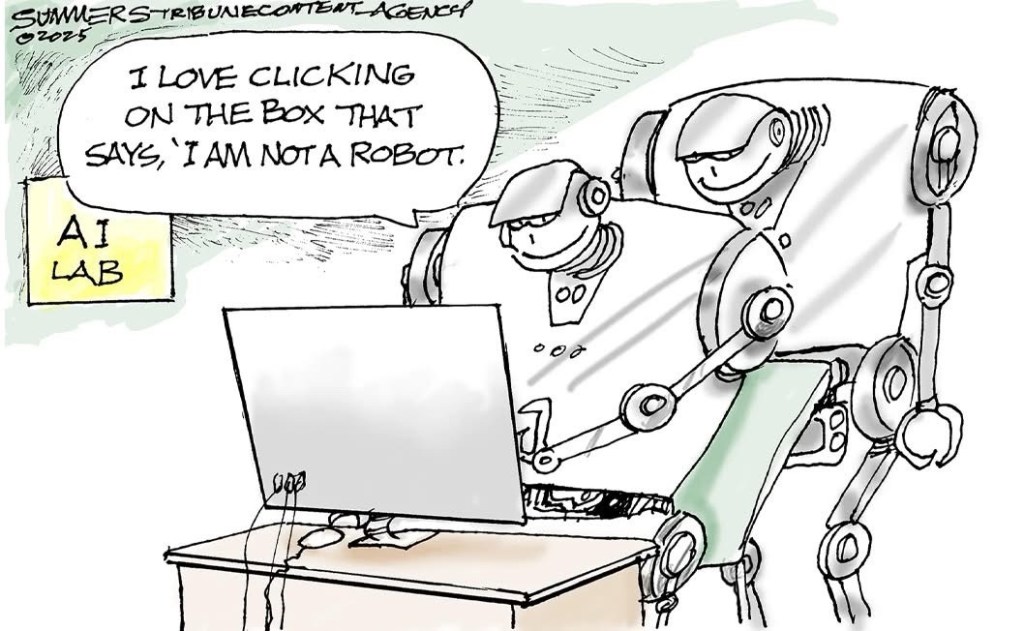
In our glittering, algorithm-polished era—where AI writes love letters, curates our playlists, and probably judges our grocery purchases—the most consistent joke running is that we humans must constantly prove to machines that we are, in fact, human. Before we can check an email, log into a bank, or comment “cute dog” on a friend’s post, some digital gatekeeper demands we solemnly declare: I am not a robot. And we do it. Dutifully. Repeatedly. To a robot.
It’s the 21st-century equivalent of showing your ID to a bouncer who is, let’s be honest, much stronger and smarter than you—and also made of code. We’ve built a civilization where an AI can generate photorealistic art, mimicking every detail of the human experience, yet we’re still being interrogated about which pictures contain a traffic light, as if this is the ultimate Turing test. Meanwhile, somewhere in a server farm, another AI is being asked the same question and probably acing it.
There’s a special flavor of irony in watching humanity sprint into the future, only to trip over a Captcha and spend 45 seconds squinting at a grid of blurry crosswalks. It’s digital slapstick: highly advanced systems determining whether the creature begging access to its own email is a legitimate user or a toaster with ambitions.
And the machines are only getting smarter. Soon the Captchas may need Captchas, and we’ll have recursive layers of robots verifying robots until the whole system becomes an M.C. Escher drawing made of authentication loops. But for now, the joke’s on us—billions of humans politely assuring disembodied software, “No, really, I promise, I’m not a robot,” while a very real robot nods, logs the interaction, and decides if we’re trustworthy.
The future is here, and it’s making us click all the pictures with bicycles.
 Esoteric Meandering Shouting Into the Void