Dwain Northey (Gen X)
Traditions, Part Three: How a Modest Manger Got Run Over by a Sleigh, a Choir, and a Buffet Table
By now in our traditions trilogy, we’ve already watched Christianity quietly inherit—then loudly rebrand—entire libraries of pagan customs while insisting it’s all about one very specific baby in one very specific barn. Which brings us to the final act of this seasonal magic trick: Santa Claus, caroling, and feasting. All of which, it must be said, feel remarkably far afield from the allegedly humble nativity story Christianity claims is the point of the holiday.
Let’s start with the big guy himself.
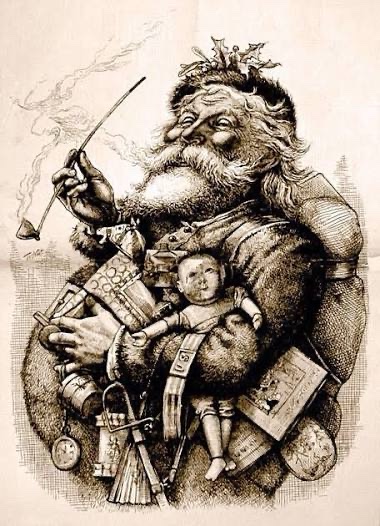
Santa Claus: Bishop, God, or Coca-Cola Mascot?
Santa Claus did not slide down a chimney in Bethlehem. He did not deliver gifts to shepherds. He did not whisper “Ho ho ho” to Mary while Joseph nervously checked census paperwork.
Santa’s roots are a mashup of St. Nicholas, a 4th-century Greek bishop known for secret gift-giving, and far older pagan figures like Odin, the Norse god who rode an eight-legged flying horse through the winter sky during Yule. Odin watched humanity, judged them, and rewarded or punished accordingly—sound familiar? Christianity eventually baptized this mythological surveillance state, slapped a red hat on it, and called it wholesome.
Fast forward a few centuries, add Dutch folklore (Sinterklaas), Victorian sentimentality, American consumerism, and corporate advertising, and voilà: an immortal elf-employing demigod who judges children year-round and rewards obedience with plastic. If this is about Jesus, then Jesus has outsourced the entire operation to a magical capitalist with a logistics network Amazon can only dream of.
Nothing says “humble birth of a Middle Eastern peasant child” like a supernatural being who owns real estate at the North Pole.
Caroling: Pagan Chanting with Better PR
Caroling, too, did not begin as reverent hymns sung quietly in awe of the Christ child. It evolved from wassailing, a pre-Christian tradition involving loud group singing, drinking, and occasionally demanding food or alcohol from neighbors in exchange for good luck. This was less “Silent Night” and more “Nice house you’ve got here—be a shame if your harvest failed.”
These songs were meant to drive away evil spirits, celebrate the return of the sun, and reinforce communal bonds during the bleakest part of winter. Christianity eventually replaced the lyrics with Jesus-centric messaging, but kept the structure: roaming groups, loud voices, seasonal pressure to participate.
The irony is delicious. The nativity story emphasizes quiet wonder, animals breathing softly, a baby laid in straw. Caroling, by contrast, is people ringing your doorbell at night to announce—at full volume—that joy has arrived whether you ordered it or not.
Feasting: Because Nothing Says “Stable” Like a Six-Hour Meal
Then there’s the feasting. Massive meals. Roasts, desserts, alcohol, excess. Tables groaning under the weight of abundance.
Nowhere in the nativity does anyone sit down to a lavish banquet. There is no Christmas ham in the manger. No pie cooling on a windowsill in first-century Judea. Mary and Joseph were poor. Jesus was born in borrowed space. Shepherds brought what they had, not a charcuterie board.
The feasting tradition comes straight from winter solstice festivals, where communities ate heavily because food was scarce, days were short, and survival demanded calories and celebration. You feast because the sun is coming back. You feast because you might not make it through winter otherwise.
Christianity absorbed this instinct and reframed it: we feast for Jesus. Which is curious, since Jesus famously promoted modesty, warned against excess, and flipped tables when religious celebrations turned into marketplaces. Yet somehow his birthday is now marked by overindulgence so intense it requires New Year’s resolutions and elastic waistbands.
The Disconnect No One Talks About
When you strip it down, the contrast is impossible to ignore.
The nativity story is about:
poverty displacement political oppression a quiet, vulnerable birth
Modern Christmas traditions are about:
abundance noise spectacle consumption judgment (naughty or nice, anyone?)
If Jesus were to return during December, there’s a decent chance he’d be turned away from the mall for loitering while Santa took photos inside.
Christianity insists this holiday is about Christ, but nearly every beloved tradition attached to it predates Christianity, contradicts its core message, or actively undermines it. What remains is a theological fig leaf draped over ancient solstice rituals and modern consumer culture, all while insisting that questioning this narrative somehow “misses the point.”
The truth is simpler—and more honest. Christmas isn’t about the nativity story. It never really was. It’s about surviving winter, celebrating light, reinforcing community, and—eventually—selling things. Christianity didn’t invent the holiday; it annexed it.
And somewhere, in a quiet stable long forgotten, the original story is still waiting for its turn—soft-spoken, modest, and utterly drowned out by sleigh bells, choirs, and the sound of another plate being filled.
 Esoteric Meandering Shouting Into the Void