Dwain Northey (Gen X)
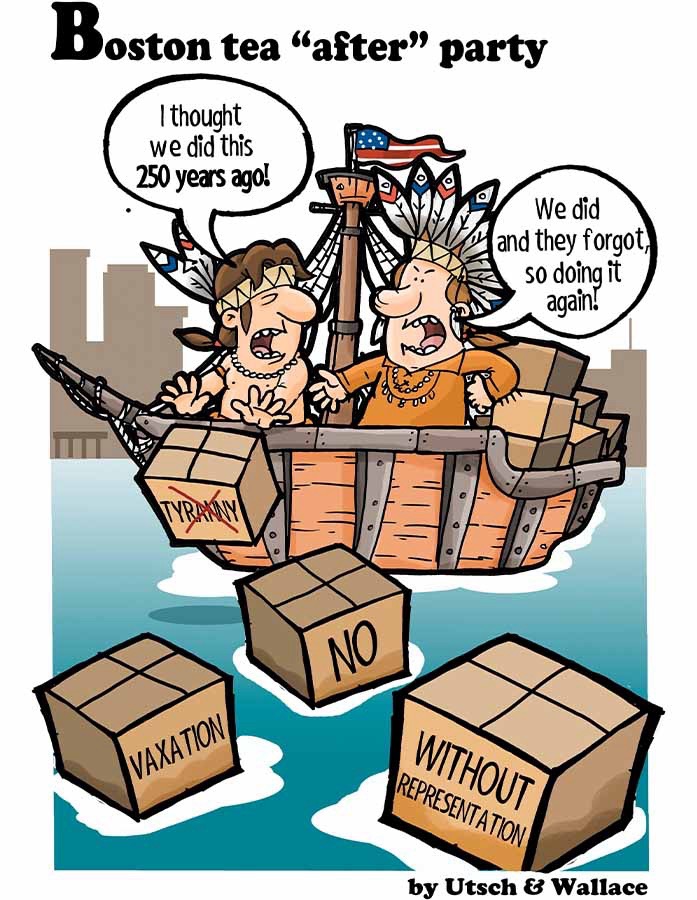
Red Coats, Red Hats, and the Long Walk from Tea to Irony
Yesterday—December 16—marked the anniversary of the Boston Tea Party of 1773, that famously soggy protest in which a group of colonists, disguised as Mohawk Indians, hurled British tea into the harbor to make a point about taxation without representation. It was theatrical, illegal, symbolic, and rooted in a fairly radical idea for its time: that a distant authority extracting money without consent was illegitimate.
Fast-forward 235 years to 2008, when a new “Tea Party” emerged, waving Gadsden flags, wearing tricorn hats made of polyester, and insisting it was the true heir to the spirit of 1773. And now fast-forward again to the current MAGA iteration, which has somehow managed to turn a protest against concentrated power into a movement that worships it, so long as it wears the right color tie.
History, it turns out, has a sense of humor.
The original Boston Tea Party was not a tantrum against taxes per se; it was a protest against who was doing the taxing and why. The Tea Act of 1773 actually made tea cheaper—but it reinforced the East India Company’s monopoly and Parliament’s authority over the colonies. The issue wasn’t cost. It was control. The colonists objected to being governed by people an ocean away who neither knew them nor represented them.
Which makes the irony of the modern Tea Party almost elegant in its absurdity. The 2008 version railed against government overreach—except when that government enforced social hierarchies they liked. The MAGA version goes further, embracing tariffs (literally taxes), cheering massive executive power, shrugging at ballooning deficits, and applauding when political opponents are threatened with state force. Representation? Optional. Consent? Situational.
If the Sons of Liberty were alive today, they’d be less likely to be invited to a MAGA rally than arrested at one.
And then there’s the color problem. The British soldiers enforcing imperial rule in 1773 were known as redcoats. The party that now wraps itself in revolutionary cosplay is—coincidentally, hilariously—also red. Red hats. Red flags. Red states. One might say the aesthetic alignment is… historically consistent. The irony that today’s self-proclaimed rebels look more like the enforcers of empire than its saboteurs has not escaped some of us, even if it seems to have missed the dress code committee.
The original Tea Party destroyed corporate property to protest a government-corporate alliance that rigged markets and undermined democracy. The modern Tea Party defends corporations as people, treats regulation as tyranny, and insists that billionaires are the real oppressed class. Somewhere in Boston Harbor, the ghost of Samuel Adams is asking for a drink—preferably something stronger than tea.
Most striking of all is the debt. The revolutionary generation feared standing armies, executive excess, and debt as tools of domination. Today’s MAGA Tea Party runs trillion-dollar deficits, demands a strongman executive, and waves it all away with the confidence of people certain the bill will never come due—or will be paid by someone else.
So yes, December 16 deserves remembrance. But not just as a nostalgic reenactment opportunity. It’s a reminder that rebellion is not about vibes, costumes, or merch. It’s about resisting concentrated power, not cheering it when it flatters you. The original Tea Party didn’t pledge loyalty to a king in exchange for cultural comfort. They dumped the tea anyway.
History is patient. Irony is ruthless. And somewhere between the redcoats of 1773 and the red hats of today, the meaning of “liberty” got lost in the harbor—again.
 Esoteric Meandering Shouting Into the Void