Dwain Northey (Gen X)
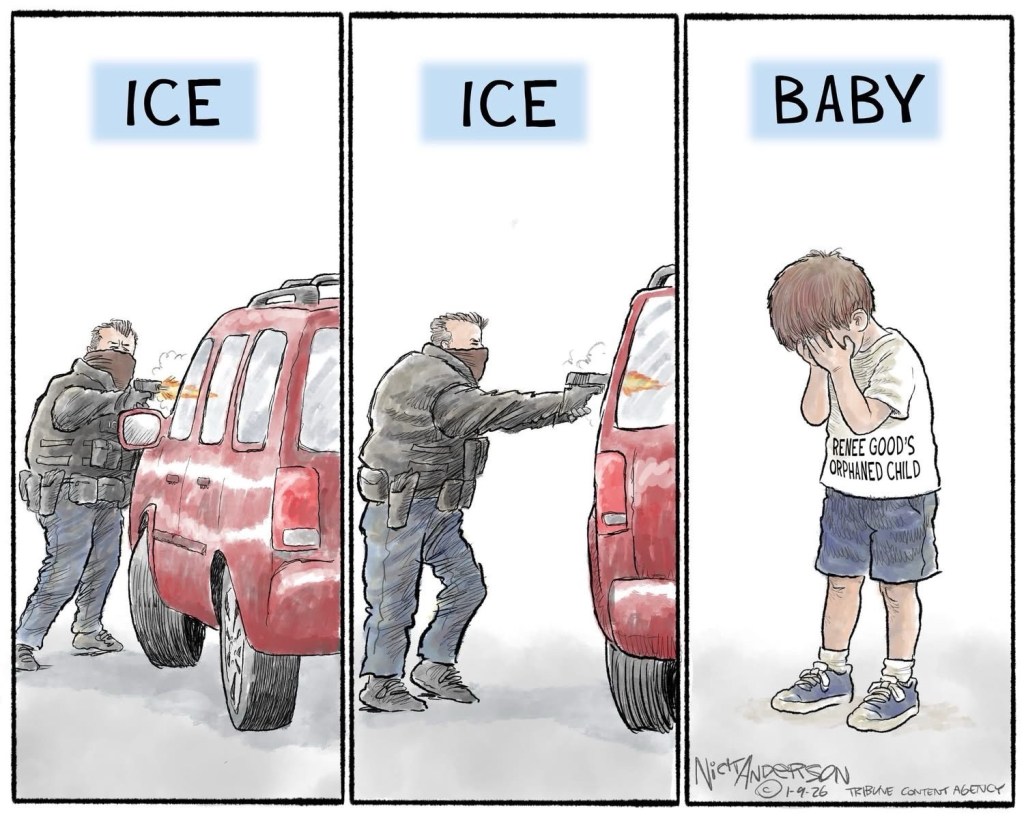
Here we go again. I hate that I even have to write this. I hate that it feels like I’m “harping,” as if repeatedly objecting to someone being shot to death is some tedious personality quirk, like always bringing up the check too early at dinner. But yes—let’s harp. Because Renée Nicole Good was shot in basically cold blood, and the reaction from the right has been a master class in moral gymnastics so advanced it deserves its own Olympic event.
Miss Good was a 37-year-old mother of three. Past tense. Three kids who will now grow up with an empty chair at birthdays, graduations, and holidays. That should be the beginning, middle, and end of the story. Full stop. Except somehow—somehow—it isn’t.
Because when the victim doesn’t fit the approved ideological mold, the script flips instantly.
When anyone so much as quoted Charlie Kirk’s own words back to him—Charlie Kirk, a noted professional agitator whose entire brand is poking bears with a microphone—people were immediately told to calm down. “Watch your tone.” “Don’t inflame tensions.” “Violence is never okay.” Suddenly everyone was a monk of nonviolence, clutching pearls so hard you’d think they were being paid by the rosary.
But now?
Now a woman is dead, and the same crowd has decided we’re no longer talking about a human being. We’re talking about a label. An “agitator.” A troublemaker. A person who, by some deeply warped logic, apparently opted into being shot the moment she failed the ideological purity test.
Funny how that works.
She is no longer Renée. No longer a mother. No longer a daughter, a friend, a coworker, a person who woke up that morning not planning to die. No, now she’s a convenient noun—agitator—which, in this moral universe, functions like a magic spell. Say it out loud and suddenly bullets become understandable. Regrettable, maybe, but understandable. Almost… inevitable. Tragic, sure—but in the same way a house fire is tragic when someone forgot to blow out a candle.
And let’s be very clear about what’s happening here:
This is retroactive justification of violence.
It’s the quiet, cowardly kind. The kind that doesn’t pull the trigger but shows up afterward with a thesaurus and a shrug. The kind that says, “Well, you know how things are these days,” as if “these days” naturally include people being executed for being on the wrong side of a political mood swing.
We are told, yet again, not to be emotional. Not to politicize it. Not to “rush to judgment.” But judgment seems to come awfully fast when the deceased isn’t useful as a martyr. Then suddenly everyone’s an armchair prosecutor, eager to explain why empathy should be withheld this one time.
And no—this is not about agreeing with everything Renée Nicole Good ever said, did, or believed. That’s the laziest dodge of all. Basic human worth is not a subscription service you cancel when someone annoys you.
A woman is dead.
Three children lost their mother.
And the response from a certain corner of the political universe is to argue—out loud—that she essentially earned a bullet.
If that doesn’t horrify you, then spare me the lectures about civility, law and order, or the sanctity of life. You don’t get to cosplay as defenders of morality while tripping over yourselves to explain why someone’s death is acceptable.
So yes, I’ll keep harping on it.
Because the moment we stop harping is the moment this kind of thinking becomes normal.
And once that happens, the question isn’t who deserved it.
It’s who’s next.
 Esoteric Meandering Shouting Into the Void