Dwain Northey (Gen X)
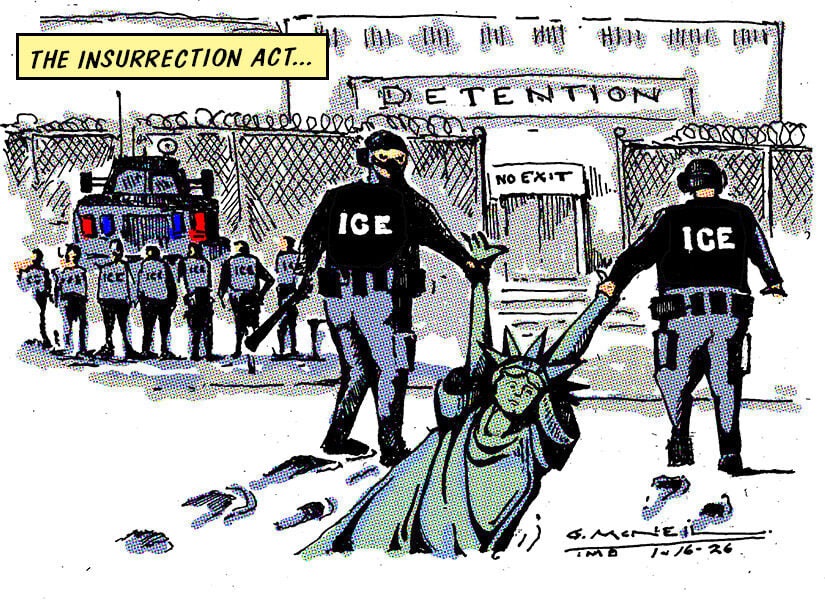
Once upon a time—specifically April 1861—state troops fired on federal troops at Fort Sumter, and America discovered that the phrase “It can’t happen here” has always been more of a vibe than a plan. Cannons boomed, flags were lowered, and what followed was a civil war so catastrophic that we still can’t agree on how to teach it without starting arguments at Thanksgiving.
Fast-forward a century and a half, and we are told—again—to relax. This time, it’s not state troops firing on federal troops. No, no. That would be dramatic. Instead, it’s federal forces bearing down on civilians, wrapped in acronyms and tactical gear, assured by very serious men on cable news that this is all perfectly normal and definitely not something future textbooks will describe with phrases like “foreboding” or “grim turning point.”
After all, these aren’t soldiers, we’re told. They’re “enforcement.” They’re “homeland” something. And if the word homeland rings a bell, well, that’s probably just your imagination being historically literate again.
So what’s the endgame?
Because history teaches us that governments do not accidentally point guns inward. That is not a whoopsie. That is a choice. And when a government starts treating civilians like enemy combatants, the question is no longer if something breaks, but what breaks first: the law, the states, or the illusion that this is still a republic operating in good faith.
One can’t help but wonder—purely hypothetically, of course—whether the desired outcome is escalation. Wouldn’t it be convenient if state authorities finally snapped, if a governor said “enough,” if state forces confronted federal ones? Wouldn’t that create just the sort of “emergency” that ambitious men adore?
Enter the Insurrection Act, that dusty old lever in the glass case labeled Break Democracy In Case of Power Lust. Suspend elections. Declare order. Centralize authority. Explain, patiently and repeatedly, that freedom must be postponed for its own safety. Kings have always loved that line. It saves time.
And Donald—our would-be strongman with a persecution complex and a monarch’s appetite—surely knows his history well enough to recognize the pattern. Chaos justifies control. Conflict justifies crowns. And nothing says “temporary emergency powers” like powers that never quite go away.
The truly depressing part is that this isn’t even original. Every aspiring autocrat reaches for the same playbook, dog-eared and blood-stained, muttering that this time it’s different because this time they’re the hero.
But here’s the catch history keeps screaming at us from the margins: escalation only works if people take the bait.
The Civil War began when restraint failed—when rhetoric became cannon fire. Today, the danger is not just in the uniforms or the weapons, but in the invitation to overreact, to meet provocation with exactly the kind of chaos that authoritarians require to finish the job.
So no, we should not fall for it. We should recognize the pattern, name it, and refuse to audition for a tragedy we already know the ending to. America has already paid once to learn how this story goes.
It would be nice—just once—if we didn’t need a war to remember it.
 Esoteric Meandering Shouting Into the Void