Dwain Northey (Gen X)
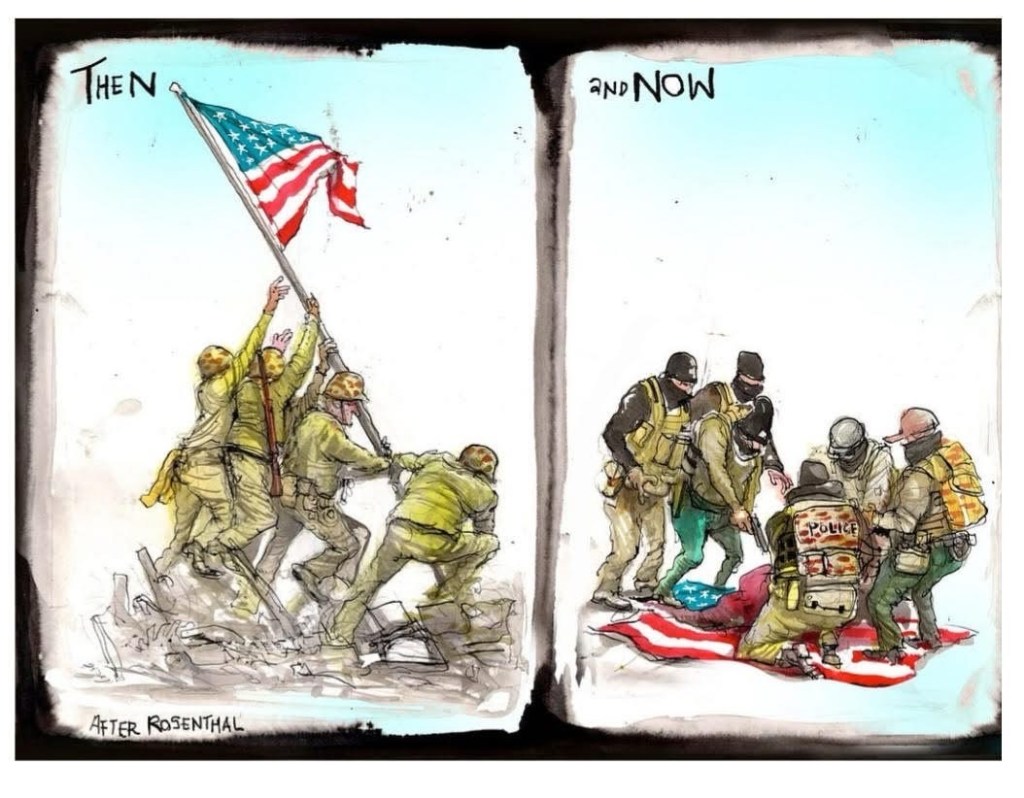
They keep insisting—very earnestly, with straight faces and carefully folded flags behind them—that they are absolutely not at war with America’s cities. Not at war at all. No, no. This is just a light domestic situation. A mild disagreement. A friendly disagreement that, for reasons no one can quite explain, requires “personnel in theater,” “operational zones,” and a “drawdown timetable.”
You know. Normal neighborhood stuff.
Apparently, when you’re not at war with your own country, the first thing you do is stop calling cities “cities” and start calling them “theater.” Chicago isn’t a place where people live, work, and pay taxes—it’s a “theater of operations.” Portland isn’t a city council problem—it’s an “active zone.” New York isn’t a municipality—it’s a “complex environment.” Funny how language works. Once you rename something, you can pretend it’s not what it obviously is.
And they are very clear about one thing: this is not an occupation. Occupations are bad. This is just a “temporary presence.” A presence with armored vehicles, federal forces, chain-of-command briefings, and press releases that sound like they were written in the Pentagon during the early stages of a foreign intervention. But relax—this isn’t war. War has uniforms everyone recognizes. War has enemies that don’t vote. War happens somewhere else.
This is different. This is just “maintaining stability.”
Of course, the cities receiving all this stability tend to share one suspicious characteristic: they’re blue. Very blue. Deep, terrifying shades of democratic blue. Somehow the red cities manage to survive without troops “embedded on the ground,” but the moment a city elects leadership the administration doesn’t like, suddenly it becomes a “hotspot” requiring “force posture adjustments.” Coincidence, surely. Pure coincidence, like rain always falling exactly where the roof is missing.
Listen carefully to the briefings and it’s impossible not to notice how much they sound like updates from an overseas conflict. “We have assets deployed.” “We’re evaluating threat levels.” “We’re drawing down operations once objectives are met.” Objectives like what, exactly? Civic harmony? Better vibes? Or maybe just reminding everyone who has the bigger toys?
And now, as if to really complete the foreign-war aesthetic, they’ve moved on to arresting journalists—for journalism. Not espionage. Not sabotage. Not incitement. Journalism. Standing there with a camera. Asking questions. Documenting what’s happening in these so-called “theaters.” Apparently, once an American city becomes a combat zone in the imagination of the administration, the First Amendment becomes optional—something to be “temporarily suspended for operational reasons.”
Because in a real war, journalists are inconvenient. They show the footage you’re not supposed to see. They record the names, the faces, the badges. They provide evidence. So naturally, the solution isn’t to stop behaving like an occupying force—it’s to treat reporters like enemy assets. Detain them. Handcuff them. Intimidate them. Then insist, with a perfectly calm tone, that the press is still free. Extremely free. Just not free to document this.
And, of course, we’re told not to worry. This isn’t oppression. It’s “crowd control.” It’s “scene security.” It’s “officer safety.” Funny how the language keeps doing the same job: sanding down reality until it fits into a press briefing. Arresting journalists sounds bad. “Neutralizing interference” sounds professional.
The strangest part isn’t even the militarized language—it’s the insistence that we’re imagining it. That we should ignore the jargon, ignore the posture, ignore the tactics, ignore the zip ties on reporters, and trust that this is all perfectly normal democratic governance. Because nothing says “healthy republic” like treating your own cities the way previous administrations treated Fallujah—and treating your own journalists like hostile embeds.
So no, they aren’t at war with America’s cities. They just talk like it. Act like it. Deploy like it. And silence the people documenting it.
But don’t worry. Once the “drawdown” is complete, I’m sure the cities will go back to being cities again—right after they’re done being theaters.
 Esoteric Meandering Shouting Into the Void