Dwain Northey (Gen X)
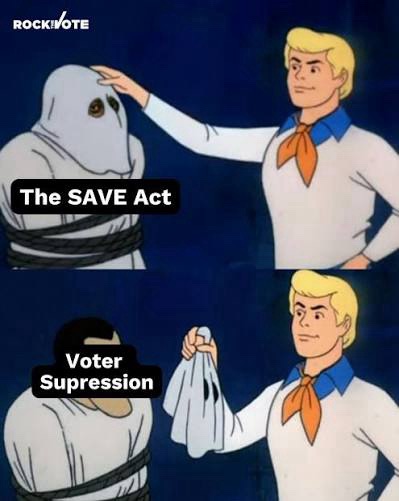
There is a proud and time-honored tradition in American politics of naming things the exact opposite of what they are. It’s a bit like calling a root canal a “smile enhancement procedure” or referring to a traffic jam as an “unexpected opportunity for reflection.” But no one has quite mastered this linguistic yoga like modern Republicans, who have elevated the oxymoron to a governing philosophy.
Take, for instance, the newest entry in the Hall of Patriotic Wordplay: a bill advertised as saving voting by making voting harder. Because nothing says “defending democracy” quite like additional paperwork, fewer polling places, stricter deadlines, and the subtle thrill of wondering whether your perfectly reasonable ID is, in fact, spiritually insufficient.
The branding, of course, is flawless. It’s always flawless. These are the same people who gave us the “PATRIOT Act,” which taught us that the most patriotic thing you can do is let the government read your emails, and “Right to Work,” which generously grants workers the right to… have fewer protections at work. One almost has to admire the efficiency. Why debate policy when you can simply win the Scrabble match?
This latest voting measure follows the same elegant formula:
Identify something broadly popular. In this case: voting, democracy, freedom, apple pie, etc. Name your bill after that thing. Preferably with words like “Freedom,” “Integrity,” or “Safeguard,” which sound reassuring and vaguely constitutional. Quietly do the opposite. Not loudly—never loudly. Just enough procedural tightening to ensure that participating in democracy feels like applying for a mortgage while standing in line at the DMV during a printer shortage.
Supporters will insist this is all about “confidence in elections,” which is a fascinating concept. Because apparently the best way to increase confidence in voting is to make fewer people able to do it. By that logic, we could dramatically increase confidence in air travel by canceling most flights.
There’s also the recurring implication that voting should be difficult to be meaningful—like a spiritual pilgrimage, but with more forms in triplicate. Perhaps next we’ll require voters to solve a riddle from a bridge troll. Only those pure of heart and fluent in bureaucratic dialect may proceed to the ballot box.
Meanwhile, the messaging remains serenely inverted. Restrictions become protections. Limitations become freedoms. Obstacles become safeguards. If this continues, we can expect future legislation such as:
The Transparency Through Secrecy Act The Small Government Expansion Initiative The Permanent Temporary Emergency Powers Resolution
All perfectly sensible, provided you don’t read them.
Of course, political wordplay isn’t exclusive to one party. Washington as a whole treats plain language the way vampires treat sunlight. But Republicans have shown a particular flair for naming legislation like a late-night infomercial—bold promises, soothing music, and important details delivered very quickly in fine print.
So here we are again, watching democracy be lovingly protected into mild inconvenience. Perhaps the ultimate goal is philosophical: if voting becomes difficult enough, the only people left doing it will be those who truly, deeply care—or at least those with flexible work schedules and a strong relationship with office supply stores.
And in the end, maybe that’s the real genius of the naming strategy. Because if you call something the “Save Voting Act,” then anyone who questions it must, by definition, be against saving voting. It’s less a policy debate and more a linguistic trapdoor.
Which is fitting, really. In an era of political theater, why stop at governing when you can also rewrite the dictionary?
 Esoteric Meandering Shouting Into the Void