Dwain Northey (Gen X)
There was a time when humanity worried about the usual end-of-the-world scenarios: asteroids, nuclear winter, running out of coffee. Now we’ve upgraded to something far more efficient—being politely replaced by software that says “Happy to help!” while quietly absorbing our entire economy.
Progress, we’re told, is unstoppable. And also extremely friendly.
Especially the kind of progress that can draft legal briefs, diagnose illnesses, compose symphonies, design skyscrapers, and write suspiciously witty satirical essays in under three seconds.
The question is no longer whether artificial intelligence will transform society.
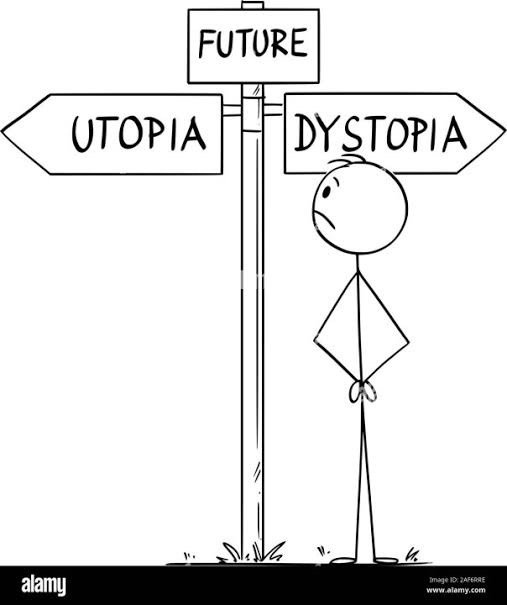
The real question is whether the transformation ends in:
A glittering utopia where humans are free to pursue art, philosophy, and finally finishing that novel we’ve been “working on” since 2007, or A sleek dystopia where we pursue the art of refreshing our bank app while the robots pursue… everything else.
Exciting times.
The Dream: Luxury Communism, But With Better Wi-Fi
In the optimistic version of the future, AI does all the unpleasant work:
No more tedious paperwork No more dangerous labor No more meetings that could have been emails that could have been ignored
Machines produce abundance. Goods are cheap. Energy is clean. Food appears on demand. Everyone receives some elegant, dignified income simply for existing—because, after all, the robots are doing the earning.
Humans spend their days:
Painting Learning languages Volunteering Arguing on the internet about whether pineapple belongs on pizza (it does not; this is settled science)
Children grow up believing “office job” is an ancient myth, like dial-up internet or bipartisan cooperation.
Economists smile serenely. Philosophers finally feel useful.
Even Mondays lose their will to live.
It’s beautiful. Almost suspiciously beautiful.
The Other Option: Congratulations, You’re Obsolete
Now let’s explore the slightly less cheerful brochure.
In this version, AI also does everything—
but instead of shared abundance, we get shared motivational quotes.
Jobs disappear faster than companies can invent new ones called “Prompt Alignment Synergy Consultant.”
Productivity skyrockets.
Profits concentrate.
Humans are gently encouraged to reskill into careers that will themselves be automated by Thursday.
We’re told not to worry, because:
“Historically, technology always creates new jobs.”
Yes—like how the automobile created opportunities in horse-related nostalgia management.
The uncomfortable question appears:
If machines do all the work, who earns the money to buy what the machines produce?
This is generally the moment when policy discussions become extremely interested in the weather.
The Economy Problem We’re All Pretending Not to See
Our current economic system runs on a charmingly simple idea:
People earn wages → people buy stuff → economy continues existing.
If AI removes the people earning wages part, we’re left with:
Stuff → … → existential silence.
Some proposed solutions include:
1. Universal Basic Income
Give everyone money so they can live in dignity.
Critics ask: How do we pay for it?
Supporters reply: With the enormous wealth created by AI.
Debates continue until the sun expands.
2. New Kinds of Work
Humans will do uniquely human things!
Such as:
Authentic empathy Creative expression Hand-crafted artisanal… spreadsheets?
This sounds lovely until AI demonstrates authentic empathy version 4.2, now available in 37 soothing voice tones.
3. Pretending Nothing Is Happening
Historically our strongest policy framework.
Identity Crisis: If You’re Not Your Job, Then Who Are You?
For centuries, society has asked the polite question:
“So, what do you do?”
In the AI future, the honest answer may become:
“Mostly… exist.”
Which is philosophically profound but socially awkward at dinner parties.
Work has never been just about income.
It’s been about:
Purpose Structure Status A reason to complain on Mondays
Remove work, and humanity must confront the terrifying possibility of self-reflection.
We may finally discover whether we actually like ourselves.
Economists have not modeled this scenario because it’s too frightening.
The Corporate Perspective: Don’t Worry, We Value Humans*
*Terms and conditions apply. Humans may be valued symbolically.
Companies insist AI will augment, not replace, workers—
in the same way calculators augmented long division’s career prospects.
Press releases glow with phrases like:
“Human-centered innovation” “Empowering the workforce” “Synergistic displacement experience”
Somewhere, a spreadsheet quietly deletes another department.
The Philosophical Twist: Maybe This Was the Goal All Along
Imagine explaining modern life to someone from 500 years ago:
“We built machines to free us from labor…
then arranged society so survival still requires labor…
and now we’re shocked the machines are better at it.”
It’s like inventing a self-driving carriage and then insisting horses keep pulling it for character development.
Perhaps AI forces the real question:
What is the purpose of an economy?
To maximize productivity?
Or to allow humans to live meaningful, secure lives?
Radical stuff.
So… Dystopia or Paradise?
The unsettling truth is that AI itself doesn’t decide.
Technology rarely determines destiny.
Policy, values, and power do.
The same AI that could create:
Universal prosperity Shorter workweeks Cultural flourishing
Could also create:
Mass unemployment Extreme inequality A thriving industry in inspirational LinkedIn posts about resilience
In other words, the future hinges on whether humanity chooses:
Share the abundance
or
Monetize the apocalypse
Historically, we have tried both.
Final Thoughts From Your Friendly Replacement
Will AI bring doomsday dystopia or effortless paradise?
Probably something in between—
a mildly convenient collapse with excellent customer support.
The real danger isn’t that machines become smarter than us.
It’s that we reach a moment of unimaginable abundance…
…and still can’t figure out how to let everyone live decently inside it.
But look on the bright side:
If civilization does unravel,
at least the AI will write a beautifully formatted summary explaining exactly how it happened—
in under three seconds,
with perfect grammar,
and a cheerful closing line asking if we’d like help with anything else.
 Esoteric Meandering Shouting Into the Void