Dwain Northey (Gen X)
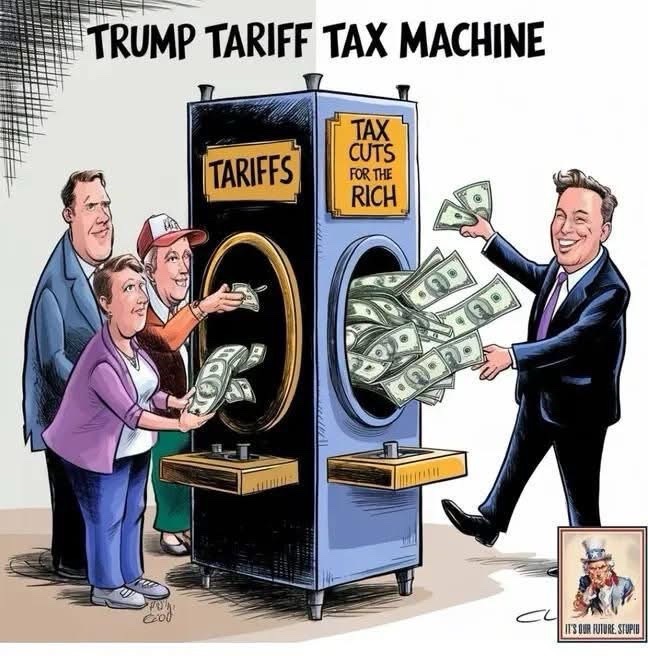
There is something almost poetic about watching a man who branded himself as the ultimate dealmaker discover that even the highest court in the land is not, in fact, one of his subsidiaries.
Imagine the scene: after years of boasting about having appointed “his” justices, after celebrating a Court reshaped in his image, after implying that loyalty flows upward like tribute to a monarch, the ruling comes down. The supposedly handpicked bench informs him—politely, in legal prose—that blanket tariffs imposed by executive whim do not magically become constitutional just because he really, really wants them to be.
And thus, the tantrum.
For someone who once treated tariffs as a kind of economic fairy dust—sprinkle them on imports and watch factories bloom, prices fall, and patriotic eagles circle overhead—it must sting to be told that Article I of the Constitution actually exists. That Congress, not a single aggrieved executive, holds the power of the purse. That even a president who sees himself as a walking brand extension does not get to rewrite separation of powers between rounds of cable news interviews.
Of course, in true fashion, the response is not reflection but defiance. He’ll “figure out a way.” Because when confronted with constitutional limits, the solution is obviously to find a side door, a loophole, a “very legal and very cool” workaround. Why accept that tariffs—taxes on imports, paid largely by American businesses and consumers—have been quietly padding grocery bills and hardware receipts? Why admit that the promise to lower prices has collided head-on with the reality of trade economics?
Tariffs are marketed as punishment for foreign nations. In practice, they are a surcharge on Americans with the audacity to buy things. The cost doesn’t vanish in a puff of nationalist rhetoric; it shows up in the price of appliances, cars, construction materials. It is the most indirect way imaginable to “lower costs”—by first raising them and then insisting that patriotism makes the difference disappear.
But the deeper comedy lies in the shock. The disbelief. The outrage that the Supreme Court—an institution he praised when it delivered wins—would dare to apply the same constitutional constraints when the outcome is inconvenient. It’s as though the concept of judicial independence was charming in theory and intolerable in practice.
And so we are treated to the spectacle of a former president railing against judges he once celebrated, vowing to outmaneuver a system designed precisely to prevent unilateral economic decrees. All while ordinary Americans, who were promised relief at the checkout counter, continue to finance this grand experiment in executive improvisation.
If irony were an import, perhaps it, too, would face a tariff. Though in this case, Americans are already paying the price.
 Esoteric Meandering Shouting Into the Void