Dwain Northey (Gen X)
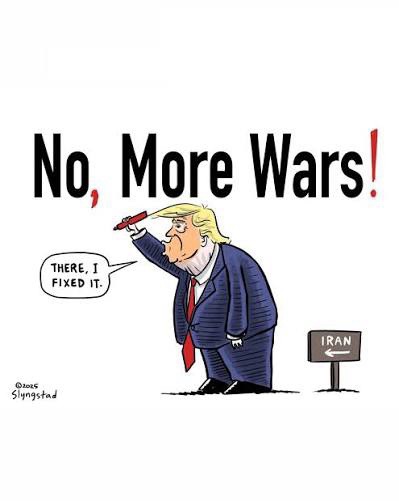
There is perhaps no sweeter sound in modern politics than a man loudly campaigning for a peace prize while rhythmically striking matches behind his back. Enter Donald Trump — or as he brands himself in his own heroic cinematic universe, DJ T: The Peacemaker.
We are told, repeatedly, that he alone can bring peace. Peace through strength. Peace through leverage. Peace through tariffs, threats, troop movements, and the occasional all-caps social media ultimatum. It’s a fascinating redefinition of the word “peace,” one that seems to involve a lot of aircraft carriers and very little actual quiet.
His State of the Union addresses and campaign speeches carry the tone of a man accepting an award he hasn’t yet won. The rhetoric is drenched in self-congratulation: wars ended (definitions flexible), adversaries tamed (results pending), global respect restored (terms and conditions apply). If confidence were diplomacy, we’d be living in a utopia.
And yet, somehow, the language of peace keeps arriving wrapped in the posture of permanent conflict. Every disagreement is a showdown. Every negotiation is a duel at high noon. Every ally must be tested for loyalty, every adversary dared to blink first. The message is less “let’s de-escalate” and more “watch how tough I look while escalating.”
Because strength, in this worldview, is measured not by the absence of war but by the volume of the threat.
It’s a peculiar approach: framing global stability as a reality show elimination round. If peace breaks out quietly and steadily, there are no dramatic photo ops. No triumphant speeches. No slow-motion walk toward the podium while the music swells. But a looming conflict? Now that creates the kind of backdrop against which one can appear decisive, commanding — heroic, even.
The irony, of course, is that history tends to remember peacetime presidents not for how loudly they flexed, but for how calmly they governed. True strength in peace is subtle. It’s patient coalition-building, steady diplomacy, boring competence. It rarely trends. It does not roar.
And so the world watches as the self-proclaimed architect of peace rattles sabers with one hand while polishing a hypothetical medal with the other. The speeches insist he is the strongman the planet has been waiting for. The tone, however, suggests a leader perpetually auditioning for a crisis dramatic enough to prove it.
If peace is the goal, it is curious how often the atmosphere feels combustible.
Perhaps the real warning is this: when a leader speaks of peace as a personal achievement rather than a shared condition, the priority may not be tranquility at all. It may be the optics of dominance. And in the pursuit of looking strong, one can end up revealing something far more fragile.
After all, the strongest peace rarely needs to announce itself.
 Esoteric Meandering Shouting Into the Void