Dwain Northey (Gen X)
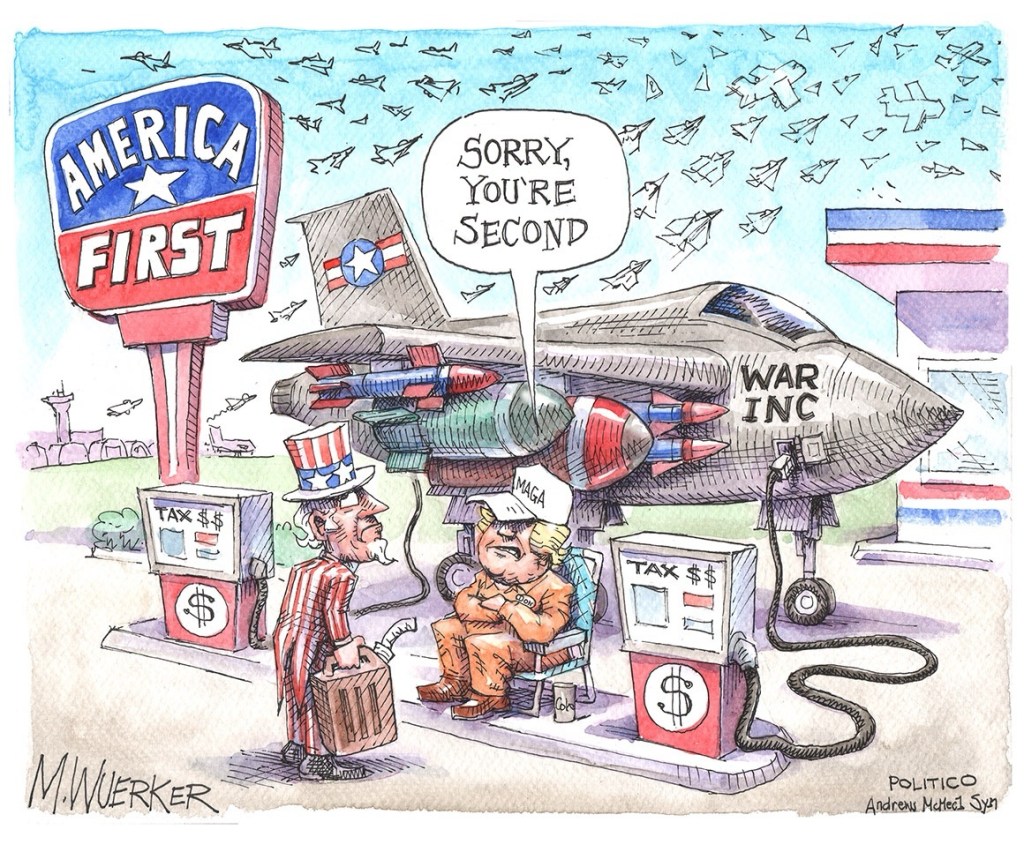
There was a time—gather round, kids—when going to war required something quaint and ceremonial called authorization. You know, that dusty little constitutional speed bump where Congress had to raise its hand and say, “Yes, let’s do this.” We even used to declare wars. The last time we formally did that was during World War II. Since then? Apparently we’ve replaced declarations with vibes and a presidential shrug.
Now we have Donald Trump—self-appointed Commander of Whatever He Feels Like—deciding that we’re at war with Iran because, well, reasons. Strategic reasons. Classified reasons. Very serious reasons. Reasons that absolutely have nothing to do with polling numbers, cable news cycles, or the irresistible urge to look “strong” on social media.
And the truly modern twist? Most Americans aren’t even seeing American lives lost. Not because war has suddenly become humane or restrained—but because it’s been outsourced to drones, algorithms, and “precision strikes.” It’s a war you can scroll past. A war that hums quietly above rooftops in Iraq and Iran. A war conducted by remote control, as if foreign policy is just another video game with upgraded graphics and a muted casualty counter.
We’re told it’s efficient. Clean. Surgical. The future.
Except “the future” apparently includes bombing a school. A school. For “reasons” that will be explained at a later date, pending review, subject to redaction, classified for your safety, trust us. Nothing says moral clarity like a press conference that boils down to: “We had intelligence. No, you can’t see it. Yes, it’s real. Probably.”
When in our history did we decide that the President could just wake up, glance at a map, and think, “You know what would really tie the week together? Some strategic explosions.” The Constitution doesn’t say, “The President may declare war whenever beachfront development opportunities seem promising.” It doesn’t say, “If Congress is annoying, just skip them.” It doesn’t say, “War is fine as long as it’s done with Wi-Fi.”
But here we are.
And somewhere, echoing through history, is the gravelly warning of Dwight D. Eisenhower. In his farewell address, he cautioned the country to beware of the “military-industrial complex.” At the time, it sounded like sober, grandfatherly advice. Now it reads like prophecy.
Because what if this isn’t about security at all? What if it’s about contracts? Defense stocks. Manufacturing quotas. Refill orders for precision-guided morality. Drones don’t build themselves. Missiles don’t restock for free. Every explosion overseas is a line item somewhere, a quarterly earnings bump wrapped in patriotic branding.
Follow the money.
Wars used to require sacrifice visible enough to spark outrage. Now they require Wi-Fi, plausible deniability, and a press secretary with steady hands. The battlefield may be in Iran, but the profits land comfortably at home.
We haven’t declared war since 1942, and yet we’ve mastered the art of permanent conflict. Endless authorizations. Open-ended military actions. “Police actions.” “Kinetic operations.” Anything but the scary W-word. Because declaring war would require debate. Accountability. Ownership.
Now war is just another executive order with better lighting—and a healthy return on investment.
Maybe this is just who we are now: a nation that once agonized over entering World War II and now treats military engagement like a subscription service—auto-renewing, rarely read, impossible to cancel.
Oceanfront property may rise and fall. Approval ratings may wobble. But the drones? They’re always on time.
And the military-industrial complex? It doesn’t need authorization. It just needs a market.
Congress can issue a strongly worded letter after recess. The contractors, however, have already cashed the check.
 Esoteric Meandering Shouting Into the Void