Dwain Northey (Gen X)
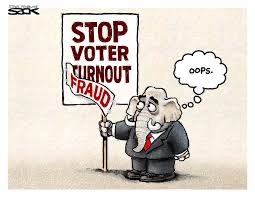
The marketing department in Washington deserves a raise. Not because they’re good at democracy, mind you, but because they’re excellent at naming bills the exact opposite of what they actually do. Which brings us to the charmingly titled Safeguard American Voter Eligibility Act, better known as the SAVE Act.
“Save” is such a warm word. It sounds like rescuing kittens from trees or preserving national parks. In reality, the SAVE Act appears less interested in saving democracy and more interested in carefully trimming the guest list for it.
Because if you read past the title—and lawmakers always hope you won’t—you discover the central idea: make voting harder for a whole bunch of people. Not through dramatic speeches about restricting voting, of course. That would be bad optics. Instead, it’s done through bureaucratic gymnastics like requiring proof of citizenship documents and making sure the name on your voter registration perfectly matches the name on your birth certificate.
Now, on paper that sounds simple enough. But in the real world, millions of Americans—particularly women—change their names when they marry. Suddenly the name on their birth certificate doesn’t match the name on their driver’s license, their voter registration, their bank account, their Costco membership, or the name their dog responds to.
And who, statistically speaking, is more likely to change their name after marriage? Women.
And who, historically speaking, includes a lot of married women who take their husband’s last name? Republican households.
Which means the SAVE Act may turn into the legislative equivalent of stepping on a rake.
This whole strategy actually has a bit of historical precedent. Back in 1980, conservative activist Paul Weyrich, co-founder of the Heritage Foundation, gave a speech that became legendary in political science circles. In it, he explained the electoral strategy with refreshing honesty:
“I don’t want everybody to vote… our leverage in the elections quite candidly goes up as the voting populace goes down.”
There it is. No euphemisms. No marketing. Just the blunt political math.
And that philosophy has hovered around parts of the Republican Party ever since: if expanding the electorate tends to help the Democratic Party, then perhaps the solution is not to attract more voters—but to shrink the pool.
Enter the SAVE Act, stage right, wrapped in a patriotic bow and waving a flag.
Supporters argue it protects elections from non-citizen voting, which sounds terrifying until you remember that documented cases of non-citizens voting are already extremely rare. We’re talking about a problem roughly on the scale of shark attacks in Kansas.
So the solution, naturally, is to create new hurdles for millions of actual citizens.
It’s a fascinating approach to civic participation. Instead of saying, “How do we get more Americans engaged in democracy?” the question becomes, “How do we make the paperwork just annoying enough that some of them give up?”
Because nothing screams confidence in your political ideas quite like hoping fewer people show up.
And yet the most ironic twist may be the name-change requirement. If the bill is applied strictly, a large number of married women—many of them reliable conservative voters—could suddenly discover that their birth certificate says “Susan Johnson,” their driver’s license says “Susan Miller,” and the government says, “Sorry Susan, democracy requires a paperwork scavenger hunt.”
Which means the SAVE Act might accomplish something rare in modern politics: accidentally suppressing the votes of the very coalition it hopes to protect.
In other words, after decades of carefully engineering ways to reduce turnout, someone may have finally designed a system that tells millions of loyal voters:
“Thank you for your support… unfortunately your maiden name is required for entry.”
Democracy saved. Just with fewer participants.
 Esoteric Meandering Shouting Into the Void