Dwain Northey (Gen X)
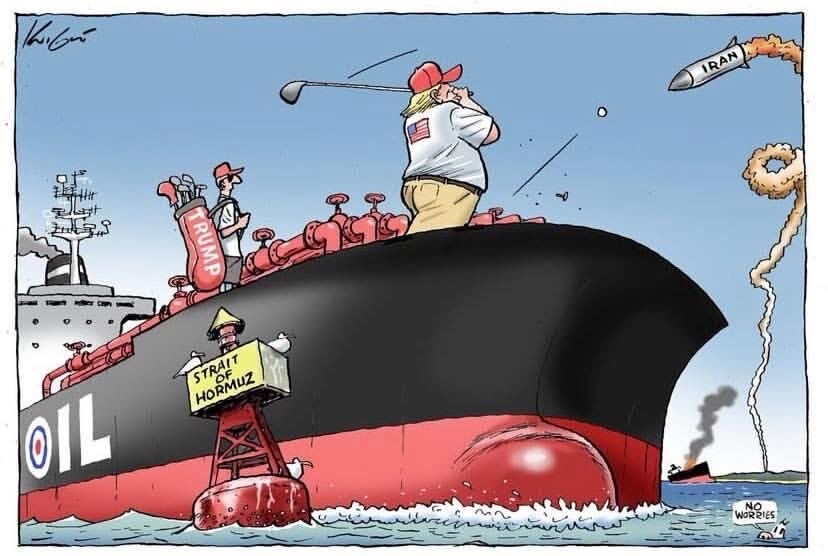
There’s something almost admirable—if you squint hard enough and abandon all attachment to reality—about the sheer confidence it takes to conduct “very productive talks” with a country that insists those talks do not, in fact, exist. It’s a bold diplomatic innovation: negotiations so advanced, so sophisticated, so cutting-edge that they occur entirely within one man’s imagination.
Welcome to the latest chapter in Dear Donald’s ongoing one-man foreign policy LARP, where he alone sits at the table, nodding gravely, shaking hands with invisible counterparts, and emerging to declare victory over conversations no one else attended. Iran, for its part, appears tragically unaware that it has been deeply engaged in these fruitful discussions. One might think that participating in negotiations usually requires… participation, but that’s just outdated, establishment thinking.
And then there’s the small matter of the Strait of Hormuz—or, as it has apparently been rebranded in this alternate universe, the “Straits of Her Mouth,” which sounds less like a critical global النفط chokepoint and more like a rejected title from a low-budget pirate romance novel. But details, details. Geography is merely a suggestion when you’re operating on this level of visionary statecraft.
In this fantasy, control of one of the world’s most strategically vital waterways is just a handshake away—presumably between Dear Donald and whichever ayatollah he mentally appoints to co-manage the operation. It’s a charming arrangement: one part imaginary diplomacy, one part imperial entitlement, and one part late-night cable news hallucination.
Naturally, the plan doesn’t stop at control. Oh no, it gets better. Because why merely oversee global oil traffic when you can also skim a tidy 10% off the top of every shipment? Not for any official purpose, of course—this isn’t about national interest. This is about the kind of entrepreneurial spirit that turns geopolitics into a personal side hustle. Forget tariffs, forget treaties—this is subscription-based hegemony, with proceeds allegedly drifting into some conveniently located overseas account.
And here’s where things get truly impressive: all of this unfolds in broad daylight, with the constitutional guardrails—those quaint little things like the Emoluments Clause—treated less as binding law and more as light reading material, perhaps skimmed once and then confidently ignored. After all, rules are for people who acknowledge reality, and reality is clearly not invited to these negotiations.
The most astonishing part, though, isn’t the imaginary meetings, the freelance control of global shipping lanes, or even the casual monetization of international crises. It’s that this entire performance—this fever-dream version of diplomacy—still manages to resonate with enough people to earn a sequel. Not a reboot. Not a reconsideration. A sequel.
Because why settle for one term grounded loosely in reality when you can have a second one fully committed to the bit?
At this rate, we should probably start checking whether other world leaders are also secretly engaged in telepathic summits. Maybe peace in the Middle East has already been achieved—no one told the Middle East yet, but give it time. The talks are going very well. Just ask him.
 Esoteric Meandering Shouting Into the Void