Dwain Northey (Gen X)
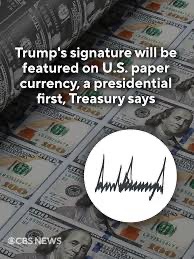
There’s a certain line in democratic governance that most leaders, regardless of ego or ambition, have historically understood not to cross. It’s the line between public service and personal branding—between representing the state and imprinting oneself onto it. And few symbols are more sacred to that distinction than a nation’s currency.
So when the idea emerges that Donald Trump would want his signature placed on U.S. currency, it doesn’t just raise eyebrows—it raises historical comparisons that most modern presidents have gone out of their way to avoid.
American money has never been about the sitting president’s identity. It’s intentionally impersonal, institutional, and slow to change. The faces that appear on bills—Washington, Lincoln, Hamilton—are not there because they demanded it, but because history, over time, placed them there. Even the signatures that do appear belong to the Treasury Secretary and Treasurer, not the president. That’s by design. It reinforces a simple idea: the system matters more than the individual.
And yet here we are, entertaining the notion that a president might want to leave a literal signature on the nation’s currency—as if the office were a brand to be stamped rather than a responsibility to be carried.
Think about the contrast. Barack Obama didn’t demand his autograph on the dollar after navigating a financial crisis. Joe Biden didn’t suggest it during massive economic recovery efforts. Bill Clinton presided over a budget surplus without deciding the dollar needed a personal touch. Even towering historical figures like Franklin D. Roosevelt—who reshaped the federal government during the Great Depression—and John F. Kennedy, with all the cultural weight he carried, never treated U.S. currency as a canvas for self-immortalization.
Why? Because there’s an unspoken understanding in democracies: the symbols of the state are not souvenirs for the leader.
That’s what makes this idea feel less like a policy quirk and more like something pulled from a different governing tradition altogether. In authoritarian systems, leaders routinely place their names, faces, and symbols on everything—currency included—not just as identification, but as reinforcement. It’s a constant, everyday reminder of who’s in charge. Every transaction becomes a subtle act of acknowledgment.
That’s not how the United States has traditionally operated. Here, the durability of institutions is supposed to outlast any one presidency. The dollar in your wallet shouldn’t feel like a campaign token.
And that’s the deeper issue. It’s not about ink on paper—it’s about what that ink represents. A signature on currency suggests ownership, or at least a desire for permanence that bypasses the normal filters of history. It’s the difference between being remembered and insisting on being seen.
In the end, the question isn’t just “how much more authoritarian can you get?” It’s why one would even want to test that boundary in the first place. Because once leaders start treating national symbols as personal billboards, the shift isn’t cosmetic—it’s philosophical.
And philosophy, unlike currency, is much harder to take out of circulation.
 Esoteric Meandering Shouting Into the Void