Dwain Northey
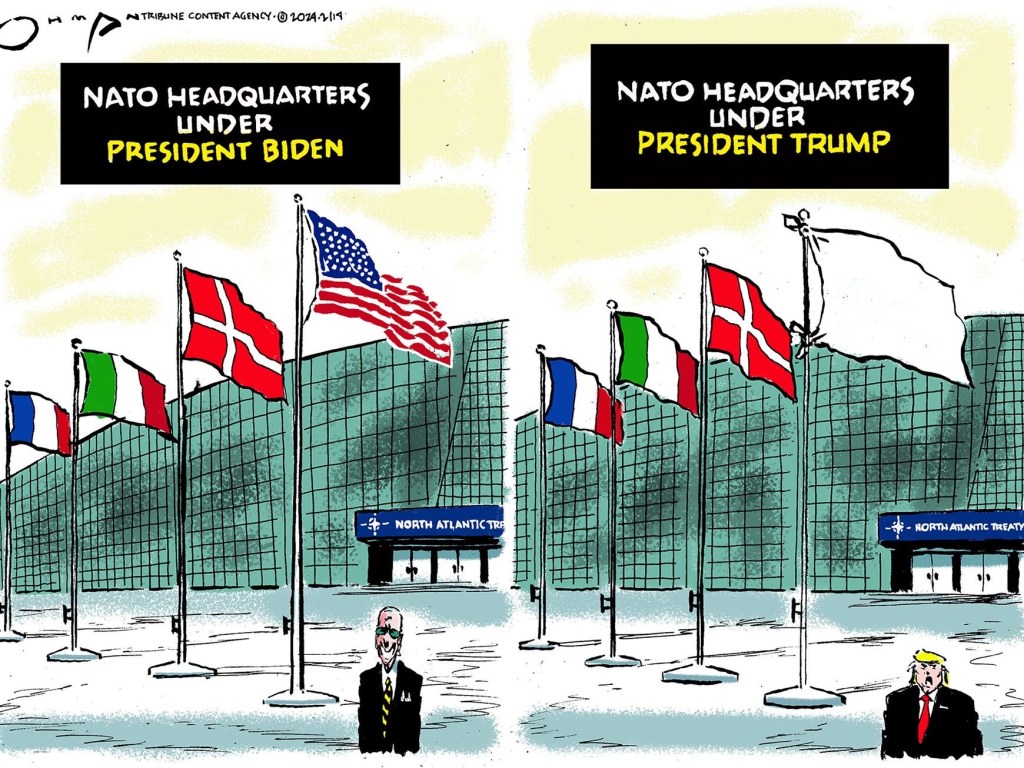
There’s something almost quaint about NATO—a relic of a time when alliances were built not on vibes or vendettas, but on the mildly radical idea that preventing global catastrophe might be worth a standing group chat among nations. Conceived under Harry S. Truman, NATO has spent roughly seventy years doing the unglamorous work of not having World War III. No small feat. You’d think “decades without planetary annihilation” might earn at least a polite nod.
But enter Donald Trump, who appears to view NATO less as a strategic alliance and more as an exclusive country club where some members are apparently late on their dues and therefore should be denied access to… collective security against existential threats. Because nothing says “stable global order” like treating mutual defense treaties the way one treats a gym membership you’re threatening to cancel out of spite.
In this reinterpretation, Article 5—the cornerstone principle that an attack on one is an attack on all—is less a solemn commitment and more a negotiable perk, like valet parking or preferred tee times. Why honor decades of deterrence doctrine when you can instead ask, “But are they paying enough?” as though Russian tanks pause politely at borders to review balance sheets.
And then comes the truly dazzling logic: if one decides to freelance a bit of international conflict—say, hypothetically, launching into a confrontation with Iran—surely the alliance exists to back that play, no questions asked. NATO, in this vision, is less “defensive pact” and more “on-call entourage,” ready to amplify whatever bold improvisation happens to be trending that week. It’s not about collective security anymore; it’s about collective validation.
Of course, when those same allies hesitate—perhaps clinging stubbornly to the original concept of “defense” rather than “impromptu adventure”—the conclusion isn’t that maybe, just maybe, alliances aren’t designed to rubber-stamp unilateral decisions. No, clearly the problem is that NATO itself is defective. After all, if the orchestra won’t follow the conductor off a cliff, what good is the orchestra?
So here we are, watching a seventy-year-old framework that helped stabilize half the planet being recast as dead weight because it refuses to function like a personal loyalty program. It’s an impressive feat: taking one of the most successful alliances in modern history and reducing it to a Yelp review about poor service and insufficient enthusiasm.
But perhaps that’s the new doctrine: peace is overrated, alliances are transactional, and if the world won’t play along, well—there’s always the option of taking your ball and going home, declaring victory on the way out.
 Esoteric Meandering Shouting Into the Void