Dwain Northey (Gen X)
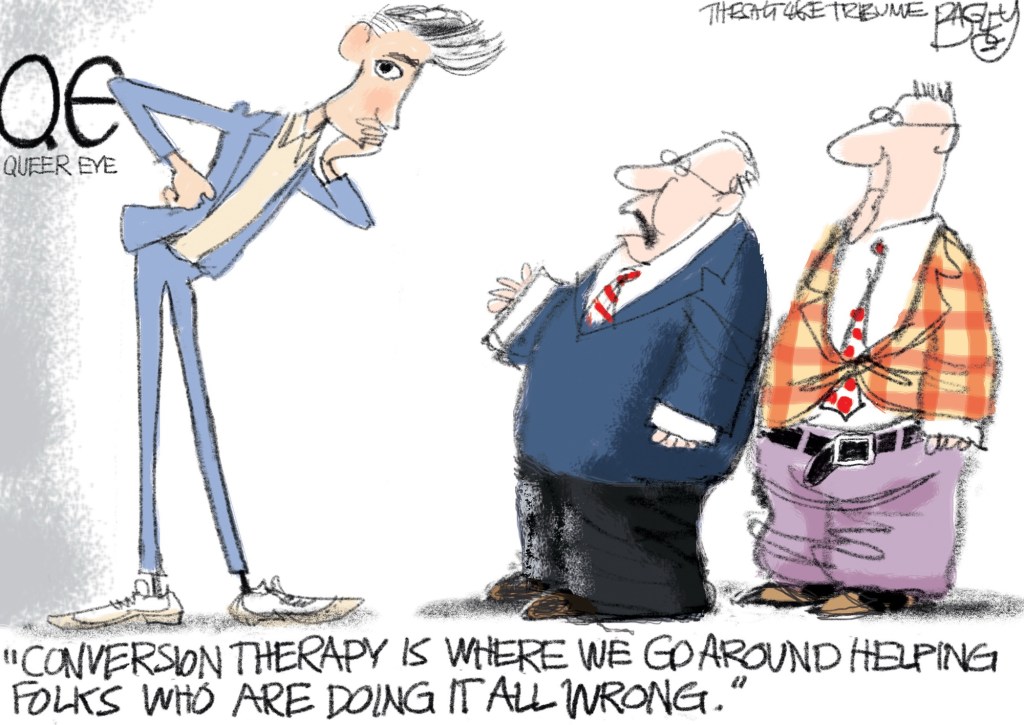
The latest decision by the Supreme Court of the United States has the unmistakable feel of a legal Jenga move—one of those confident little tugs that seems harmless right up until the whole tower starts wobbling in ways nobody wants to be responsible for.
The logic, at least on paper, is elegant: if something is “just talking,” then it falls neatly under the warm, protective umbrella of the First Amendment. No physical coercion, no direct action—just words. And words, as we all learned in civics class, are sacred. End of story. Curtain closed. Everyone go home.
Except… not quite.
Because once you establish that “just talking” is categorically protected—even in contexts where the intent is to fundamentally alter someone’s identity or well-being—you’ve opened a door that doesn’t politely stay in its hinges. It swings. Widely.
Take psychotherapy. The entire field rests on the premise that words are not just harmless little puffs of air but powerful tools that can reshape thoughts, behaviors, and even a person’s sense of self. That’s the whole point. If words are powerful enough to heal, they are—awkwardly enough—powerful enough to harm. But under this new framing, where does that leave accountability? If a therapist’s words push someone toward destructive decisions, is that protected speech or professional malpractice? Apparently, we’re now supposed to believe it’s a philosophical gray area instead of, say, a lawsuit.
Or consider financial advice. If your accountant gently “talks” you into a series of spectacularly bad, ethically questionable investments, are they offering protected speech or violating a fiduciary duty? After all, they didn’t physically move your money—perish the thought. They just… suggested things. Repeatedly. Persuasively. With charts.
The absurdity here isn’t subtle—it’s baked into the premise. Society has long recognized that context matters. A random person shouting bad advice on a street corner is one thing. A licensed professional, operating within a framework of trust and ethical obligation, is another. We regulate doctors, lawyers, therapists, and financial advisors precisely because their words carry weight and authority. “Just talking” isn’t neutral in those settings—it’s the entire mechanism of influence.
And that’s where the conversion therapy angle becomes especially strange. The ruling effectively says: you may not act physically to change someone’s identity, but you are perfectly free to try to talk them out of it—as long as you keep your hands to yourself. It’s a bit like saying you can’t push someone off a cliff, but you’re welcome to spend hours convincing them it’s a great idea to jump.
What emerges is a kind of legal contradiction dressed up as consistency. On one hand, we acknowledge that certain practices are harmful enough to warrant prohibition. On the other, we carve out a massive exception for the exact mechanism through which those harms often occur. It’s harm—just… verbal harm. Which, conveniently, we’ve decided not to count the same way.
To be fair, the court is grappling with a genuinely difficult boundary: how to protect free speech without endorsing harmful conduct. But by drawing the line so cleanly between speech and action, they may have simplified the problem to the point of distortion. In reality, the two are often inseparable—especially in professions built entirely on persuasion.
The slippery slope concern isn’t that every bad conversation will suddenly become constitutionally protected chaos. Courts will still recognize fraud, malpractice, coercion, and other established exceptions. But the ruling does invite a wave of arguments from people eager to rebrand questionable conduct as “just speech.” Expect a parade of cases where defendants shrug and say, “I didn’t do anything—I just talked,” as if that settles the matter.
So here we are: a legal landscape where words are simultaneously powerful enough to be feared, regulated, and monetized—and yet, in certain contexts, apparently too harmless to restrain. It’s a neat trick, really. And like all neat tricks, it works best until someone starts asking how it actually functions up close.
Because if “just talking” is always protected, then we’re left with an uncomfortable implication: either words don’t matter nearly as much as we think—or they matter so much that pretending they don’t is going to cause problems in places far beyond this one case.
 Esoteric Meandering Shouting Into the Void