Dwain Northey (Gen X)
https://www.cbsnews.com/news/naacp-travel-advisory-florida-says-state-hostile-to-black-americans/
Remember the good old days when there were only travel advisories and or ban for, what some would call, third word countries? Well now because of the vile vitriol of one Governor Ron DeSantis the state of Florida, a vacation destination, has received a travel advisory by the NAACP.
The wannabe future President has made the climate so venomous in Florida the anyone who is a part of any minority group does not feel safe in the state. Black, Brown, LGTBQ+, these are all groups that are under attack in the Sunshine State. The majority Republican legislature and their fearful leader has passed laws that make almost everything a jailable offence and the fact that the state has very loose gun laws and a stand your ground law makes it more dangerous than being a blonde female in central America.
Florida residents are able to carry concealed guns without a permit under a bill signed into law by Republican Gov. Ron DeSantis. The law, which goes into effect on July 1, means that anyone who can legally own a gun in Florida can carry a concealed gun in public without any training or background check. This with their ridiculous stand your ground law, ‘Florida’s “Stand-Your-Ground” law was passed in 2005. The law allows those who feel a reasonable threat of death or bodily injury to “meet force with force” rather than retreat. Similar “Castle Doctrine” laws assert that a person does not need to retreat if their home is attacked.’ Makes it really sketchy to go there.
This in top of the don’t say gay rule and the new trans ruling that just passed.
“Florida lawmakers have no shame. This discriminatory bill is extraordinarily desperate and extreme in a year full of extreme, discriminatory legislation. It is a cruel effort to stigmatize, marginalize and erase the LGBTQ+ community, particularly transgender youth. Let me be clear: gender-affirming care saves lives. Every mainstream American medical and mental health organization – representing millions of providers in the United States – call for age-appropriate, gender-affirming care for transgender and non-binary people.
“These politicians have no place inserting themselves in conversations between doctors, parents, and transgender youth about gender-affirming care. And at the same time that Florida lawmakers crow about protecting parental rights they make an extra-constitutional attempt to strip parents of – you guessed it! – their parental rights. The Human Rights Campaign strongly condemns this bill and will continue to fight for LGBTQ+ youth and their families who deserve better from their elected leaders.”
This law makes it possible for anyone to just accuse someone of gender affirming care to have their child taken from them this would include someone traveling from out of state. This alone justifies a travel ban to the Magic Kingdom for families.
Oh, and I haven’t even mentioned DeSantis holy war with Disney, the largest employer in the state. I really hope the Mouse eats this ass holes lunch.
Well that’s enough bitching, thanks again for suffering though my rant.
-
Isolation paradox
Dwain Northey (Gen X)

There is something profoundly strange about human beings and our relationship with isolation.
Throughout history, people have voluntarily removed themselves from society in the pursuit of peace. Monks retreat into monasteries. Buddhist practitioners may take vows of silence. Hermits disappear into mountains, deserts, forests, or caves because they believe the noise of the world is an obstacle to understanding themselves. For some people, solitude isn’t punishment at all. It is the destination.
And then we have another form of isolation: solitary confinement.
Human-rights organizations and prison-reform advocates have long argued that prolonged solitary confinement can constitute cruel, inhuman, or degrading treatment. That can initially seem almost absurdly counterintuitive to someone who genuinely enjoys being alone.
If I can spend an entire Saturday perfectly happy without speaking to another human being, why would putting somebody alone in a room be considered psychologically harmful?
Because, as it turns out, being alone and being isolated are two very different psychological experiences.
The monk chose the mountain.
The prisoner was sent to the cell.
That distinction may be enormous.
When you choose solitude, being alone can feel like freedom. When solitude is imposed upon you, it can feel like abandonment, punishment and helplessness. One says, I am choosing to be here. The other says, Someone has decided that I deserve to be here.
And perhaps that loss of agency is one of the most important pieces of the puzzle.
Imagine that I decide tomorrow that I want to spend three days alone in my house. I have books. I have television. I have music. I have a refrigerator full of food. I can open the door and walk outside whenever I want. I can call somebody. I can take a shower. I can sit in a chair and stare at the ceiling for six hours if that’s what I feel like doing.
That’s solitude.
Now take away my ability to leave.
Take away meaningful human interaction.
Take away normal sensory stimulation.
Give me a small room with almost nothing to do, tell me that I will remain there for an indefinite period and make somebody else the person who decides when I am allowed to return to society.
That’s not simply being alone.
That’s deprivation of autonomy.
And human beings apparently need autonomy almost as much as they need companionship.
This is where the apparent contradiction begins to make sense.
A monk taking a vow of silence isn’t necessarily experiencing the absence of human contact as deprivation. The silence itself is the practice. The monk has chosen it, understands its purpose and presumably has a framework for interpreting the experience.
The prisoner in solitary confinement doesn’t have that luxury.
The silence isn’t enlightenment.
It’s punishment.
And the difference between those two experiences may be enormous.
There is another psychological component that fascinates me: stimulation.
Our brains aren’t designed to sit inside an empty sensory environment indefinitely. We need things to process. Conversation provides stimulation. Reading provides stimulation. Movement provides stimulation. Nature provides stimulation. Music provides stimulation. Even the irritating guy in the next cubicle provides stimulation.
Take enough of that away and the brain doesn’t necessarily just become peaceful.
Sometimes it starts creating its own stimulation.
That’s where reports of hallucinations, distorted perceptions, anxiety, paranoia, obsessive thinking and other psychological symptoms associated with prolonged isolation become particularly disturbing.
And suddenly the old idea that “if you enjoy being alone, solitary confinement shouldn’t bother you” falls apart.
Because enjoying solitude generally means having the ability to end the solitude.
That’s the part I think is easy to overlook.
I can enjoy being alone because somewhere in the back of my mind is the knowledge that I don’t have to be alone.
I can call someone.
I can walk outside.
I can go get coffee.
I can turn on the television.
I can get in my car.
I can walk into a crowded room and immediately regret it.
That last option matters too.
Freedom includes the freedom to choose solitude and the freedom to choose company.
Solitary confinement removes the second choice.
And perhaps that’s why it can be psychologically devastating even to people who ordinarily prefer their own company.
There’s a profound difference between saying, I don’t need anybody right now, and being told, Nobody is available to you.
The first is independence.
The second is deprivation.
Maybe that’s the real paradox of isolation.
We don’t necessarily need constant human contact. Some of us would go completely insane if that were the requirement. There are people who genuinely need substantial amounts of solitude to recharge, think, create or simply escape the exhausting theater of everyday human interaction.
But that doesn’t mean human connection is optional.
Perhaps what the human brain really needs isn’t a certain number of people around it at all times.
Perhaps it needs choice.
The choice to be alone.
The choice not to be alone.
The knowledge that another human being is available if you need one.
And maybe that’s why someone can spend an entire day happily alone while another person can psychologically unravel in a cell.
The difference isn’t necessarily how much they like people.
It’s whether the solitude belongs to them.
That’s a surprisingly profound distinction.
Because the moment solitude becomes something you cannot escape, it stops being solitude in the psychological sense.
It becomes confinement.
And perhaps that’s why the phrase “cruel and unusual punishment” begins to make considerably more sense.
The cruelty isn’t simply that you’re alone.
It’s that someone else controls your aloneness.
-
Welcome to the Golden Age
Dwain Northey (Gen X)

Well, folks, I believe we have finally arrived.
The Golden Age has officially begun, just as promised by our geriatric Commander in Chief and his increasingly elaborate traveling entourage of sycophants, billionaires, foreign dignitaries, and people apparently carrying very expensive gift bags.
Forget economic indicators. Forget wages. Forget whether the average American can afford groceries, rent, healthcare, or the increasingly ambitious concept of owning a home.
We have jets.
Apparently, nothing says America First quite like other countries handing the American president aircraft worth untold fortunes. And because apparently airplanes weren’t sufficiently ostentatious, we can add diamond-encrusted jewelry and other spectacular gifts to the growing collection of things being bestowed upon the man who promised to restore American greatness.
And honestly, what could possibly be more American than a president being showered with luxury while millions of Americans are being told to tighten their belts?
That is, after all, the fundamental philosophy of the modern Republican economic miracle: the rich get richer, the poor get poorer, and everyone is encouraged to applaud the falling champagne bottle.
Welcome back to Reagan-era trickle-down economics, folks.
Except somebody forgot to mention that when you stand underneath the top of the economic pyramid waiting for the wealth to trickle down, you may want to bring an umbrella.
Or perhaps a hazmat suit.
Because the wealth isn’t exactly trickling.
It appears to be pooling at the top.
Meanwhile, the White House itself looks like it’s been through a particularly aggressive episode of Extreme Makeover: Presidential Edition. Everything is rumbling, construction is everywhere, and somewhere in the middle of all this imperial remodeling sits a reflecting pool that looks less like a symbol of American grandeur and more like the swimming pool behind a Motel 6 that has recently lost a fight with chlorine.
But don’t worry.
It’s the Golden Age.
Look at the gold!
Never mind that the infrastructure is crumbling.
Never mind that healthcare costs are climbing.
Never mind that ordinary people are watching their purchasing power evaporate while the wealthiest Americans continue accumulating fortunes large enough to require their own gravitational fields.
Never mind all that.
There is gold.
And apparently that’s the metric now.
Then we have the Oval Office itself.
There is so much gilded décor, gold trim, glitter, ornamentation and unapologetic opulence packed into that room that I genuinely suspect Marie Antoinette would walk through the doors, look around, and say, “Dude, this is a little much.”
And this is the woman historically associated with the whole “Let them eat cake” thing.
Imagine being so extravagantly ostentatious that Marie Antoinette would be embarrassed for you.
That’s not merely excessive.
That’s achieving a level of conspicuous consumption that would make the French aristocracy whisper, “Perhaps we should tone it down.”
The Oval Office increasingly looks less like the workplace of the President of the United States and more like the lobby of a casino owned by a man who just discovered gold leaf.
And somewhere in the middle of all this gilded magnificence, we’re supposed to believe this represents the greatness of America.
No.
It represents the greatness of wealth concentrated in the hands of people who have somehow convinced everyone else that their wealth is evidence of everybody else’s success.
It’s economic astrology.
“Your billionaire is entering a favorable tax position this quarter, so good news! You may experience a slight reduction in your standard of living.”
And naturally, we’re told this is capitalism at its finest.
The same people who spent years screaming about socialism somehow have no problem with government resources, political favors, tax advantages, tariffs, bailouts, and spectacular gifts flowing upward.
Because apparently socialism is when you get something.
Capitalism is when they get everything.
And if you’re particularly lucky, perhaps a tiny golden droplet will eventually trickle down your leg.
Which brings us to the most appropriate description of this entire magnificent economic renaissance:
If this is a Golden Age, then apparently we’re talking about golden showers.
The wealthy are getting showered with gold.
The powerful are getting showered with gifts.
The president is getting showered with luxury.
And the rest of us are standing underneath wondering why the trickle-down economics we’ve been promised for forty years still hasn’t reached the fucking ground.
But hey, at least the reflecting pool is there.
Well…
Technically it’s there.
It just looks like Motel 6 drained the pool, forgot to refill it, and then Washington decided to make it a metaphor.
So congratulations, America.
The Golden Age has arrived.
The rich are golden.
The gifts are golden.
The jets are golden.
The jewels are golden.
The Oval Office is so fucking gilded that Marie Antoinette herself might walk in and mutter, “Perhaps the peasants have a point.”
And if you’re an ordinary American wondering why none of that gold seems to be improving your life, don’t be so negative.
That’s just because you’re standing on the wrong end of the trickle.
Welcome to the Golden Age.
Bring a towel.
And maybe some cake.
-
Time Machine
If you had a time machine and could send just one message to your past self, what would it say?
If I had the opportunity to go back and tell myself something, I’d probably just say stick to one thing and get good at it. I’ve been in a lot of different professions or job opportunities but get frustrated very quickly and never stick anything so I would probably give myself the advice to stick to something.
-
Now you see me…
Dwain Northey (Gen X)


The Fox News Spin: The Great Air Force One Disappearing Act
And so, ladies and gentlemen, we arrive at yet another episode of “The Fox News Spin.”
Because apparently the latest chapter in the ongoing saga of Donald Trump has all the ingredients of a Hollywood political thriller: a credible threat, Air Force One, a secret exit, a smaller military aircraft, a decoy presidential plane, and a president being quietly spirited away like a mob boss leaving through the kitchen.
Here’s the part that makes this story absolutely fucking fascinating.
Donald Trump did board the regular Air Force One. He entered the aircraft like everybody expected him to. The plane was then treated as though the president was aboard.
Except he wasn’t.
At some point, Trump exited Air Force One and was secretly transferred to a smaller military aircraft, while the regular Air Force One continued on with the staff and press corps.
And apparently, the people on Air Force One didn’t know he wasn’t there.
Think about that for a minute.
The president’s own staff and members of the press corps were flying around on the presidential aircraft believing the president was aboard, while the actual president was somewhere else entirely.
That’s not exactly “Hello, everyone, the president is safely aboard.”
That’s a decoy operation.
And then comes the really fucking cinematic part.
When they reached London, Trump apparently re-entered the regular Air Force One so that he could disembark with everyone else.
So the people aboard Air Force One could spend the entire trip believing Donald Trump was somewhere on that aircraft, only to have him magically reappear when they landed.
Now you see him.
Now you don’t.
Now you see him again.
Ladies and gentlemen, welcome to the world’s most expensive game of presidential hide-and-seek.
And this is where I would absolutely love to be sitting inside the Fox News editorial meeting.
Because how exactly do you spin this?
I’m guessing it starts something like this:
“President Trump demonstrates once again his extraordinary commitment to national security by employing sophisticated military deception against credible threats to his life.”
Notice how the word “fled” never appears.
He didn’t flee.
He strategically relocated.
He wasn’t secretly whisked away.
He was tactically repositioned.
He didn’t abandon Air Force One.
Air Force One was merely being utilized as a presidential security decoy.
And the fact that his own staff and members of the press didn’t know he wasn’t aboard?
That’s probably going to become evidence of how incredibly brilliant the operation was.
Because apparently the best security operation is one where the people you’re supposedly protecting don’t know what’s happening.
Again, let’s be perfectly clear:
If there was a credible threat against the president, protecting him is exactly what the Secret Service and military are supposed to do.
Using deception to prevent an attacker from knowing the president’s actual location is perfectly understandable.
That’s not the scandal.
The fascinating part is the sheer theatricality of it.
Donald Trump boards Air Force One.
Donald Trump gets off Air Force One.
Donald Trump gets into another aircraft.
Air Force One continues flying as the apparent presidential aircraft.
Everybody aboard apparently believes the president is there.
Trump eventually rejoins Air Force One in London.
Then he gets off the plane with everybody else.
Nobody knows the president wasn’t there.
That’s not a presidential motorcade.
That’s a fucking magic trick.
And naturally, the Trump propaganda machine will have to make sure nobody uses words like “hiding,” “escape,” “decoy,” “fleeing,” or—God forbid—“fear.”
Because Donald Trump apparently cannot experience fear.
He can only experience strategic tactical repositioning.
He can never retreat.
He can only redeploy.
He can never hide.
He can only operate covertly.
He can never be scared.
He can only be demonstrating extraordinary courage while secretly leaving the aircraft everyone thinks he’s on.
And then, of course, Trump himself will probably declare the entire story Fake News!
He’ll tell us that the reports are lies.
He’ll tell us nobody has ever been braver.
He’ll tell us he wasn’t hiding from anybody.
He’ll probably remind us that presidents do this all the time.
And maybe that’s the final Fox News spin:
“This is what presidents do.”
Really?
Because I’m pretty sure most presidents don’t board Air Force One, secretly get off, disappear onto another aircraft, allow their own staff and press corps to unknowingly fly around on a decoy plane, and then sneak back aboard in London just in time to walk down the stairs with everybody else.
That’s not exactly the presidential equivalent of waving to the passengers as you leave the plane.
That’s The Great Donald Trump Air Force One Disappearing Act.
And somewhere inside Fox News headquarters, I can already hear the chyron:
TRUMP: BRAVELY VANISHES FROM PLANE TO PROTECT AMERICA
And beneath it, probably:
EXPERTS SAY THIS IS WHAT REAL LEADERSHIP LOOKS LIKE.
Because in the Fox News universe, apparently Donald Trump can’t simply be a president who was protected from a credible threat.
No.
He has to be the bravest human being in recorded antiquity while simultaneously being invisible to the people sitting on his own airplane.
It’s an impressive trick.
David Copperfield would be taking notes.
-
Dinner with King
Which author would you love to have dinner with?
If I would have dinner with any author, I would like to have dinner with Steven King just cause I’ve read most of what he read his written and I think my disturbed mind thinks kinda like his does so it would be great to collaborate on a book idea that I have with the great Stephen King.
-
Faith in people?
What’s a moment when a stranger completely restored your faith in people?
Oh my God, I’m still waiting for the moment that someone will restore my faith in people, every day I feel like someone destroys my face in humanity by saying something utterly ridiculous or believing something that is so beyond the pale that it just makes my Gen X latchkey kid brain want to freaking explode so I haven’t met the moment that someone reinstituted my faith in humanity.
-
C.T.S.D.
Dwain Northey (Gen X)

Chronic Trump Stress Disorder
We live in a world where soldiers can come home from war carrying something called PTSD—Post-Traumatic Stress Disorder. We understand the concept. You experience something terrifying, your brain files it under HOLY FUCKING SHIT, and then, long after the danger has supposedly passed, your nervous system keeps acting like somebody is still shooting at you.
But I think we may need to expand the diagnostic manual.
Because millions of us have developed something I will unofficially call CTSD: Chronic Trump Stress Disorder.
And before anyone reaches for their medical degree, no, I am not suggesting this is an actual psychiatric diagnosis. I am suggesting that if you have spent the better part of the last decade watching Donald Trump occupy the political landscape, your nervous system deserves hazard pay.
The first Trump presidency, from 2017 to 2021, was basically four years of waking up every morning and wondering:
What the hell happened while I was asleep?
Who did he insult?
Who did he fire?
What institution did he attack?
What treaty did he threaten?
What country did he piss off?
And, because apparently this was a perfectly reasonable thing for Americans to contemplate before breakfast:
Who is he going to bomb next?
There was a strange rhythm to it. You’d wake up, make coffee, check the news, and discover that the President of the United States had apparently spent the previous evening playing geopolitical Jenga.
And somehow, looking back, that version of Trump now seems almost quaint.
Quaint.
That is an absolutely fucking terrifying word to use when describing the first Trump presidency.
Because the current iteration doesn’t feel like a rerun.
It feels like someone took the original series, removed the brakes, threw the instruction manual into a fireplace, and decided the writers’ room should consist entirely of people yelling “What if we made it worse?”
The exhausting part isn’t simply disagreeing with Donald Trump. Political disagreement is normal. Democrats and Republicans have hated each other’s policies since before cable news discovered there was money to be made keeping everybody permanently furious.
This is different.
The stress comes from the unpredictability.
You don’t know what tomorrow’s headline is going to be.
You don’t know whether the next morning will bring a policy announcement, a constitutional crisis, an international confrontation, another bizarre executive action, another attack on an institution, another political vendetta, or something so completely fucking surreal that you briefly wonder whether The Onion has somehow taken over CNN.
And eventually, your brain starts adapting.
You stop being surprised.
That’s probably the most disturbing part.
The bar for “this is completely insane” keeps moving.
Something happens and you think, Well, that’s certainly disturbing.
Then something else happens and you think, Okay, that’s worse.
Then something happens after that and your brain simply shrugs and says:
Of course.
That’s CTSD.
It’s not necessarily panic anymore.
It’s anticipatory exhaustion.
It’s waking up already wondering what you’re going to have to process today.
It’s opening your phone with the emotional equivalent of putting on body armor.
It’s seeing a notification about the President and thinking, Oh Jesus, what now?
And the rest of the world gets dragged into it because American politics doesn’t exist inside America’s borders anymore. When the United States sneezes, the global economy reaches for a tissue. When the American president starts threatening allies, enemies, treaties, institutions or entire geopolitical arrangements, people everywhere start paying attention.
Which means CTSD may not even be exclusively American.
We may have accidentally exported it.
There is something uniquely exhausting about living through a political era in which normal has become the thing you have to explain.
You find yourself telling someone, “No, seriously, this actually happened.”
And they say, “You’re kidding.”
And you say, “I wish I were.”
That’s the psychological toll.
Not necessarily one gigantic traumatic event, but the cumulative effect of thousands of smaller shocks. The constant drip-drip-drip of outrage, uncertainty, anger, fear and disbelief.
Eventually, you become emotionally conditioned to expect the next shoe to drop.
And that’s where my completely unofficial medical diagnosis comes in:
Chronic Trump Stress Disorder.
Symptoms may include:
Checking the news before you’ve even finished your coffee.
Saying “you’ve got to be fucking kidding me” several times a week.
Developing a reflexive distrust of the phrase breaking news.
Experiencing a brief moment of genuine peace when nothing political has happened for six consecutive hours.
And perhaps the most serious symptom of all:
Remembering the first Trump presidency and thinking, “Honestly, those were simpler times.”
Because that’s when you know we’ve gone completely off the rails.
When the period you once considered an unprecedented political nightmare starts looking like the calm before the storm, you’ve officially entered CTSD territory.
And maybe the real problem isn’t that we’re all becoming overly sensitive.
Maybe we’re becoming accustomed to the abnormal.
That’s what should scare us.
Because a democracy shouldn’t require its citizens to develop psychological coping mechanisms just to make it through the news cycle.
We shouldn’t have to wake up every morning wondering what our government did while we were sleeping.
We shouldn’t have to normalize instability.
We shouldn’t have to become experts in constitutional crises, executive power, geopolitical brinkmanship and political retaliation just to understand what the fuck is happening in our own country.
But here we are.
So if you find yourself staring blankly at the television while another completely unprecedented event unfolds and thinking, Well, that’s Tuesday, congratulations.
You may have CTSD.
There is currently no known vaccine.
The recommended treatment is apparently another election.
And judging by the way things are going, I’m not entirely convinced that’s going to lower anybody’s blood pressure.
-
Photos by Michelle

-
The Billboard Industrial Complex
Dwain Northey (Gen X)
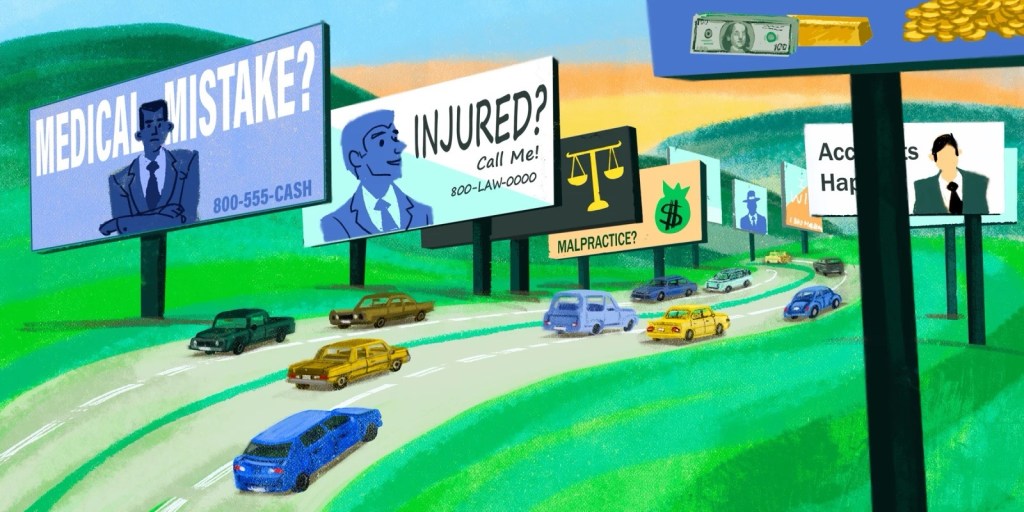
I drive every day. And because apparently the American highway system has decided that my commute should also be a continuing-education course in personal injury law, I see accident attorney billboards everywhere.
Everywhere.
You have the husband-and-wife law firm. You have the guy with the giant head. You have the woman pointing at you like she just caught you stealing a candy bar. You have the attorneys standing dramatically in front of a courthouse. You have slogans that apparently passed through seventeen focus groups and one very caffeinated marketing consultant.
INJURED? CALL US!
WE FIGHT FOR YOU!
DON’T SETTLE!
And, of course, the phone number is approximately 14 feet tall.
Which brings me to the question my sarcastic brain inevitably asks:
Who goes to law school with the dream of eventually having their face on a billboard?
Seriously.
At some point in college, somebody sits down with a career counselor and says, “I’ve given this a lot of thought. I want to become an attorney.”
“Wonderful. What area of law interests you?”
“Well, eventually I’d like my face to be 30 feet tall next to Interstate 17.”
Ah. The dream.
Years of undergraduate education. Law school. Bar exam. Student loans. Internships. Research. Case law. Briefs. Courtrooms.
All so you can eventually stand next to a highway wearing a suit while twelve thousand commuters stare at your giant disembodied head every morning.
That is some serious ambition.
And then there’s another question I’ve always wondered about:
Why do some highways have so many accident attorney billboards?
Is it because there are a lot of accidents?
Or are there a lot of accidents because there are so many accident attorney billboards?
I realize this is probably not how causality works, but hear me out.
You’re driving down the highway and every 500 feet there’s another billboard screaming:
ACCIDENT? YOU MAY BE ENTITLED TO MONEY!
Then another:
INJURED? DON’T TALK TO THE INSURANCE COMPANY!
Then another:
YOU COULD BE OWED MILLIONS!
At some point I’m wondering whether we’ve accidentally turned the highway into a financial incentive program.
“Please maintain a safe following distance.”
Sure.
But also…
What if I get rear-ended?
Maybe that’s my retirement plan.
Forget 401(k)s. Forget Social Security. Forget investing.
I could just get T-boned at 45 miles an hour and hope the other guy has really good insurance.
Apparently, getting into an automobile accident has evolved from being one of the worst things that can happen to you into a potential income opportunity.
And I’m not suggesting anyone should actually want to get hurt. Obviously. An accident can be traumatic, expensive, life-altering and sometimes fatal.
But the cultural messaging surrounding accidents is fascinating.
We have somehow created an entire industry whose advertising message is essentially:
“Congratulations! You got hit by a truck! Let’s see what we can get you.”
There is something profoundly weird about that.
We’ve become so litigious that every unfortunate event now seems to come with a corresponding legal marketing campaign.
Slip on a wet floor?
Call somebody.
Get rear-ended?
Call somebody.
Trip over a sidewalk?
Call somebody.
Look at a ladder wrong?
There is probably an attorney standing behind a billboard waiting for you.
And the billboards themselves have become so ubiquitous that I barely notice them anymore. They’re just part of the American landscape now.
Exit signs.
Gas stations.
Fast food.
Motel.
ATTORNEY.
It’s almost like roadside scenery.
And here’s where my brain starts wandering into the truly ridiculous question:
When did getting into an accident become part of someone’s retirement strategy?
Because somewhere along the line, we seem to have embraced the idea that if something bad happens to you, the first question shouldn’t necessarily be, “How do we fix this?”
It should be:
“How much is this worth?”
That is a pretty extraordinary cultural shift.
We don’t just experience misfortune anymore.
We monetize it.
And lawyers aren’t entirely responsible for this, of course. Insurance companies, corporations, medical billing, questionable business practices and our entire adversarial legal system all play a role.
But the sheer scale of the personal-injury advertising machine is fascinating.
There are apparently enough attorneys competing for accident victims that they have to purchase enormous pieces of real estate along our highways just to remind us that they’re available.
Imagine being the attorney who has to explain the marketing budget.
“Why did we spend $400,000 putting your face on billboards?”
“Because apparently people don’t know I’m a lawyer.”
“Did you try having a website?”
“No.”
“Social media?”
“No.”
“Television?”
“No.”
“So…”
“BILLBOARD.”
And not just one.
No, apparently the ultimate measure of legal success is billboard saturation.
Because if I can drive from one side of town to the other without seeing your face at least six times, are you even really an attorney?
Maybe that’s the next bar association requirement.
Pass the bar exam?
Check.
Character and fitness evaluation?
Check.
Twenty hours of continuing legal education?
Check.
Minimum of six highway billboards?
Congratulations. You’re officially practicing law.
And the funniest part is that these billboards have become so normalized that nobody even questions the underlying absurdity anymore.
We just accept that driving to work means being surrounded by enormous advertisements reminding us that our next fender-bender could potentially be the financial event of our lives.
Which leaves me with one final question:
Are we driving on highways, or are we driving through a gigantic legal vending machine?
Because somewhere between the exit ramp and the next red light, there’s apparently a lawyer waiting to turn my misfortune into a case number.
And somewhere, some law student is currently dreaming about the day when they can finally say:
“I made it.”
Not because they argued a landmark constitutional case.
Not because they changed the legal system.
Not because they defended the innocent or secured justice for somebody who desperately needed it.
No.
Because they drove past their own face on the interstate.
Now that’s the American Dream.
-
What Could Possibly Go Wrong?
Dwain Northey (Gen X)
Well, folks, I suppose we can finally stop wondering what could possibly go wrong.
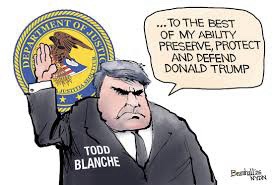
The Senate has now confirmed Donald Trump’s former personal defense attorney, Todd Blanche, as the Attorney General of the United States. Because apparently when you’re trying to convince the country that the Department of Justice is completely independent from the president, the obvious solution is to put the president’s former lawyer in charge of it.
What could possibly go wrong?
Blanche wasn’t merely some random lawyer who happened to cross paths with Donald Trump once at a cocktail party. He was Trump’s personal attorney. He represented him in criminal matters. He was part of Trump’s legal defense team.
And now he is the nation’s top law enforcement officer.
Let’s just sit with that for a moment.
The Attorney General is supposed to be the lawyer for the United States of America—not the lawyer for Donald Trump. The distinction is rather important. In fact, it is the entire fucking point of having a Justice Department that is supposed to operate independently of the White House.
But apparently we have decided that distinction is just unnecessarily complicated.
The Senate confirmed Blanche 50–49, with the vote taking place in the early morning hours as the Senate was preparing to leave for recess. (Le Monde.fr)
Because nothing says “we are completely comfortable with this decision” quite like holding the vote while most of America is asleep.
It has the unmistakable aroma of a legislative version of quietly sneaking out of the house after curfew.
“Hey, everybody! Nothing to see here! We’re just confirming the president’s former personal lawyer to run the entire federal law-enforcement apparatus at four in the morning. Go back to sleep.”
And before somebody tells me this is an unfair comparison, let me explain the comparison I’m making.
This isn’t about whether Todd Blanche is personally competent as a lawyer. It isn’t even necessarily about whether he is a good person. It is about the fundamental conflict created when the president’s former personal attorney becomes the person responsible for overseeing investigations involving that same president.
That is precisely why recusal rules and ethical independence matter.
In fact, Blanche had previously been advised by Justice Department ethics officials that he should recuse himself from matters involving Trump. (Senator Schiff)
And now the guy who was supposed to recuse himself from Trump’s cases is running the entire department that handles those cases.
That is not exactly what I would call a reassuring organizational chart.
And this is where the comparison to Roy Cohn becomes difficult to ignore.
Cohn was famous for operating as Donald Trump’s mentor, fixer and personal attorney, and for treating the machinery of government as something to be manipulated on behalf of his clients and allies.
The Attorney General is supposed to be the exact opposite of that.
The Attorney General is supposed to be the person who can look the president in the eye and say:
No.
Not “No, sir, because the polling isn’t good.”
Not “No, sir, because the Senate might get upset.”
Not “No, sir, because Fox News might have a problem with it.”
No, because the law doesn’t allow you to do that.
That is the job.
And that is precisely why the Senate’s decision matters.
Because if the president can install his personal lawyer as the nation’s chief law-enforcement officer, the question isn’t merely whether the DOJ has been politicized.
The question becomes whether we are redefining what the DOJ is for.
Is it still an institution whose responsibility is to enforce federal law regardless of who happens to occupy the Oval Office?
Or is it becoming the president’s legal department—with a few million employees, guns, prosecutors, grand juries and federal prisons attached?
Because those are two very different things.
And here’s the part that really makes my Gen-X bullshit detector start screaming:
We’ve spent decades hearing Republicans lecture everyone about the importance of law and order.
Law and order.
Law and order.
Law and order.
Apparently the slogan has now been updated to:
Law and order, provided the order comes from the guy in charge.
The irony is almost too perfect.
The people who spent years screaming about Hillary Clinton’s emails, Hunter Biden’s laptop, Benghazi, FBI investigations, congressional investigations and the supposed weaponization of government are now apparently perfectly comfortable with putting the president’s personal lawyer in charge of the Justice Department.
Because apparently government weaponization is only terrifying when the other team has the weapon.
When it’s your guy holding it?
Well, that’s different.
That’s patriotism.
That’s leadership.
That’s probably just “draining the swamp,” somehow.
And before anyone accuses me of declaring that the weaponization of the DOJ is now legally or factually “complete,” let me be precise: that is my characterization of what this appointment represents. But the concern isn’t imaginary. Blanche’s confirmation has already been described by critics as a major threat to the traditional independence of the Justice Department, particularly because of his previous role as Trump’s personal lawyer. (The Guardian)
So congratulations, America.
We have apparently reached the stage where the person who used to defend the president can now decide who gets investigated by the federal government.
And they held the vote in the middle of the damn night.
What could possibly go wrong?
Honestly, at this point, I’m afraid to ask.
Because every time we do, somebody in Washington seems to interpret it as a fucking challenge.


You must be logged in to post a comment.