Dwain Northey (Gen X)
https://www.cbsnews.com/news/naacp-travel-advisory-florida-says-state-hostile-to-black-americans/
Remember the good old days when there were only travel advisories and or ban for, what some would call, third word countries? Well now because of the vile vitriol of one Governor Ron DeSantis the state of Florida, a vacation destination, has received a travel advisory by the NAACP.
The wannabe future President has made the climate so venomous in Florida the anyone who is a part of any minority group does not feel safe in the state. Black, Brown, LGTBQ+, these are all groups that are under attack in the Sunshine State. The majority Republican legislature and their fearful leader has passed laws that make almost everything a jailable offence and the fact that the state has very loose gun laws and a stand your ground law makes it more dangerous than being a blonde female in central America.
Florida residents are able to carry concealed guns without a permit under a bill signed into law by Republican Gov. Ron DeSantis. The law, which goes into effect on July 1, means that anyone who can legally own a gun in Florida can carry a concealed gun in public without any training or background check. This with their ridiculous stand your ground law, ‘Florida’s “Stand-Your-Ground” law was passed in 2005. The law allows those who feel a reasonable threat of death or bodily injury to “meet force with force” rather than retreat. Similar “Castle Doctrine” laws assert that a person does not need to retreat if their home is attacked.’ Makes it really sketchy to go there.
This in top of the don’t say gay rule and the new trans ruling that just passed.
“Florida lawmakers have no shame. This discriminatory bill is extraordinarily desperate and extreme in a year full of extreme, discriminatory legislation. It is a cruel effort to stigmatize, marginalize and erase the LGBTQ+ community, particularly transgender youth. Let me be clear: gender-affirming care saves lives. Every mainstream American medical and mental health organization – representing millions of providers in the United States – call for age-appropriate, gender-affirming care for transgender and non-binary people.
“These politicians have no place inserting themselves in conversations between doctors, parents, and transgender youth about gender-affirming care. And at the same time that Florida lawmakers crow about protecting parental rights they make an extra-constitutional attempt to strip parents of – you guessed it! – their parental rights. The Human Rights Campaign strongly condemns this bill and will continue to fight for LGBTQ+ youth and their families who deserve better from their elected leaders.”
This law makes it possible for anyone to just accuse someone of gender affirming care to have their child taken from them this would include someone traveling from out of state. This alone justifies a travel ban to the Magic Kingdom for families.
Oh, and I haven’t even mentioned DeSantis holy war with Disney, the largest employer in the state. I really hope the Mouse eats this ass holes lunch.
Well that’s enough bitching, thanks again for suffering though my rant.
-
Rabbit Season
Dwain Northey (Gen X)
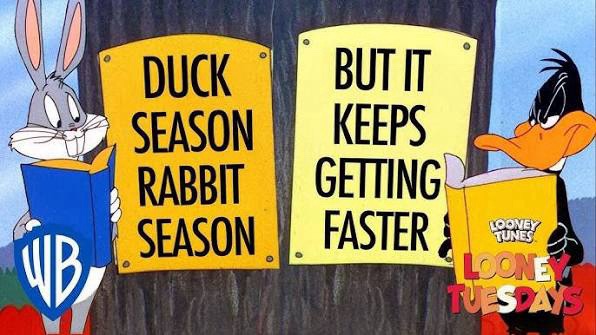
There’s a very specific kind of irony unfolding around the alleged White House Correspondents’ Dinner shooter’s “not guilty” plea, and it almost feels like a live-action version of “rabbit season, duck season.” Because according to reports, the suspect’s own manifesto supposedly ranted about not being able to live under a government “full of pedophiles.” Which creates an absolutely spectacular legal headache if the defense strategy becomes, “No, no, Donald Trump wasn’t the target.”
Because then the obvious follow-up question becomes: “Interesting. So if Trump wasn’t the target… are you admitting the shooter’s reasoning excluded him from the category he described?”
Congratulations. In trying to avoid one political landmine, they’ve stepped directly onto another one while juggling lit dynamite.
It’s like watching lawyers attempt legal Twister on a floor made entirely of conspiracy theories and cable news clips. Left foot on “he didn’t mean Trump.” Right foot on “the manifesto specifically mentioned government pedophiles.” And suddenly everyone in the courtroom is pretending basic sentence structure is impossible to interpret.
This is the modern political era in America: where every statement immediately folds into a Möbius strip of denial, reinterpretation, and accidental self-owns. Nobody can just say what they mean anymore because every argument now comes with splash damage. One side screams, “He was targeting Trump!” while the other side desperately tries to explain why he definitely wasn’t — without accidentally implying they agree with the manifesto’s logic.
That’s the part that makes this so absurd. The defense almost has to perform a Looney Tunes routine in real time:
“Duck season!”
“Rabbit season!”
“Trump season!”
“No wait—”And somewhere in the background, the entire country collectively realizes we’ve reached the point where political discourse sounds less like constitutional debate and more like two raccoons fighting in a dumpster behind a failed casino.
Of course, the simplest answer is probably the boring one: deranged people write deranged manifestos, and trying to extract coherent ideology from insanity usually ends badly. But that would require everyone to stop turning every tragedy into a partisan scavenger hunt for “gotcha” moments. And in modern America, that apparently violates the laws of physics.
-
Silencing our voice
Dwain Northey (Gen X)
For years, I’ve listened to politicians explain to me that gerrymandering is not voter suppression. And technically, in the most lawyerly, hair-splitting, “depends on what your definition of is is” kind of way, they’re right. They’re not stopping me from physically casting a ballot. Nobody is standing outside the polling station snatching pens out of my hand like some democracy-themed mugging. I still get to vote.
What they are doing is making sure my vote matters less.
And apparently that distinction is supposed to comfort me.
Gerrymandering is basically political engineering disguised as cartography. It’s taking communities, especially minority communities or urban populations that tend to vote differently than rural conservative areas, and cracking them apart like a windshield hit by a brick. One district gets sliced into three. Another gets stretched across half a state like melted mozzarella cheese on a bad pizza commercial. Suddenly neighborhoods that actually share interests, schools, infrastructure, and culture are split apart because somebody in the state legislature decided the map looked better if democracy resembled a hostage situation.
Republicans will tell you this is just politics. Completely normal. Perfectly legal. Nothing to see here.
And again, technically, they’re right. Gerrymandering isn’t usually about preventing votes from being cast. It’s about diluting those votes after they’re cast. It’s the electoral version of turning down the volume on voices they don’t want heard.
You can pack voters into one overwhelmingly blue district where Democrats win with 85% of the vote, then spread the remaining Democratic voters thinly across five other districts where Republicans win 52 to 48. Congratulations. Same number of people voted, but magically one side now controls nearly everything. It’s democracy by optical illusion.
The House of Representatives is where this game matters most because House seats are geographic. Draw the lines right and you can practically preselect who wins before a single ballot is cast. Politicians love talking about “the will of the people” while simultaneously using software sophisticated enough to make Vegas odds makers blush.
But when it comes to Senate races or presidential elections, the game changes because you can’t gerrymander an entire statewide vote the same way. You can’t redraw Arizona into twelve tiny Floridas just because you don’t like Maricopa County. So when certain politicians realize the numbers aren’t going their way statewide, suddenly the strategy shifts from dilution to outright negation.
That’s where we saw the real mask slip off.
Because after the 2020 election, Donald Trump and his allies weren’t trying to redraw congressional districts. They were trying to throw out entire batches of votes. Entire counties. Entire cities. Entire populations that happened to vote against him.
And somehow we were all supposed to pretend that was about “election integrity.”
Funny how election integrity always seems to mean invalidating somebody else’s election.
That’s the important distinction people dance around. Gerrymandering says, “You may vote, but we’ll reduce the impact afterward.” Election denialism says, “You voted, but we may simply pretend it never happened.”
One weakens representation. The other attacks the existence of representation altogether.
And the truly amazing part is how calmly this all gets discussed now. As if carving up districts to engineer outcomes or attempting to discard lawful votes are just normal policy disagreements, like debating highway funding or whether schools need better cafeteria food.
Two hundred and fifty years after declaring independence from a king, we somehow arrived at a political era where some Americans are perfectly comfortable with the idea that voters shouldn’t really choose leaders anymore. Leaders should choose voters. And if voters still make the “wrong” choice, apparently the solution is to either dilute their voice or erase it entirely.
But sure, they’ll remind me with a straight face that technically it isn’t voter suppression.
Technically.
-
Gen X reflections on loneliness
Dwain Northey (Gen X)

There’s a particular kind of loneliness that sneaks up on Gen X people because we were practically raised to pretend it didn’t exist.
We were the “figure it out yourself” generation. The latchkey kids. The generation that got handed house keys, microwaved pizza rolls, and vague instructions like, “Be home before dark.” Nobody asked us if we were overwhelmed. Nobody sat us down to explain emotional bandwidth. Half of us grew up believing that if you could survive sarcasm, neglect, and drinking from a hose, then congratulations, you were emotionally prepared for adulthood.
Turns out, surviving and coping are not always the same thing.
I’ve been alone plenty of times in my life. That part isn’t new. I know how to occupy silence. I know how to distract myself. I know how to keep moving because Gen X practically turned emotional compartmentalization into an Olympic sport. We learned early that when life punches you in the mouth, you crack a joke, shrug your shoulders, and go to work the next morning.
But lately, the loneliness feels different.
Ever since my son’s wedding, something shifted in me. Not in a bad way exactly. The wedding was beautiful. I was proud. Happy. Emotional in that weird Gen X way where you try not to cry openly because somewhere deep in your brain a voice still says, “Keep it together.” But after all the noise faded and everybody went back to their lives, the quiet hit differently.
It’s profound now.
Not dramatic. Not cinematic. Just heavy.
The kind of loneliness that shows up at random moments. Standing in the kitchen. Folding laundry. Driving somewhere with no real urgency to get there. It’s the realization that parts of your purpose have changed, and nobody hands you instructions for what comes next.
And the strange thing is, I don’t even necessarily want people around me every second. Gen X people are notoriously independent. We don’t suddenly become social butterflies because we’re lonely. Most of us would rather wrestle a bear than “open up” in a group setting with soft lighting and a feelings worksheet.
But loneliness isn’t always about physical isolation. Sometimes it’s about feeling untethered.
I think a lot of us chemically enhanced our way around these feelings for years. Alcohol. Weed. Pills. Constant distractions. Endless scrolling. Noise. Anything to keep the silence from getting too loud. And I’m not judging anybody who does. Life is hard. People cope however they can.
But for me, I can’t really go that route. I don’t have the bandwidth for it, mentally or emotionally, and honestly I know myself well enough to know that escaping something isn’t the same as dealing with it.
So I sit with it instead.
Which sounds noble until you actually do it.
Because sitting with loneliness is uncomfortable as hell. There’s no soundtrack. No inspirational montage. Just you and your thoughts at 2 a.m. wondering why being needed less somehow hurts more than you expected it to.
And I wonder constantly how other people deal with it. Especially people who don’t numb themselves chemically. How do they carry it without letting it hollow them out? How do they make peace with the silence without becoming consumed by it?
Maybe part of the answer is admitting it out loud.
Gen X was taught resilience, but not vulnerability. We learned how to endure almost anything except emotional honesty. We can survive layoffs, divorces, recessions, wars, and existential dread with a sarcastic one-liner and a cup of bad coffee. But saying, “I feel profoundly lonely lately,” somehow still feels illegal.
Maybe because admitting loneliness feels too much like admitting weakness.
But I don’t think it is weakness anymore.
I think it’s the bill that comes due after a lifetime of being the strong one.
And maybe the only real way through it is understanding that loneliness isn’t proof that we failed at life. It’s proof that we loved people deeply enough for their absence, their growing up, or their moving on to leave an echo behind.
That echo just gets loud sometimes.
-
Administration or regime
Dwain Northey (Gen X(
It’s funny how language tells on people before they even realize it.
For decades we talked about presidential administrations. The George Washington administration. The Ronald Reagan administration. The Barack Obama administration. Even when Americans bitterly disagreed with a president, there was still an understanding that the office itself was temporary. Administrations come and go. Terms end. Power transfers. That was the entire revolutionary point of the experiment.
About 250 years ago, Americans fought a war specifically because they were tired of having a king. We literally declared independence from one. The whole sales pitch of the country was, “Hey, maybe one guy shouldn’t have unlimited power forever.” It was kind of our thing.
And ever since then, every president — good, bad, mediocre, scandal-ridden, or forgettable — has had an administration. Because presidents were supposed to be temporary stewards of a constitutional republic, not permanent rulers basking in loyalty worship.
But now? Suddenly people casually talk about the Trump regime.
Regime.
That word is doing a lot of heavy lifting.
A regime isn’t just a government. A regime is something entrenched. Something that doesn’t particularly enjoy opposition, criticism, elections, or the whole inconvenient idea that eventually someone else gets a turn. Historically, regimes are what happen when leaders start confusing public service with personal ownership.
Nobody ever said “the Eisenhower Regime.”
Nobody whispered fearfully about “the Carter Regime.”
And somehow “the Trump Regime” gets tossed around like it’s perfectly normal vocabulary in a constitutional democracy.Which, honestly, feels like America looked at 250 years of democratic tradition and said, “You know what this country really misses? Monarchy. But make it spray tan.”
Apparently it only took two and a half centuries for part of the country to decide maybe kings weren’t the problem — maybe we just hadn’t found the right one yet. And unfortunately, after all this time, the chosen de facto monarch turns out to be a straw-haired, orange-painted buffoon who rants online at three in the morning like your divorced uncle after six beers and a Facebook conspiracy binge.
And the truly remarkable part is how many people treat this like strength. The more he attacks institutions, the more some supporters cheer. Courts, elections, the press, the Constitution itself — all suddenly become optional obstacles standing in the way of Dear Leader’s feelings.
That’s where the “regime” language stops sounding accidental and starts sounding revealing.
Because a term implies service. An administration implies stewardship. A regime implies permanence. Ownership. Loyalty to the ruler over loyalty to the republic.
And it tracks with the broader shift we’ve watched happen in real time. Presidents used to at least pretend they served institutions larger than themselves. Now politics resembles a bizarre fusion of celebrity worship, grievance culture, and apocalyptic religion. Criticism becomes betrayal. Losing elections becomes impossible to accept. Reality itself becomes negotiable as long as the right people stay in power.
That’s how you drift from “administration” to “regime” without even noticing the road signs.
And when people point this out, the response is always outrage. “How dare you compare this to authoritarianism?” Well, maybe stop using authoritarian vocabulary while demanding authoritarian behavior. That would probably help.
Because historically, regimes are not famous for peaceful transfers of power. That’s kind of their defining characteristic.
Meanwhile Democrats are still standing in the corner clutching parliamentary procedure manuals like substitute teachers trying to restore order in a classroom fire.
Maybe that’s why the shift in language feels so important. Buried inside one little word — regime — is the assumption that power is supposed to stay put. That the leader is supposed to remain. That elections are merely annoying formalities instead of the foundation of the entire system.
And once a democracy starts romanticizing strongmen and flirting with the idea of kings again, history suggests the ending is rarely patriotic music and a civics lesson. Usually it’s just the slow realization that the people who screamed loudest about freedom were perfectly happy trading it away for someone who promised to hurt the people they disliked.
-
Mothers Day
Dwain Northey (Gen X)

Mother’s Day always makes me stop and think about how much we take our mothers for granted. We love them, of course we do, but life has a way of making us assume there will always be another phone call, another visit, another holiday, another chance to say thank you for all the things they did that we were too young, too stubborn, or too distracted to notice at the time.
As I’ve gotten older, I’ve realized mothers carry the weight of entire families on their backs while somehow making it look ordinary. They worry when nobody sees it. They sacrifice things they never talk about. They celebrate our victories louder than their own and somehow still manage to forgive us for the countless times we acted like we knew everything. And if we’re honest, most of us eventually discover our mothers were right about far more things than we ever wanted to admit.
Today is their day, and they deserve it. The flowers, the phone calls, the dinners, the hugs, the embarrassing social media posts — all of it. But the truth is, mothers deserve more than one designated Sunday a year where we suddenly remember to appreciate them. Every day should be Mother’s Day in some small way. A quick call. A visit. A thank you. A reminder that all the little things they did mattered more than we realized.
I know not everyone has a perfect relationship with their mother, and life can be complicated. But for those of us lucky enough to still have our moms here, today is a good reminder that time moves fast. Someday, we’d give anything for one more conversation, one more piece of advice, or even one more moment hearing them tell us to drive safe or wear a jacket because apparently we’re still twelve years old in their eyes.
And honestly, maybe that’s part of what makes mothers so special. No matter how old we get, to them we’re still their kids.
-
Red Lining
Dwain Northey (Gen X)
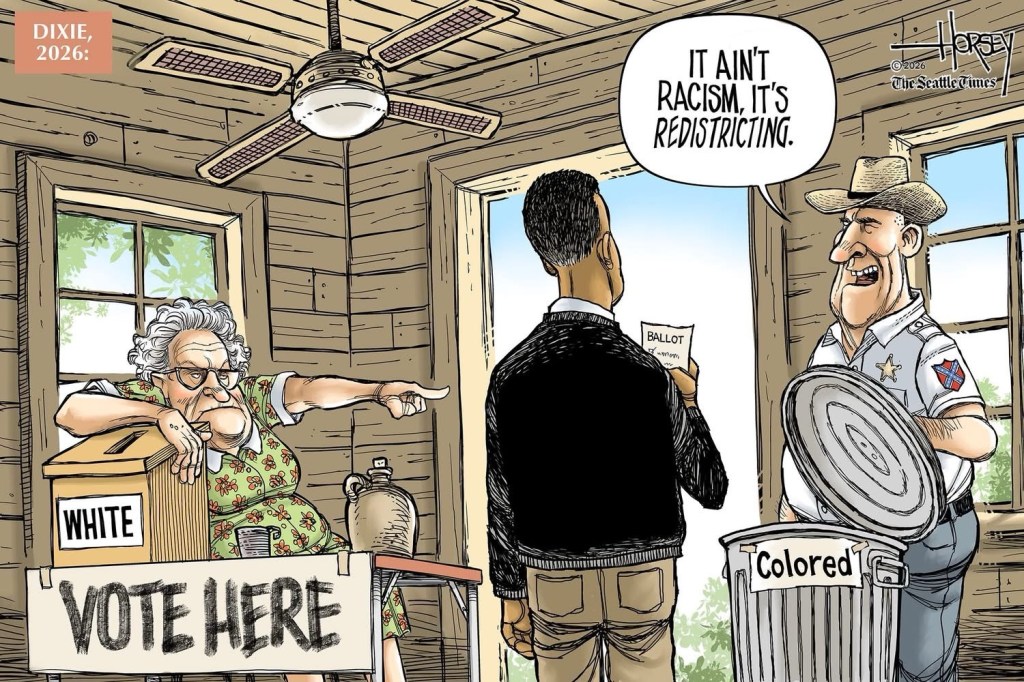
There’s something almost admirable about the modern political imagination in America. We used to at least put effort into hiding discrimination. There was theater. There were coded speeches, dog whistles, strategic pauses before saying “urban voters.” Now? We’ve apparently streamlined the process down to: “No, no, it’s not about race. It just so happens the people we’re targeting are overwhelmingly minorities. Totally different.”
And thankfully, the recent Supreme Court logic has handed politicians a shiny new permission slip. According to this legal masterpiece, if you carve up districts and disenfranchise people because of how they vote instead of explicitly because of their race, then congratulations — apparently racism has been solved. It’s not discrimination if you’re targeting voting patterns. Even if those voting patterns are directly tied to race because of, you know, centuries of American history.
That’s some Olympic-level semantic gymnastics.
It’s basically the political version of a guy standing in the rain insisting he’s dry because technically the water is “atmospheric moisture.”
Southern states heard this ruling and reacted the way toddlers react when they discover the baby gate isn’t locked anymore. Suddenly there’s a stampede toward maps, redistricting software, and dimly lit back rooms where democracy goes to die beside an overflowing ashtray and a half-empty bottle of bourbon.
Take Tennessee. Memphis — a heavily Black city — had a congressional district that actually allowed its residents to speak with some unified political voice. Clearly unacceptable. So in what felt like a late-night poker game among men named Bubba and Earl muttering “hold my whiskey,” they split Memphis apart like a pizza nobody wanted Black voters to finish eating.
Problem solved.
Now those communities get diluted into larger, whiter, more rural districts where their votes disappear into the political equivalent of screaming into a tornado. But remember: not racist. Absolutely not. They’re not targeting Black voters because they’re Black. They’re targeting them because they tend to vote a certain way. Which, coincidentally, is exactly why race and voting rights became linked in the first place.
That distinction apparently makes perfect sense if you attended the “Legal Technicalities for Cowards” school of constitutional interpretation.
And honestly, the most insulting part is the fake innocence afterward.
Politicians stand there with perfectly straight faces saying things like, “This is about fairness,” while holding district maps that look like someone dropped cooked spaghetti across the state. You don’t accidentally create districts shaped like a drunk salamander unless your goal is to make sure certain people’s votes count less than others.
At this point, America doesn’t even gerrymander districts anymore. We perform abstract expressionism with democracy.
And for those of us old enough to remember civics class, this all feels vaguely familiar. “Taxation without representation” used to be a slogan Americans got very dramatic about. There may have been a tea-related incident over it. But apparently the modern version is perfectly acceptable as long as you bury it under enough legal jargon and say “partisan advantage” instead of “racial suppression.”
Because that’s the magic trick now. Replace the word “race” with “political behavior,” and suddenly everyone in power pretends not to notice who’s actually being silenced.
It’s like banning a church choir from singing and then insisting you have nothing against religion — you just happen to oppose group harmonization occurring on Sundays.
Completely different.
The truly terrifying part is how open it’s becoming. There was a time when getting caught suppressing minority votes caused public shame. Now it gets you invited onto cable news to explain how dismantling representation is actually preserving democracy. Somewhere George Orwell is staring at Earth like, “I mean… even I thought that was a little too on the nose.”
And the Supreme Court’s position essentially boils down to this: if racism and politics become statistically inseparable because of the country’s history, then targeting the politics is somehow magically constitutional even when the outcome is identical.
That’s not justice. That’s laundering discrimination through Excel spreadsheets.
But hey, at least we’ve simplified things. America no longer has to ask whether voter suppression disproportionately harms minorities. We can just shrug and say, “Well technically we’re suppressing Democrats,” as entire communities lose their voice.
Progress.
-
Words, literally
Dwain Northey (Gen X)

There are days I’m convinced I’m the only person on earth who reads signs literally instead of just absorbing the intended vibe. Apparently, the rest of humanity sees marketing slogans and translates them emotionally while my brain immediately starts cross-examining them like an attorney who hasn’t slept in three days.
Take the phrase “Voted Number One.”
Immediately my brain goes: voted by who? When was the election? Was turnout good? Was there election interference? Was this a peer-reviewed process or just three guys named Rick standing near a cash register saying, “Yeah, I guess this place is pretty good”?
Because “voted number one” sounds impressive until you realize it could mean literally anything. “Voted Number One Hot Dog Stand in a Three-Block Radius by Readers of Carl’s Tire & Bait Quarterly.” Technically true. Still feels like information I should have before I emotionally commit to your chili fries.
Then there’s “World Famous.”
World famous where exactly? Because there are restaurants sitting in tiny strip malls between a vape shop and a failing tax service claiming to be “world famous,” yet nobody outside a seven-mile radius has ever heard of them.
I saw a sign once for “World Famous Pizza,” and I thought, buddy, the world is four and a half billion internet users deep. Naples exists. New York exists. Chicago exists. You’re attached to a gas station in suburban Arizona. Let’s manage expectations.
And words matter to me, maybe because I’m of a certain age where language still meant something specific instead of just sounding optimistic enough to slap on a billboard.
For example, companies love saying, “Safety is our goal.”
Now maybe it’s just me, but that statement does not comfort me the way they think it does.
A goal is something you aspire to. A goal is something you occasionally fail at while saying, “We’ll get ‘em next quarter.”
I don’t want safety to be your goal. I want it to be your standard. Your mission. Your non-negotiable promise.
If I’m boarding an airplane, I don’t want the mechanic standing there saying, “Well, safety remains our objective.” Objective? Sir, I was hoping safety was already achieved before we started taxiing.
If I’m going into surgery, I don’t want to hear, “We strive for safety.” Strive? That sounds like you’re still workshopping the concept.
And honestly, that’s the thing with modern corporate language. Nobody actually commits to anything anymore. Everything is carefully worded to sound reassuring while legally promising absolutely nothing.
Same thing with businesses saying things like, “We strive for excellence.”
You strive for it? So you haven’t caught it yet?
That’s like a surgeon walking into the operating room saying, “Nobody wants success more than we do.” Wonderful. I personally was hoping for competence over ambition, but let’s see how this unfolds.
And then there are the slogans that are supposed to inspire confidence but instead accidentally sound terrifying if you read them too literally.
Near the airport where I live there’s a huge sign for a cancer center that says:
“Curing cancer at the speed of life.”Now maybe everyone else immediately understands the intended uplifting message, but my brain just slams on the brakes and goes, hold on… what exactly is “the speed of life”?
Because life moves at wildly different speeds depending on who you ask.
For a toddler on Christmas morning, life moves at light speed.
For somebody sitting in DMV chairs number 47 through 89, life stops entirely.
And for anyone over 50 trying to get through a work week, Tuesday alone lasts roughly four to six calendar years.So when you tell me you’re curing cancer “at the speed of life,” that doesn’t reassure me nearly as much as you think it does.
Honestly, it sounds less like a medical breakthrough and more like a philosophical threat.
Are we talking fast life?
Slow life?
Dog years?
Government years?
Cable company technician arrival window years?Because if I’m dealing with cancer, I don’t necessarily want abstract poetic metaphors. I want specifics. I want timelines. I want charts. I want a doctor saying, “We are aggressively treating this with measurable urgency,” not something that sounds like it belongs embroidered on a decorative pillow in a hospice waiting room.
And maybe this is just part of getting older. You start realizing how much of modern life depends on people agreeing not to examine language too closely. Everyone else reads slogans emotionally while a few of us are stuck doing accidental forensic linguistics in parking lots.
For example, I saw a moving truck that proudly announced:
“Reliable Movers.”Not “The Best Movers.”
Not “Professional Movers.”
Not “Trusted Movers.”Reliable.
And all I could think was, yep, that tracks. That’s exactly the level of confidence I’m looking for when strangers are carrying my furniture down stairs.
Not excellence.
Not precision.
Just:
“We usually get it right.”Somewhere there’s probably another truck that says “Adequate Plumbing” or “Mostly Honest Auto Repair.”
Honestly, at least that feels authentic.
Because we’ve entered this strange era where every sign, slogan, and advertisement sounds like it was generated by a committee trying to legally avoid making an actual promise. Everything is carefully worded to imply greatness without technically guaranteeing competence.
“Fresh Ingredients.”
Compared to what?“Customer Focused.”
As opposed to openly hostile?“Quality Service.”
Again, the bar feels disturbingly low here.“Open Late.”
That’s not a flex. That’s insomnia with overhead lighting.“Fast Friendly Service.”
Those are usually mutually exclusive.“Authentic Mexican Food.”
Good. I was worried it might be emotionally experimental Mexican food.Maybe that’s why these signs make me laugh. My brain can’t stop interpreting them exactly as written, and once you do that, the whole marketing world starts sounding unintentionally honest.
“Now Hiring Friendly Staff.”
Meaning the current staff has apparently declared war on humanity.“Under New Management.”
Translation: something happened here.“Family Owned.”
Which could mean wholesome tradition or three brothers screaming at each other behind a deli counter. Fifty-fifty.And somewhere out there right now, a marketing executive is proudly approving another billboard that says:
“Experience the future today.”While people like me are sitting there wondering,
“Well then what are we supposed to do tomorrow?” -
Renewable Race
Dwain Northey (Gen X)
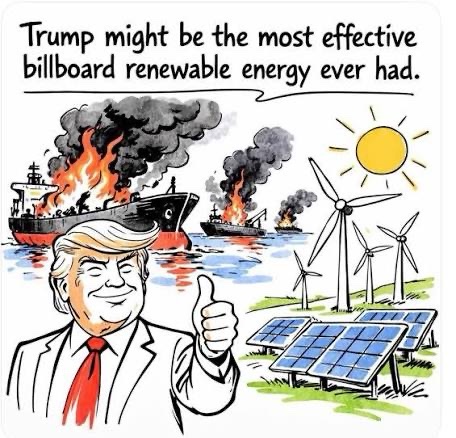
For the first time since humanity discovered that setting dead dinosaurs on fire could power a factory, the world is now generating more electricity growth from renewables than from fossil fuels. Solar, wind, hydro, wave energy — all those scary, woke electrons are finally outpacing the old “dig up sludge and light it on fire” business model. And naturally, this administration looks at that achievement the same way a medieval plague doctor might look at hand sanitizer: with deep suspicion and probably a conspiracy theory.
We’ve reached the point where even oil companies quietly admit the energy transition is happening. Not publicly, of course. Publicly they still act like solar panels are a communist plot cooked up by hippies and weather forecasters. But privately? They know. The market knows. Investors know. Utilities know. Hell, your neighbor with six Teslas and a battery wall the size of a bunker definitely knows.
Yet somehow the loudest people in government are still standing there yelling, “Coal is the future!” like a guy insisting Blockbuster is about to make a comeback.
And leading the charge, naturally, is Donald Trump, a man who talks about wind turbines the way villagers used to talk about witches. According to him, wind farms don’t exist in China — which is fascinating, because China only happens to be the world’s largest producer of wind energy. Minor detail. It would be like claiming fish don’t exist in the ocean while standing waist-deep in the Pacific holding a tuna.
Then there was the unforgettable declaration that wind turbines cause cancer. Not might. Not maybe. Cause cancer.
Now, I’m no scientist, but I feel fairly confident saying the giant white spinny thing in a field is probably not the leading carcinogen of our era. Meanwhile, fossil fuels — the thing we’ve been inhaling for over a century — are linked to lung cancer, heart disease, asthma, strokes, poisoned groundwater, and the occasional ocean catching on fire. But apparently that’s all perfectly normal because the smoke comes from “real American energy.”
You almost have to admire the commitment to the bit.
Imagine looking at a solar panel — a silent rectangle that just sits there absorbing sunlight — and deciding that’s the dangerous technology. Meanwhile, the alternative is literally burning toxic material beneath the earth’s crust and pumping the leftovers into the atmosphere like we’re trying to speedrun climate collapse.
But renewables threaten something more important than fossil fuels: nostalgia.
Because for a certain kind of politician, energy policy isn’t about efficiency or public health or the future. It’s emotional support policy for people who think every problem can be solved by reopening a coal mine and yelling at a librarian.
And the irony is brutal. The same crowd constantly screaming about “American innovation” is actively fighting the industries where the future is clearly headed. China, Europe, and other countries are pouring money into renewable infrastructure, battery storage, grid modernization, and electric transportation while parts of our government are still behaving like solar panels personally insulted their pickup truck.
We’re watching the global economy shift in real time, and these people are reacting the way horse breeders probably reacted to the first automobile. “Sure, it moves faster and doesn’t poop in the street, but can it really replace a good mule?”
The funniest part is that renewable energy is no longer some fringe environmentalist fantasy. It’s becoming cheaper. More scalable. More practical. Entire states already generate huge portions of their electricity from wind and solar because, shockingly, the sun keeps showing up for work every day without demanding subsidies or starting wars in the Middle East.
And despite decades of fearmongering, the average wind turbine has yet to leap from its foundation and attack a village.
At this point, opposing renewable energy feels less like policy and more like performance art. The facts are already here. The economics are already here. The technology is already here. The rest of the world is moving forward while some of our leaders are standing in front of a coal plant like a guy lovingly defending his fax machine.
History is going to look back on this moment and wonder how anyone thought the dangerous option was windmills while the safe option was filling the sky with combustion fumes.
But then again, this is the same political movement that looked at a global pandemic and decided the real threat was Dr. Fauci and paper masks. So perhaps expecting nuance on atmospheric chemistry was always asking a little too much.
-
Shaking the snow globe
Dwain Northey (Gen X)
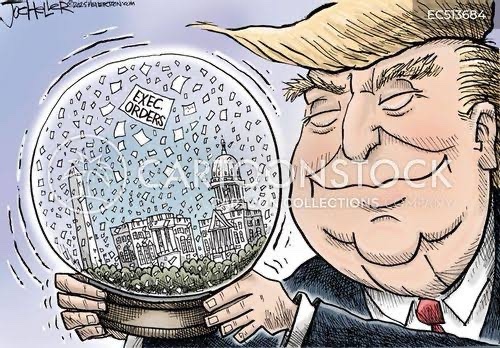
I remember when politics at least pretended to be about persuasion—arguments, facts, maybe even a shared reality. Then somewhere along the line, the GOP looked at the old propaganda playbook and said, “You know what aged surprisingly well? Chaos.” Not subtle messaging. Not coherent policy. Just flood the zone with so much noise, nonsense, contradiction, and outright fabrication that the average person throws up their hands and says, “I don’t even know what’s true anymore.” Mission accomplished.
It’s not a new tactic. It’s just been modernized, digitized, and weaponized. The idea is simple: if everything is confusing, nothing is accountable. If every story contradicts the last one, then no one can pin you down on anything. And if you say enough outrageous things in rapid succession, people stop reacting to any of them. It’s not governing—it’s psychological saturation.
Take the current moment. We’re told there’s a justified war brewing with Iran—except the framing keeps shifting like a shell game. One day it’s defensive, the next it’s preemptive, then it’s something else entirely depending on which spokesperson is standing at which podium. It’s like the conflict itself is being rebranded in real time, as if changing the label somehow resets the consequences. Cease-fire? What cease-fire? That was two narratives ago.
Meanwhile, we already have a federal budget the size of a global superpower’s operating manual—and somehow that’s not enough. Now we need a reconciliation bill layered on top of it, bloated beyond recognition, because apparently fiscal responsibility is only a campaign slogan, not a governing principle. The same people who used to clutch pearls over deficits now treat trillion-dollar add-ons like loose change in the couch cushions.
And buried in that legislative monstrosity? A cool billion dollars for a ballroom. A ballroom. Not infrastructure, not healthcare, not anything remotely resembling public need—just a gilded vanity project that screams quiet part out loud: this isn’t about serving the country, it’s about decorating the throne room. Because if you’re planning your legacy in chandeliers and polished marble, you’re not exactly signaling a short stay.
Donald Trump has never been subtle about branding everything in gold leaf, but this goes beyond aesthetics. It’s symbolic. It says permanence. It says entitlement. It says, “I’m not just passing through—I’m installing upgrades.”
And the most remarkable part? None of it exists in isolation. The war messaging, the budget bloat, the vanity spending—it all blends together into that same fog of excess where nothing can be examined too closely because there’s always something louder, shinier, or more outrageous happening five minutes later.
That’s the strategy. Not clarity—overload. Not truth—volume. Not governance—spectacle.
And the rest of us are left standing in the middle of it, trying to figure out which way is up while the people in charge keep shaking the snow globe.
-
Every Citizens Right
Dwain Northey (Gen X)
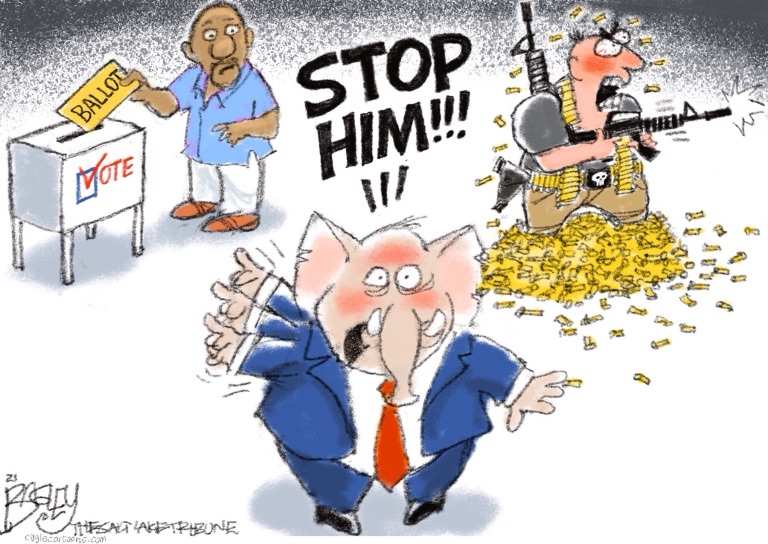
I’ve been informed—usually with a reassuring pat on the shoulder—that I shouldn’t be all that worked up about voting rights. After all, I’m a 59-year-old white guy. Statistically speaking, I’m the VIP section of the electorate. The velvet rope practically parts itself when I show up. So why, I’m asked, would I care if other people are having their access to the ballot box chipped away?
And I have to admit, it’s a compelling argument—if you ignore, well, history, basic fairness, and the entire premise of democracy.
Because here’s the thing that seems to get lost in these conversations: efforts to restrict voting don’t start by targeting the people in the center of power. They start at the edges. They always start at the edges. It’s like a slow-moving storm you can see forming on the horizon—easy to ignore if you’re still standing in the sunshine, right up until it rolls directly over you.
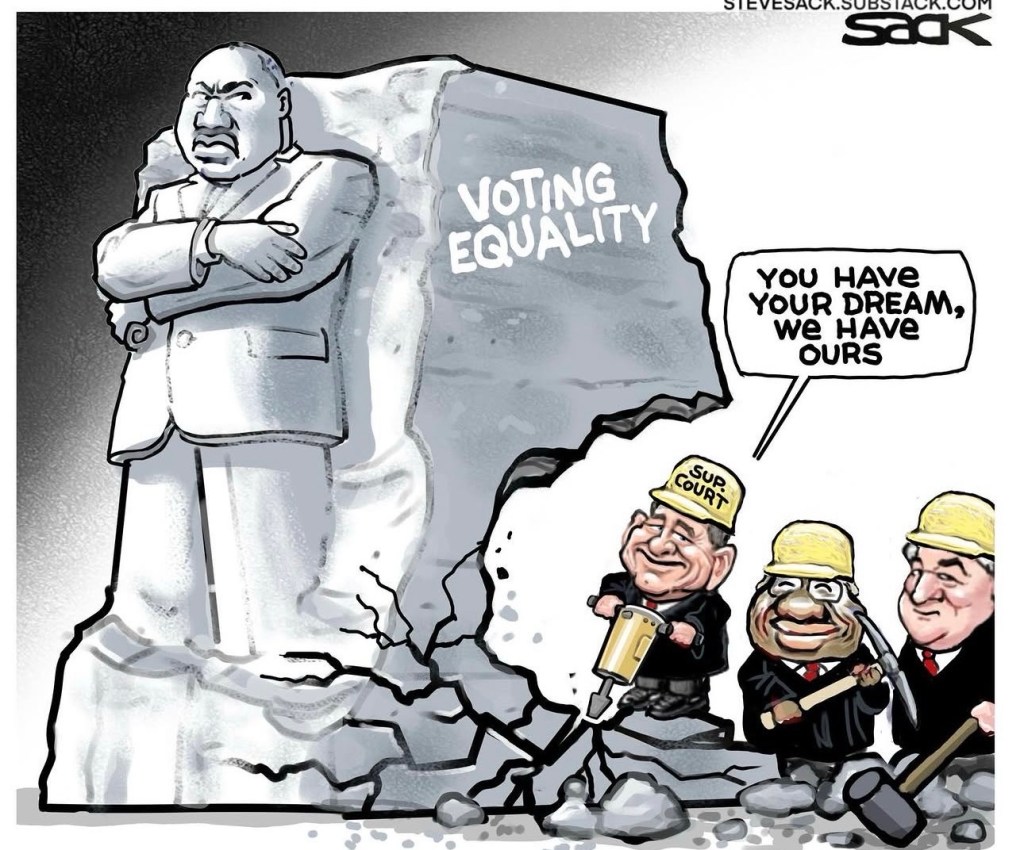
So when I see the Supreme Court taking a hatchet—no, let’s call it a “surgically precise legal instrument,” because that sounds nicer—to key provisions of the Voting Rights Act, I don’t exactly feel reassured. I don’t think, “Well, that’s fine, I’ll be unaffected.” I think, “Oh, good, we’re loosening the bolts on the guardrails that kept elections at least somewhat fair.”
And I get it—some folks genuinely believe this is about preventing fraud. The ever-elusive, Bigfoot-level voter fraud that somehow justifies making it harder for actual, real, living people to vote. Because obviously, the real threat to democracy is not fewer people participating—it’s the terrifying possibility that more of them might.
Now, I happen to vote Democratic. Which, if you’ve been paying attention, increasingly places me in a category that some would prefer had a slightly more… “streamlined” voting experience. You know, fewer polling places, longer lines, maybe a fun little scavenger hunt for acceptable ID. Nothing says civic engagement like needing three forms of documentation and a half day off work just to exercise a constitutional right.
But even if that weren’t the case—even if my vote were completely insulated—I’d still care. Because the idea that voting rights should depend on whether I personally benefit is, frankly, ridiculous. That’s not how rights are supposed to work. They’re not a loyalty program where you rack up points based on how closely you align with whoever’s in charge.
I believe everyone should have the right to vote. Full stop. Even if they vote for candidates I wouldn’t trust to water my plants, let alone run a country. That’s the deal. That’s democracy. It’s messy, it’s frustrating, and sometimes it makes you question your fellow citizens’ life choices—but it’s supposed to be inclusive.
What worries me is that not everyone sees it that way anymore. There’s this growing comfort with the idea that some votes matter more than others—or that some people should have to jump through more hoops to be heard. And that’s where the “you shouldn’t care” argument really falls apart.
Because if you’re okay with someone else’s rights being trimmed down today, you’re essentially betting that yours won’t be tomorrow. And historically, that’s not a great bet.
So no, I’m not going to shrug this off just because I’m not the first target. I’ve seen enough to know how this story tends to go. It doesn’t stop at the edges. It never does.
And besides, if we reach a point where the only votes that are easy to cast are the ones that agree with the people in power, then we haven’t protected democracy—we’ve just politely escorted it out the back door and hoped nobody notices.


You must be logged in to post a comment.