Dwain Northey (Gen X)
https://www.cbsnews.com/news/naacp-travel-advisory-florida-says-state-hostile-to-black-americans/
Remember the good old days when there were only travel advisories and or ban for, what some would call, third word countries? Well now because of the vile vitriol of one Governor Ron DeSantis the state of Florida, a vacation destination, has received a travel advisory by the NAACP.
The wannabe future President has made the climate so venomous in Florida the anyone who is a part of any minority group does not feel safe in the state. Black, Brown, LGTBQ+, these are all groups that are under attack in the Sunshine State. The majority Republican legislature and their fearful leader has passed laws that make almost everything a jailable offence and the fact that the state has very loose gun laws and a stand your ground law makes it more dangerous than being a blonde female in central America.
Florida residents are able to carry concealed guns without a permit under a bill signed into law by Republican Gov. Ron DeSantis. The law, which goes into effect on July 1, means that anyone who can legally own a gun in Florida can carry a concealed gun in public without any training or background check. This with their ridiculous stand your ground law, ‘Florida’s “Stand-Your-Ground” law was passed in 2005. The law allows those who feel a reasonable threat of death or bodily injury to “meet force with force” rather than retreat. Similar “Castle Doctrine” laws assert that a person does not need to retreat if their home is attacked.’ Makes it really sketchy to go there.
This in top of the don’t say gay rule and the new trans ruling that just passed.
“Florida lawmakers have no shame. This discriminatory bill is extraordinarily desperate and extreme in a year full of extreme, discriminatory legislation. It is a cruel effort to stigmatize, marginalize and erase the LGBTQ+ community, particularly transgender youth. Let me be clear: gender-affirming care saves lives. Every mainstream American medical and mental health organization – representing millions of providers in the United States – call for age-appropriate, gender-affirming care for transgender and non-binary people.
“These politicians have no place inserting themselves in conversations between doctors, parents, and transgender youth about gender-affirming care. And at the same time that Florida lawmakers crow about protecting parental rights they make an extra-constitutional attempt to strip parents of – you guessed it! – their parental rights. The Human Rights Campaign strongly condemns this bill and will continue to fight for LGBTQ+ youth and their families who deserve better from their elected leaders.”
This law makes it possible for anyone to just accuse someone of gender affirming care to have their child taken from them this would include someone traveling from out of state. This alone justifies a travel ban to the Magic Kingdom for families.
Oh, and I haven’t even mentioned DeSantis holy war with Disney, the largest employer in the state. I really hope the Mouse eats this ass holes lunch.
Well that’s enough bitching, thanks again for suffering though my rant.
-
Traditions part two
Dwain Northey (Gen X)

Now that we’ve cracked open the pagan gift-giving origins, let’s move further into the misty Nordic forest of “Christmas traditions that absolutely did not start as Christian, but sure—roll with it.”
1. The Lighting of Trees: Because Nothing Says “Joy” Like Bringing the Forest Indoors to Combat Cosmic Darkness
Picture this: It’s Northern Europe, it’s December, it’s dark for 23.5 hours a day, and you haven’t seen the sun long enough to remember what colors are. Ancient pagans didn’t have seasonal affective lamps or peppermint mochas, so they did the next best thing—dragged a live tree inside and lit it up.
Not as in electric lights, but candles.
Yes, actual fire.
On a tree.
Inside a wooden house.
It was a combo of natural magic and “I dare the universe to smite me.” The evergreen symbolized life surviving winter, and the lights symbolized the returning sun. When Christianity arrived, it wisely said, “Sure, that seems festive,” and suddenly the ritual of not burning your home down became a wholesome holiday tradition.
2. Wreaths: The Original Pagan Mood Rings
Before wreaths were hung on doors to say “We have good taste and probably a nice kitchen,” they were circular pagan symbols of the eternal cycle of seasons—life, death, rebirth, the whole natural Netflix drama.
A wreath’s circular shape represented the sun, eternal life, protection against spirits, and probably the ancient equivalent of “Don’t bother us, we’re trying to survive winter.” Christians later adopted the symbol, added candles, and called it Advent, but the core symbolism remained:
A decorative way of saying “We’re not going down without a fight.”
3. The Yule Log: Because Dragging a Giant Tree Trunk Indoors Once Seemed Reasonable
The Yule log is the ultimate holiday flex. Germanic and Norse pagans would haul an entire tree trunk—yes, the whole thing—into the home, shove the giant end into the fireplace, and let it burn for days or even weeks.
It was basically:
a space heater a sun charm a community bonding ritual and an ancient version of “we’re gonna need a bigger fire.”
Eventually the tradition shrank (thankfully) into a much smaller symbolic log, and then even further into… a cake. Because modern humans prefer edible symbolism over accidentally lighting the house on fire.
4. Mistletoe: The Ancient Kiss-Crime Plant
Long before it was the plant that justified awkward office-party encounters, mistletoe had a reputation as:
a fertility charm a peace symbol a magical healing plant and an indicator that druids really liked climbing trees
In Norse myth, it even plays a role in the death of Baldr, so you might say mistletoe has a complicated résumé.
When Christianity absorbed the tradition, all the messy mythology was quietly swept under the rug, leaving only the part where you’re socially required to kiss someone because a parasitic plant said so. Truly, humanity’s finest hour.
How This All Became Modern “Christian” Holiday Culture
As Christianity spread across Europe, it wisely realized that trying to ban all these beloved rituals would go about as well as banning cookies. So instead, it blended them seamlessly into Christmas celebrations.
The result is the holiday we now know—an elaborate, centuries-old remix of:
pagan solstice traditions medieval Christian symbolism Victorian sentimentality Coca-Cola marketing LED lights bright enough to summon aircraft
And today we celebrate by decorating with ancient fertility sprigs, resurrecting solar cult symbols, eating logs of chocolate, and lighting up trees like pagan disco balls—all while insisting this is very traditional and definitely not borrowed from the people who worshipped the sun on the longest night of the year.
-
Ignorant-Cruelty-Enterprise
Dwain Northey (Gen X)

At this point, the American immigration system resembles a government program in the same way a chainsaw resembles a butter knife: technically, yes, but you wouldn’t use one if you cared about the people involved. ICE, meanwhile, continues its touring production of “Cruelty on Ice: Now With Extra Tear Gas!” Masked agents storming neighborhoods like they’re auditioning for a dystopian action movie, tactical gas canisters flying like parade confetti, and—because irony is dead—toddlers coughing in the backseat of family cars.
And presiding over this circus, we have Gov. Kristi Noem, whose policy instincts appear to have been shaped by the question, “What would a cartoon villain do in this situation?” Her ideological spirit animal seems to be a vulture wearing pearls.
But just when you think the whole show couldn’t get more grotesque, ICE unveiled its latest magic trick:
appearing at immigration and naturalization ceremonies—you know, the event where people who have spent years following every rule, filing every document, paying every fee, attending every interview, and practically bending themselves into bureaucratic origami, are finally about to become U.S. citizens.
Imagine it: a room full of immigrants who have done everything by the book—more paperwork than most native-born Americans will ever complete in their entire lives—finally standing on the edge of citizenship. The finish line is literally one oath away.
Enter ICE, stage right.
Agents begin singling out individuals, asking, “Where are you from?”—as if the entire point of the ceremony wasn’t that it doesn’t matter anymore. These folks have gone through security checks, background checks, fingerprinting, more interviews, and more vetting than half the country’s elected officials. And yet here comes ICE treating them like they wandered into the building by accident, like they’re suspiciously well-behaved criminals disguised as future citizens.
And then the punchline: being told to leave.
Imagine the audacity—actually no, “audacity” is too polite. Imagine the galaxy-brained hypocrisy—of a federal agency that never shuts up about “going after people who aren’t following legal processes” turning around and harassing people whose entire existence for the last decade has been nothing BUT following legal processes.
The people at these ceremonies did every single thing ICE insists immigrants ought to do.
And ICE still shows up to say, “Not you. Out. Now.”
It’s like a fire department lecturing people about installing smoke detectors and then setting fire to their houses anyway—for consistency.
But ICE isn’t done. Oh no. This is the same organization that tears up families for sport, tear-gasses children, and masks its agents as if they’re ashamed to be recognized (imagine that!) while insisting they’re defending the nation from the existential threat of… people filling out paperwork too well?
If it weren’t so horrifying, it would be slapstick.
This isn’t “enforcement.”
This isn’t “sovereignty.”
This isn’t “law and order.”
This is just cruelty, dressed up in tactical gear and supported by leaders whose moral compasses have been replaced with spinning novelty magnets from a truck stop.
When a federal agency spends more time harassing people at their citizenship ceremonies than actually focusing on criminals, we’ve officially crossed the line from dysfunction into farce.
And yet we’re supposed to keep a straight face when they insist, “We only go after people who aren’t doing things legally”? Please. They’re literally crashing the ceremony that celebrates legal immigration.
If hypocrisy were a renewable energy source, ICE alone could power the entire Midwest.
-
The Great Venezuelan Panic: Trump’s Biggest, Dumbest Game of Risk
Dwain Northey (Gen X)

If you ever wondered what happens when you hand the nuclear codes and a Sharpie to a man who thinks “scale” is just something lizards use to shed their skin, look no further than Donald Trump’s sudden geopolitical romance with Venezuela. It’s like watching two people play the board game Risk without realizing the board isn’t to scale—and one of them is actively drawing new territories with a magic marker.
Apparently, Trump and Pete Hegseth have discovered a new Venezuela—one that is mysteriously only a few nautical skips from Miami. Yes, in their alternate universe, the northern coast of South America must have done a dramatic plate-tectonic shimmy right up toward Florida. Who knew continental drift could be accelerated by Fox News segments and sheer presidential willpower?
Because in our universe—the boring, reality-based one—Venezuela sits a couple thousand miles from the U.S. coastline. You know, the kind of distance only achievable by a plane, a ship, or perhaps a trained dolphin wearing a jetpack. But in Trumpworld? A cartel speedboat apparently goes full Marvel Cinematic Universe, skimming thousands of miles nonstop like it’s powered by Tony Stark’s arc reactor.
But of course, maps—real maps—have never been Trump’s strong suit. This is the same man who, when confronted with a hurricane forecast he didn’t like, simply improved it with a Sharpie. Meteorology by Crayola. Geography by Crayola. National security by Crayola. Truly a renaissance man.
So naturally, Trump and Hegseth have now Sharpie-adjusted the Caribbean Sea itself. Presto! Venezuela is now basically offshore of Tampa. If they could draw a dotted line from Caracas to Miami like a treasure map, they absolutely would. “X marks the fentanyl that doesn’t exist!”
Because let’s take a moment to appreciate the pièce de résistance of this whole panic: not one ounce, not one pill, not one grain of fentanyl comes from Venezuela. Zero. Zilch. Nada. But don’t let facts ruin a perfectly good fear-mongering narrative. No, sir. Because according to Trump’s press secretary, the former president has bravely saved “300 million” Americans from fentanyl deaths.
Which is quite a miracle, considering the actual population of the United States is about 340 million. By their math, virtually every person in the country has been personally dragged back from the brink at least once.
But who cares? What matters is that Trump’s imaginary Venezuela—now positioned somewhere between Cuba and Disney World—is apparently mounting a fentanyl invasion with imaginary drugs on imaginary boats from an imaginary distance to kill imaginary populations.
It’s like watching a toddler play army with plastic dinosaurs while insisting the dinosaurs are “very real” and “very dangerous” and “nobody knows more about dinosaurs than I do.”
And in the end, that’s what makes this the biggest, dumbest game of Risk ever played. Except in Risk, players at least look at the board before declaring war.
Trump just redraws it with a Sharpie and calls it strategy.

-
Creating Monsters…
The Great Birthday Paradox
Dwain Northey (Gen X)

From the moment a child emerges squalling into the world—red, indignant, and already judging the lighting choices in the delivery room—we begin their training in the grand human tradition of annual self-celebration. “Happy Birthday!” we cry, as though the tiny creature has accomplished something other than being forcibly evicted from their first apartment. And so begins the sacred cycle: every year, like clockwork, we gather to shower them with gifts, cake, praise, and sometimes inflatable bounce houses that cost more than diplomatic summits.
Because nothing says congratulations on not dying this year quite like a plastic toy that will break before New Year’s.
This ritual makes perfect sense—after all, birthdays are your special day. A personal fiesta. A yearly reminder that you are the protagonist of the universe and everyone else is a supporting character who should show up with a gift bag.
But then we encounter the theological plot twist: Christmas.
Ah yes, Christmas—Jesus’s birthday. (Or a few months off, but we don’t let calendars ruin the vibe.)
Now, logic would dictate that if Christmas is indeed the divine birthday party for the Christian world’s most important figure, then perhaps Jesus should be the one getting the gifts? Maybe a nice robe upgrade. A sandal warranty extension. A cloud-to-harp Bluetooth speaker.
But no. According to long-standing cultural tradition and the marketing department at every big-box store, the proper way to celebrate Jesus’s birthday is for everyone else—especially children—to receive presents. Mountains of presents. Cascades of wrapping paper. Whole ecosystems worth of Amazon boxes. Because nothing honors the Prince of Peace quite like plastic dinosaurs and glitter slime.
It’s as if the logic goes:
Children’s Birthdays: “It’s YOUR day, sweetie! Here are gifts because you’re special.” Jesus’s Birthday: “It’s HIS day, sweetie! Here are gifts because YOU’RE special.”
At this point even geometry can’t square the circle—we’ve moved into full quantum metaphysics. Jesus’s birthday creates a wormhole where all gifts are simultaneously for him and not for him. Schrodinger’s Present.
And Christian parents say this with a straight face.
“It’s Jesus’s birthday, so of course you get a new PlayStation.”
Naturally. Because when Jesus said, “Suffer the children to come unto me,” he clearly meant “bring them LEGOs.”
To be fair, Jesus himself probably would’ve shrugged and gone along with it. The man multiplied loaves and fishes; he understood the assignment: give the people stuff.
So here we are, raising generation after generation to believe:
On THEIR birthday: everything is about them. On JESUS’S birthday: everything is also about them. On Easter: still them, but with more candy and a rabbit for some reason.
At this point, the only holiday not about children getting gifts is Tax Day, and honestly, someone’s probably working on that.
So if you’re struggling to square the circle, don’t worry—you’re not supposed to. Holiday logic isn’t geometry. It’s jazz. Improvised. Chaotic. Commercially sponsored.
And ultimately, the message we send is simple:
Every child is the center of the universe.
Jesus is also the center of the universe.
And if you question the math, the Grinch wins.
-
Traditions
Dwain Northey (Gen X)

🎄 A Very Pagan Christmas: A Satirical Historical Essay on Gift-Giving 🎁
Now that we’ve compared Jesus Christ to every mythological demigod who ever bench-pressed a hydra or resurrected on a weekend itinerary, it’s time to turn our gaze toward the holiday traditions that orbit his birthday celebration — or what would have been his birthday celebration if he hadn’t been historically scheduled somewhere around late spring. But December 25th had better real estate and a prime slot right next to the solstice, so here we are.
Let’s begin with gift-giving, that heartwarming ritual in which we express love, gratitude, and the quiet, seething stress of maxed-out credit cards.
Because as it turns out, the whole practice didn’t exactly descend from angelic hosts humming “O Holy Night.” No, it came from the much rowdier — and significantly more intoxicated — Roman holiday known as Saturnalia, a cheerful week-long festival honoring Saturn, god of agriculture, time, and apparently, unrestrained partying. Saturnalia was basically the ancient world’s Black Friday, Mardi Gras, and bring-your-own-wine office party all rolled into one.
During this festival, Romans exchanged gifts — wax candles, little figurines, fruit, pottery, and whatever else you could hand someone without Amazon Prime. The entire social order flipped upside down: slaves got the day off, bosses served their workers, gambling was legal, and everyone got absolutely hammered under the sacred protection of “it’s tradition.”
So when Christianity eventually rose to power and needed to absorb the wildly popular solstice festivities, the early Church had two choices:
Ban Saturnalia and enrage every Roman within a thousand miles, or Slap a halo on it, add a nativity set, and call it holy.
Guess which one they picked.
Thus, the tradition of giving gifts — once a salute to Saturn, master of sowing and seasonal chaos — slipped quietly into the Christmas canon. Over time, the wax candles became luxury scarves, the little figurines became PS5s, and the Saturnalian spirit of rowdy revelry transformed into that timeless Christian value known as “compulsory holiday spending.”
And of course, our modern Christmas mascot, Santa Claus, is basically a cross-cultural mashup: part St. Nicholas, part Norse Odin, part Coca-Cola marketing fever dream. The man rides through the sky like Odin, brings gifts like St. Nick, and has the rosy cheeks of someone who’s been enjoying Saturnalia’s beverage traditions all night long.
So the next time someone insists Christmas was built solely on biblical foundations, feel free to gently remind them — with the warm glow of satire — that the holiday’s most cherished ritual once belonged to a pagan festival celebrating a god who’d be more at home at a toga party than a midnight mass.
After all, nothing says “Merry Christmas” like honoring ancient Roman bacchanalia with a $700 tablet wrapped in glitter paper.
-
Asclepius and Jesus: Two Healers, Two Traditions, One Echoing Story
Dwain Northey (Gen X)
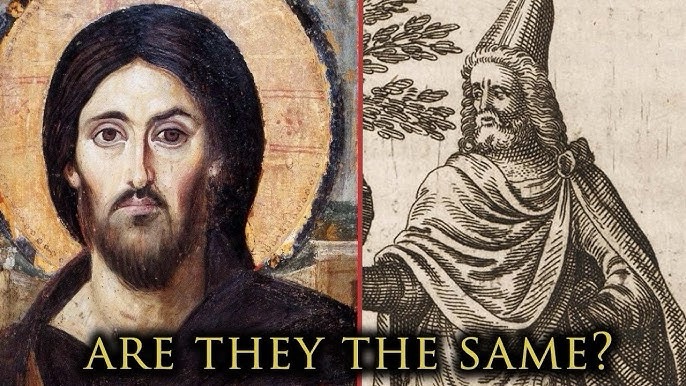
Across ancient religious traditions, cultures often shaped their gods and heroes around the same deep human longings—healing, resurrection, divine parentage, and the hope that suffering could be undone. In Greek mythology, Asclepius, the physician-god, embodied humanity’s desire to conquer death. In early Christianity, Jesus, described by believers not as a demigod but as God incarnate or God’s son depending on the theology, filled a remarkably similar symbolic role. When the two stories are placed side-by-side, the parallels become striking—not because one directly copies the other, but because human imagination tends to return to similar archetypes.
Divine Lineage
Asclepius is born of a mortal woman, Coronis, and the chief god Apollo, making him—within Greek terms—a demigod with divine gifts. His infancy is marked by drama: Coronis dies before his birth and Apollo rescues the child from her pyre, giving him over to the wise centaur Chiron to be raised.
The Jesus narrative, in Christian theology, is different in concept but similar in structure: he is born of Mary, a human woman, and the divine Father through miraculous conception. Though Christianity does not call Jesus a “demigod,” many outside observers have historically noted that the combination of divine paternity and human birth fits the broader ancient Mediterranean pattern.
The Healer Motif
Asclepius becomes the ultimate healer, taught every medical art, able to mend wounds, cure disease, and—eventually—raise the dead. This last power becomes his defining trait, the reason mortals flock to his temples and sleep in the abaton hoping to receive healing dreams.
Jesus’s story centers on healing as well: restoring the blind, curing the sick, raising the dead (Lazarus being the most famous example), and offering spiritual wholeness. His miracles elevate him beyond prophet or teacher—they mark him as a divine agent whose authority over life and death is absolute.
Both figures, in their traditions, are the embodiment of divine medicine: the idea that the divine directly intervenes to mend the broken.
A Death That Offends the Divine Order
Asclepius’s downfall comes because he takes his healing too far. When he begins resurrecting mortals, Zeus intervenes and kills him with a thunderbolt to preserve cosmic balance. The gods cannot allow immortality to spread unchecked.
Jesus, in Christian accounts, is executed not by divine decree but by earthly authorities; yet his death is still framed as necessary for a larger cosmic story. While Asclepius is struck down for reversing death, Jesus is killed so that death might be reversed for all believers.
Resurrection and Divine Elevation
After Asclepius is slain, Apollo protests, and the gods eventually restore Asclepius, raising him to full divinity. He becomes a god of healing, worshiped throughout the Mediterranean with serpent-entwined rods—symbols still used in medicine.
Jesus’s resurrection is the central miracle of Christianity: a divine validation of his message and identity. After rising, he ascends to sit at the right hand of God, an exaltation strikingly similar to the way Greek gods elevated a heroic figure into the heavenly realm.
Temples and Followers
Asclepius’s sanctuaries—Asclepieia—were healing centers where the sick sought cures through ritual, dreams, and the presence of the god. His followers spread across the Greek and Roman world, and many inscriptions record miraculous healings attributed to him.
Early Christianity likewise spread accounts of Jesus’s healing power, resurrection, and divine authority, building a community centered on faith, sacrament, and the hope of spiritual and physical salvation.
So What Do These Parallels Mean?
The similarities between Asclepius and Jesus don’t necessarily imply direct borrowing; instead they reveal a shared ancient archetype:
the divine healer, born in a blend of human and divine worlds, who conquers death and is ultimately exalted.
Humanity has always hoped for three things:
• that suffering can be healed,
• that death can be undone,
• and that a compassionate divine figure stands between human frailty and cosmic fate.
Asclepius embodied that hope for the Greeks. Jesus embodied it for early Christians—and still does for billions of people today.
Both stories, separated by culture but united by yearning, show how myth and faith evolve around humanity’s deepest fears and greatest dreams.
-
Paradox of mankind
Dwain Northey (Gen X)

The Planet With Everything… Except the Ability to Share
Isn’t it heartwarming to know we were born on a planet that comes pre-loaded—factory-stock, if you will—with enough resources to feed, house, and sustain every living being strolling, crawling, swimming, or photosynthesizing across its surface? It’s like Earth rolled off the cosmic assembly line with the deluxe package: oceans, forests, metals, fertile soil, an oxygen atmosphere—basically the universe’s version of an all-inclusive resort.
And somehow, somehow, despite this generational jackpot, humanity keeps acting like it’s trapped in a Costco on Black Friday with only three discounted TVs left.
We keep being told the problem is “resource scarcity,” which is adorable, because the actual scarcity is clearly “willingness to share.” Resources we’ve got; distribution we do not. It’s as though the species capable of splitting atoms, landing robots on asteroids, and making 47 varieties of oat milk cannot, for the life of it, figure out how to get food to hungry people or clean water to communities without a multinational corporation taking a cut first.
But the real fun begins when we ask why. Why can’t humanity do a task so simple even kindergarteners master it? (“One for you, one for me, one for the class…”) Ah, but in kindergarten we hadn’t yet unlocked the advanced skill tree of Ego, Greed, and Imaginary Hierarchies.
Somewhere along the evolutionary timeline—right between discovering fire and inventing cryptocurrency—we picked up the idea that some humans are just… more human than others. More deserving. More chosen. More “Ascended,” if you want to dress it in spiritual yoga pants. This convenient belief allows a handful to sit atop mountains of wealth that would make ancient pharaohs blush, while assuring the rest that, spiritually speaking, they obviously chose the “limited access” life plan.
Of course, if ego doesn’t quite explain it, we can always fall back on humanity’s favorite pastime: Greed, the sport in which the winners are the ones who hoard the most while insisting that scarcity is everybody else’s fault. It’s a beautifully circular logic: “There’s not enough because I have most of it, and because I have most of it, clearly I deserve it, which means you don’t, which proves there’s not enough.” Nobel-worthy reasoning, truly.
And the disparity—wow, it’s versatile! It works on every scale. Individuals? Check. Nations? Absolutely. Entire regions? Oh yes, we’ve globalized inequality like pros. It’s incredible that a species that can coordinate worldwide streaming for a new sitcom cannot coordinate getting clean drinking water to every human being. Maybe if basic necessities came with monthly subscription fees, we’d figure it out.
But maybe the real punchline is this: the planet isn’t failing us. The resources aren’t failing us. We are failing us—spectacularly, creatively, consistently. And we’re doing it while insisting we’re the most intelligent life form around, which is possibly the funniest part of the whole cosmic comedy.
One day, perhaps, humanity will collectively look in the mirror, realize the planet isn’t the problem, and decide to fix the distribution systems that currently function with the efficiency of a toddler managing a stock portfolio.
Until then, we’ll keep living on a planet that has everything… except the ability to share.
-
Sweet Little rhymes aren’t so sweet
Dwain Northey (Gen X)

Many of the sing-song verses we feed to children—bright, lilting, and seemingly harmless—are, on closer inspection, tiny time capsules of human horror. They survive because they’re catchy. They persist because they’re easy to remember. But beneath the rhymes and rhythms lie centuries of plague, executions, disasters, and political satire. It’s the world’s darkest history lesson, disguised as a lullaby.
Take “Mary, Mary, Quite Contrary.” The innocent image of a whimsical gardener hides a far grimmer figure: Mary I of England—“Bloody Mary.” Her “garden” wasn’t a peaceful patch of flowers but a metaphor for the growing number of protestors and dissenters executed under her reign. The “silver bells” and “cockle shells” weren’t gardening tools but, according to popular interpretations, references to instruments of torture. A cheerful jingle about horticulture? Not quite. More like Tudor-era religious violence with a rhyme scheme.
Then there’s “Ring Around the Rosie,” the deceptively cheerful circle game that children play while obliviously reenacting a pandemic. The “rosie” referred to the red-ringed rash of plague victims; the “posies,” herbs stuffed into pockets to fend off disease; “ashes, ashes,” a nod to mass cremations—or, in some versions, the sneezing that heralded illness. And of course, “we all fall down” does exactly what it sounds like. It’s a plague simulator disguised as recess entertainment.
But the darkness doesn’t end there.
“Rock-a-Bye Baby,” for instance, sounds tender—until you realize it describes a baby being blown out of a treetop cradle to its probable doom. Some trace the rhyme to the 17th-century English political climate, with the “baby” representing the infant heir James Francis Edward Stuart, and the “wind” symbolizing political upheaval that would eventually unseat the Stuart line. Others interpret it more straightforwardly: a warning about the dangers of placing infants anywhere except firmly on the ground. Either way, it’s less “peaceful lullaby” and more “catastrophic fall set to melody.”
“Humpty Dumpty” fares no better. Despite modern depictions of a jolly egg, the original rhyme never mentions eggs at all. Many historians believe Humpty wasn’t a creature but a machine—specifically a massive cannon used during the English Civil War. When the cannon fell from its fortification during a siege, “all the king’s horses and all the king’s men” really couldn’t put the shattered artillery back together again. Humpty Dumpty isn’t a clumsy egg—it’s a battlefield disaster sanitized into nonsense verse.
And even “Mary Had a Little Lamb,” the softest, sweetest of the bunch, carries a more sobering backstory. Based on a real 19th-century event in Massachusetts, it reflects early American educational norms and rural life. Mary Sawyer really did have a lamb that followed her to school—an unusual disruption that highlighted strict classroom expectations of the era. Less horrifying than plague or war, perhaps, but still rooted in a time when a farm animal wandering into an austere one-room schoolhouse was noteworthy enough to become cultural lore.
All these cute little rhymes—recited in preschools, printed on blankets, stitched onto baby clothes—are actually memorials to centuries of human suffering, fear, and political turmoil. Nursery rhymes endure because they slip into memory easily, carrying with them stories people once couldn’t write openly or speak safely.
The irony is almost poetic: the songs meant to soothe children are built from the ghosts of history, whispering through melody that the world has always been sharp beneath its soft edges.
-
Cold in December… See Global Warming is a Hoax
Dwain Northey (Gen X)

Somewhere right now, as the upper half of the continent is being flash-frozen under a December polar vortex so cold it could make a penguin file a workplace complaint, a group of self-appointed climate geniuses is triumphantly proclaiming: “See! This PROVES global warming is a hoax!”
Because nothing says “I deeply understand atmospheric physics” quite like confusing weather, a short-term local mood swing, with climate, the long-term behavior of an entire planet.
Apparently, if the human race had actually affected the climate by burning fossil fuels for 150 years like we’re hosting a global barbecue nobody asked for, then December in Canada should now resemble Miami Beach with moose. Anything less, and clearly the entire scientific community is just making things up for the frequent-flyer miles.
These are the same folks who believe that if your house is on fire but one room has not yet ignited, congratulations—the whole thing must be perfectly fine. Flames? Smoke? Rising temperatures? No worries. Just go stand in the pantry where it’s cool and declare victory over thermodynamics.
But the real triumph is the explanation for the unseasonable cold. How do they reconcile record lows with decades of data showing warming oceans, melting ice caps, and enough greenhouse gases to turn Earth into a slow cooker? Easy. They don’t. They just point to the thermometer, yell “Checkmate, liberals!” and consider the scientific method complete.
Meanwhile, actual climate scientists are standing there like exhausted kindergarten teachers trying to explain that warming the global climate also destabilizes the jet stream, which then causes—you guessed it—more intense polar vortex events. But good luck with that, because the moment you say “jet stream,” someone will respond, “Oh here we go with the conspiracy airline talk again.”
It’s truly remarkable: a group of people who will spend three days researching toaster reviews before buying anything at Walmart have zero hesitation dismissing an entire field of science because they had to scrape ice off their windshield this morning.
So yes, Canada is being deep-froze in December with record-breaking cold. Yes, it’s unseasonable. And yes, it is literally exactly the kind of extreme weather climate scientists have warned about for years.
But please—tell us again how if the planet were really warming, you wouldn’t need to put on gloves today. Tell us how the Earth, a 4.5-billion-year-old system with interconnected atmospheric and oceanic dynamics, must conform to the comfort settings of your thermostat or else the whole field of climatology collapses.
After all, nothing says “scientific credibility” like believing the global climate operates on the same principles as your local forecast app.
-
12/7/41
Dwain Northey (Gen X)

December 7 carries a weight that stretches far beyond a square on a calendar. Eighty-six years ago, in 1941, the quiet Sunday morning at Pearl Harbor shattered under the sudden roar of Japanese aircraft. The attack was not just a strike on a U.S. naval base in Hawaii—it was the spark that hurled the United States fully into World War II, altering the trajectory of the conflict and reshaping the entire world order of the mid-20th century.
Before that day, the U.S. was officially neutral, though tensions simmered beneath the surface. Many Americans wanted no part of another global war after the trauma of World War I. But at 7:48 a.m., when bombs fell and ships burned, neutrality became impossible. The attack killed more than 2,400 Americans and destroyed or damaged much of the Pacific Fleet. The next day, Congress declared war on Japan, and within days Germany and Italy declared war on the United States. In an instant, America went from reluctant observer to full-scale participant in the largest conflict humanity had ever seen.
What followed reshaped the world: the mobilization of the American economy, which became an industrial powerhouse; the island-hopping campaign across the Pacific; the liberation of Europe; the beginnings of nuclear weapons; and the eventual rise of the U.S. and Soviet Union as global superpowers. Pearl Harbor wasn’t just an attack—it was the hinge on which the 20th century swung.
And yet, for many millennials and Gen Z—through no fault of their own—December 7 can feel more like a trivia answer than a turning point. The distance of time, combined with the firehose of modern information, can blur the significance of even world-shaping events. But remembering Pearl Harbor isn’t about glorifying war; it’s about understanding the chain reactions of history. A single morning in Hawaii changed global alliances, battle strategies, economies, borders, and the lives of millions.
December 7 remains a reminder that the world can change in a moment, that decisions made oceans away can reverberate for generations, and that history—no matter how old—still shapes the world young people inherit today.


You must be logged in to post a comment.