Dwain Northey (Gen X)
https://www.cbsnews.com/news/naacp-travel-advisory-florida-says-state-hostile-to-black-americans/
Remember the good old days when there were only travel advisories and or ban for, what some would call, third word countries? Well now because of the vile vitriol of one Governor Ron DeSantis the state of Florida, a vacation destination, has received a travel advisory by the NAACP.
The wannabe future President has made the climate so venomous in Florida the anyone who is a part of any minority group does not feel safe in the state. Black, Brown, LGTBQ+, these are all groups that are under attack in the Sunshine State. The majority Republican legislature and their fearful leader has passed laws that make almost everything a jailable offence and the fact that the state has very loose gun laws and a stand your ground law makes it more dangerous than being a blonde female in central America.
Florida residents are able to carry concealed guns without a permit under a bill signed into law by Republican Gov. Ron DeSantis. The law, which goes into effect on July 1, means that anyone who can legally own a gun in Florida can carry a concealed gun in public without any training or background check. This with their ridiculous stand your ground law, ‘Florida’s “Stand-Your-Ground” law was passed in 2005. The law allows those who feel a reasonable threat of death or bodily injury to “meet force with force” rather than retreat. Similar “Castle Doctrine” laws assert that a person does not need to retreat if their home is attacked.’ Makes it really sketchy to go there.
This in top of the don’t say gay rule and the new trans ruling that just passed.
“Florida lawmakers have no shame. This discriminatory bill is extraordinarily desperate and extreme in a year full of extreme, discriminatory legislation. It is a cruel effort to stigmatize, marginalize and erase the LGBTQ+ community, particularly transgender youth. Let me be clear: gender-affirming care saves lives. Every mainstream American medical and mental health organization – representing millions of providers in the United States – call for age-appropriate, gender-affirming care for transgender and non-binary people.
“These politicians have no place inserting themselves in conversations between doctors, parents, and transgender youth about gender-affirming care. And at the same time that Florida lawmakers crow about protecting parental rights they make an extra-constitutional attempt to strip parents of – you guessed it! – their parental rights. The Human Rights Campaign strongly condemns this bill and will continue to fight for LGBTQ+ youth and their families who deserve better from their elected leaders.”
This law makes it possible for anyone to just accuse someone of gender affirming care to have their child taken from them this would include someone traveling from out of state. This alone justifies a travel ban to the Magic Kingdom for families.
Oh, and I haven’t even mentioned DeSantis holy war with Disney, the largest employer in the state. I really hope the Mouse eats this ass holes lunch.
Well that’s enough bitching, thanks again for suffering though my rant.
-
FELON 47 ADDRESSED THE NATION
Dwain Northey (Gen X)

In an hour and forty minute ’look how great I am’ address to the world, Donald did nothing but continue the rhetoric of one of his rallies.
His misinterpretation of how tariffs work was reminiscent to the middle school boys gym teacher that gets tasks with teaching sex ed to 12 year old girls.
Those of us that have volunteered to serve this country are disgusted that a draft dodging felon had the audacity to talk down to an elected leader that is actually fighting for the life of his nation. The mere notion that our support for an ally is transactional, and that they have to give us their natural resources for any kind of support against an enemy, trying to take their country from them, makes me nauseous.
The number of lies that Donny Dumbass told in 100 minutes would be humerus if it weren’t terrifying and dangerous to the United States and the World.
-
A little Catholic history
There were once three popes at the same time.
You’ve heard of The Young Popeand you’ve heard of The Two Popes, but did you know there were once three popes at the same time? The history of the papacy stretches back some 2,000 years and is full of oddities, few of which were more contentious than the Western Schism. It had its roots in the Avignon Papacy, a period that lasted from 1309 to 1376 and saw seven popes reside in Avignon rather than Rome. (Now a French prefecture, Avignon was then part of the Kingdom of Arles, which itself was part of the Holy Roman Empire.) Pope Gregory XI ended this period when he returned to Rome on January 17, 1377. After his death the following year, Romans rioted to bring about the election of a Roman pope.
Urban VI won, but proved so hostile to his cardinals that most of them regretted their decision and retreated to Anagni, Italy, to elect one of their own, Clement VII, as the antipope later that year. They declared Urban VI illegitimate because his election took place under duress. Clement VII resided in Avignon, with the two sides at a stalemate until the 1409 Council of Pisaelected a third pope, Alexander V, who was quickly succeeded by John XXIII following his untimely — and, according to some, conspiratorial, death the following year. Yet another council followed, this one taking place in Constance, Germany, from 1414 to 1418, ending the conflict for good. The Pisan and Avignon popes were deposed, the Roman pope agreed to resign, and Martin V was elected the one true pope.
-
Happy New Year in Ancient Greece
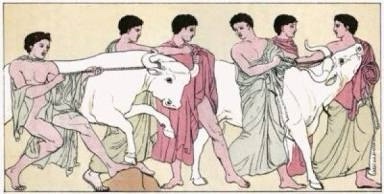
Today’s modern calendar comes with a lot of quirks, not least of which are the names of the last four months. Although September, October, November, and December seemingly begin with numeral prefixes, the numbers don’t match their place in the calendar. October, for example, is not the eighth month of the year, but the 10th. So what’s going on here? Well, blame the Romans.
Ancient Rome’s original calendar, which according to myth was created by the city’s legendary founder Romulus in the eighth century BCE, contained only 10 months. The year lasted 304 days, beginning in March (named for the Roman god Mars) and ending in December, the 10th month (marking the annual harvest). But because this calendar woefully underestimated the true length of a year, it was replaced with a new calendar by the Roman king Numa Pompilius around 713 BCE. The new calendar put the year at 355 days long, divided into 12 months, based on the cycles of the moon. It added the month of January to the start of the year and tacked on February at the end, though the latter eventually moved to its current position between January and March. This change threw the numerically named months (which at that point also included Quintilis and Sextilis) out of whack. Strangely, no one seemed to mind, and this quirk of the calendar has been with us ever since.
-
Voices from the Past

-
Who Wins In Recessions? The Rich And The Lucky

ByTeresa Ghilarducci, Senior Contributor. Teresa Ghilarducci Ph.D. is an Economics Professor.
While virtually everyone else has been struggling through the COVID-19 recession, billionaires have done well between March 18 and May 19. According to a report from the Institute for Policy Research and Americans for Tax Fairness, U.S. billionaires’ wealth grew by more than $400 billion over that period.
Consumer spending is down 7.6 percent in the first quarter of 2020 from the last quarter of 2019, but composition of consumer spending has changed. The demand for online shopping and news exploded Jeff Bezos’ wealth by over 30% to $148 billion (Bezos runs AmazonAMZN +1.7% and owns the Washington Post). His ex-wife’s wealth grew even more, by 33%. Bill Gates, Mark Zuckerberg, Warren Buffett, Larry Ellison, Michael Bloomberg, and some Walton heirs also have done well in the two months since the shutdown orders in the United States were put in place and an estimated 50 million Americans have lost their jobs.
Another odd phenomenon is that average workers’ pay actually increased in April, with average weekly earnings rising from $804 a week to $842. This is odd because wages and salaries usually fall or remain stagnant when there is surplus labor, and in March and April there were more people looking for work than jobs available.
The reason for the increase in average pay: low-income workers disproportionately lost their jobs and high-income workers kept theirs. In April, the low-paid leisure and hospitality sector lost half of its employment. Meanwhile, the finance sector lost hardly any jobs. High-income workers are usually a bit more secure in recessions. But economies are interdependent and in the last recession high-paid workers, especially those in finance, lost their jobs.
In this recession, the worst since the Great Depression in the 1930s, high-income workers are more likely to keep their jobs and billionaires are seeing their fortunes grow. In short, the COVID-19 recession is causing more inequality. Even Federal Reserve Chair Jerome Powell felt compelled to point out the growing inequality. As the Fed noted in May, 40% of those earning under $40,000 will lose their jobs in the COVID-19 recession.
The wealthy are always more likely to win in recessions, as NYU economist Edward Wolff has found. During recessions, wealth and income inequality grows. And as economist Hilary Hoynes and others have discovered, poor and indebted households are affected much more by business cycles. Future research will likely find similar effects from the COVID-19 recession.
Another awful and quite pronounced effect of this recession is how it will worsen gaps in mortality. Longevity inequality was already growing before the pandemic because of the uneven access to health care, health care disparities, and unequal access to healthful living places with fresh air, fresh food, and walkable places. Those most at risk of dying early are also those more severely affected by this recession, due to the effect of the virus on those with diabetes and other co-morbidities.
The winners in all recessions are the people who keep their jobs and hours, can work at home, and those with excess cash and wealth to snap up what owners needing cash sell: lower-priced small business, lower-priced stocks and bonds, and perhaps even a lower-priced house or two. The COVID-19 recession will cause more wealth, income, and health inequality.
-
Guess we are part of the Access now
Dwain Northey (Gen X)

So Felon 47 has gone 100% Kremlin… Our current administration signed on with Belarus, North Korea, and Russia condemning Ukraine for Russia’s invasion of its sovereign country. Yesterday in the oval office, Trump belittled the duly elected president of Ukraine pretty much telling him that we are not on his side, and we will not help him, his option is surrender. When did we start siding with the invaders and no those that are fighting to defend their country?
The King Donald version of the Bible and Constitution is Fuck the Poor and needy, expel the stranger, oh and by the way if you happen to have $5millions our doors are open. This is not the nation and its values I was raised in and I am very sad for our future if this is the path we are on.
-
Be Gone Elon
Dwain Northey (Gen X)

The unelected South African that has been given carte blanche to dismantle our government needs to be sent back to where he came from. The majority of us have zero impact on this maniac but continuing to disparage Tesla by calling the cars SwastaCars and the CyberTruck the DouchePanzer is a start.
Canada stated a petition to remove Musk Canadian citizenship, even though he is not a Canadian citizen, it sends a message that they want nothing to do with this Bond Villain.
We are letting 2 trust fund fools cut funds from government agencies like hedge fund managers dismantling their latest acquisition. Donny who bankrupted multiple companies to include Casinos and Elon who bought Twitter for $44 billion and the platform is now worth $7 billion… amazing if they want to run government like a business the mission must be total destruction. Crazy that with all the waste and fraud DOGE is supposedly finding none of it is in the billion dollar contracts that Elon has… I am sure the is no conflict of interest there…
Send the South African apartheid trust fund baby back to South Africa.
-
Cuts or just a guillotine
Lyle Northey (Silent/Boomer)

We have yet to see enough pushback by the members of Congress. The republican side seems to think that the idea of calling Trump out is that he will get the money to see to it that you do not get reelected. Continue as you are and the chances are you will be eliminated and that will give you no place to go. Say what you want but chances are as everything is turned over to his nibbs your job opportunities will get less and less as the government dries up and downsizes. Your job is in danger because you are there to govern and when you are no long there or the job is no long there then where do you suppose that leaves you? It is sad to say but even an idiot should be able to see this coming. Trump and Musk are dead set on destroying everything that gets between them and personal gain, so the members of Congress are an inconvienent bump in the road. One man rule is pretty much what he is shooting for and if you do not stop him he will achieve that goal very quickly. The cabinet picks you people have put in place are going to do as they are told, and it seems that members of the republican party seem to think they will stay safe as long as they do as they are told. Look at the cuts that have been made so far, no one is exempt from the chopping block. Nothing has stopped him from getting rid of programs and agencies that help people, red state or blue state, no difference that has not saved much. Wake up and smell the coffee before it is too late. The police nor the military owe him loyalty. Sure there are some that will follow but if the military follows the rule of the UCMJ then they do not have to obey orders from someone that is drunk, or mentally ill, and sick in the head is what sits in the WH. Between the Supreme Court granting immunity and the unvetted headhunter that is working with him, Trump has beecome the worst, most dangerous, and stupidest person to ever occupy the highest office in the land. His first term in office was fueled by the fact that he wasn't in politics and he was running against a woman. The belief that someone that knows nothing about the inner workings of government is qualified to run the nation is flawed just as is the belief that a woman, even one that has been in politics, is not capable of doing the job. Both are stupid points of view. The Trump administration is proving that stupid people in jobs they are not knowledgeable of is a bad move, look at all the crap that is going on with the cabinet selections. Then we have the supposed money saving of cutting or gutting various agencies and programs so that we can give rich people more money. One of the rich people that wants more money is Trump in the form of the government paying for his legal fees because he keeps being sued for being stupid. Again it is amazing to me that any person that took an oath to the Constitution would willingly work for this administration, they should be doing everything they can to dismantle it. The first time Trump was elected people went crazy with having to fight to keep or reenstate programs that were on his chopping block, and they did not listen to his speeches or they would have been aware that all this was going to happen. The fact that he now has made comments to the effect that they cheated to win does not help the current situation except to highlight the danger of doing the same stupid thing over and over and expecting a different outcome. The current state of the world has caused the majority of us to realize that if we are looking for the best in people we will be disappointed more often than not, and we do not have to hunt for the worst in people because that confronts us at every turn. Morgan Freeman made a comment on an interview that we can choose our course be either looking for fear or looking for faith, he chooses faith, what is your choice? -
People First (ok wealthy people first)
Dwain Northey (Gen X)

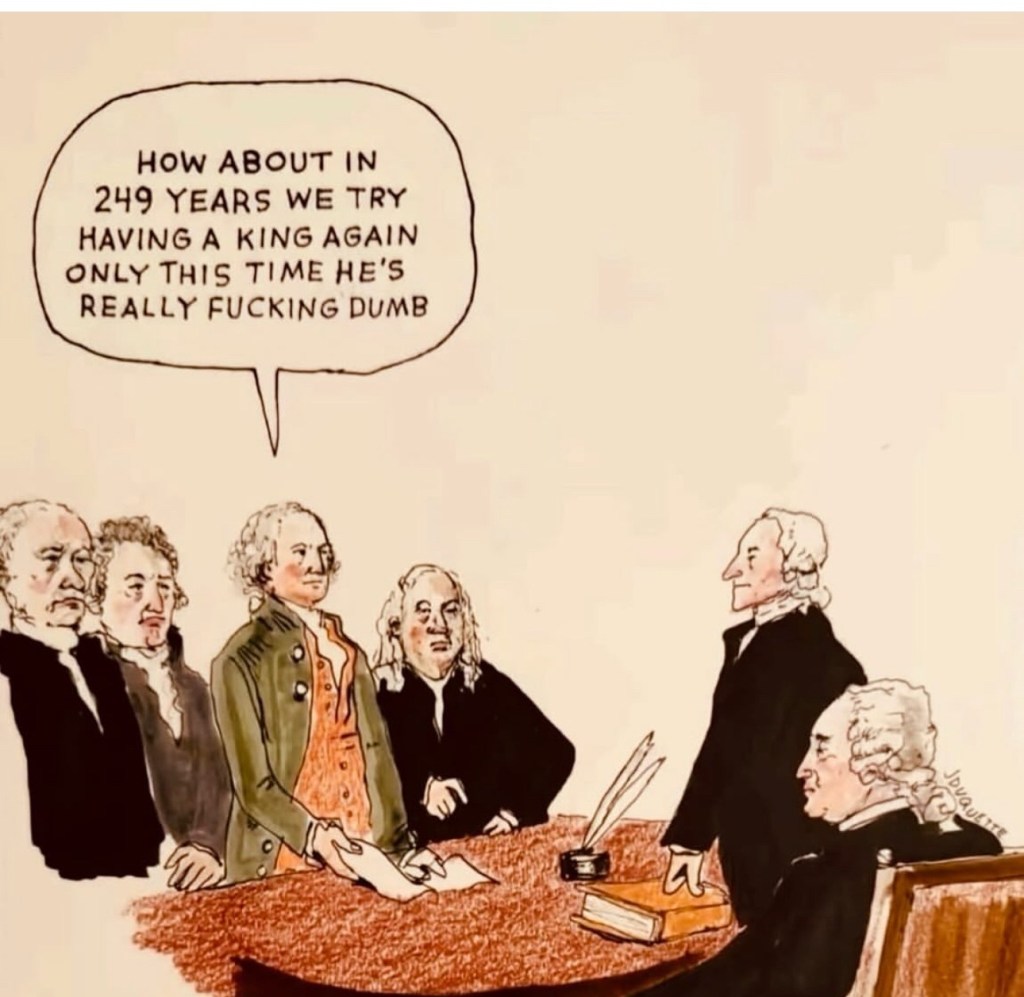
The House Trumpulicans have passed the blueprint for their budget. This plan has put everything that helps Americans that make less than 7 figures on the menu and will do nothing to reduce our debt or deficit.
If you can’t pay for private school for your kids, or for nursing care for elderly parents or even for your own medicine… well that’s just too bad because the ultra wealthy need another tax cut. Don’t be fooled if you have to work you will still be paying taxes but chances are you will not see one benefit… roads will crumble and planes will crash because that budget has been cut. More fentanyl will cross the boarder because USAID that helped control the raw materials needed for the drug have been removed .
Let’s just go back to the world or Oliver Twist, where roaming gangs of children will pick pockets so they can eat…. Thanks Donald and your Trumpubicans for making America Weak and Hated, just what our founders hoped would happen 😢
-
Ancient Emojis

You don’t need to have a complete understanding of exactly how hieroglyphs function amid the rules of grammar in order to find them fascinating, though. Many symbols represent items that in turn provide glimpses into life in ancient Egypt and its advanced state as a civilization. The following hieroglyphs do just that — and we’ll use the names and reference points from Gardiner’s list to help illuminate them.
Ancient Egyptian hieroglyphics have long captured the imaginations of scholars and casual observers alike, and efforts to translate them date back to the ninth century CE. Yet hieroglyphics remained mostly indecipherable until the discovery of the Rosetta Stone in 1799. Early progress was made by English polymath Thomas Young in the 1810s, and French linguist Jean-François Champollion completed a breakthrough translation that he presented in Paris on September 27, 1822.
The accuracy of Champollion’s translation was a watershed moment that enabled a greater understanding of hieroglyphs, leading to deeper and wider-ranging study. In 1927, English Egyptologist Alan Gardiner published the reference work Egyptian Grammar, which included an appendix compiling the major hieroglyphs and their meanings, known as Gardiner’s Sign List, a reference standard still used today.
You don’t need to have a complete understanding of exactly how hieroglyphs function amid the rules of grammar in order to find them fascinating, though. Many symbols represent items that in turn provide glimpses into life in ancient Egypt and its advanced state as a civilization. The following hieroglyphs do just that — and we’ll use the names and reference points from Gardiner’s list to help illuminate them.


You must be logged in to post a comment.