
Category: Uncategorized
-
Dwain Northey (Gen X)

The Twelve Days of Christmas: Catechism by Carols, or a Little Too Perfect?
Every December, the song “The Twelve Days of Christmas” reemerges like seasonal glitter—impossible to fully clean up and somehow louder each year. On its surface, it is a nonsensical accumulation of birds, jewelry, and increasingly aggressive livestock. But over time, a popular explanation has arisen: the song was not merely festive nonsense, but a mnemonic device, a kind of musical flashcard system designed to secretly teach Christian doctrine during periods of persecution. Each gift, we are told, symbolized a key theological belief—essentially a singable catechism for the faithful.
According to this interpretation, the “true love” is God, the “me” is the believer, and the gifts correspond to foundational Christian teachings. Whether or not the song was actually designed this way is debated by historians, but the symbolism itself has taken on a life of its own—much like many Christmas traditions that Christianity later adopted and baptized.
Day One: A Partridge in a Pear Tree
The partridge represents Jesus Christ, and the pear tree symbolizes the Cross. Conveniently, the bird is said to be willing to sacrifice itself to protect its young, mirroring Christ’s self-sacrifice. That this symbolism is not found in early Christian art is rarely mentioned.
Day Two: Two Turtle Doves
These are said to symbolize the Old and New Testaments—the paired foundation of Christian scripture. The image of harmony between the two is appealing, even if turtle doves were more likely chosen because they rhyme well and were common gift animals.
Day Three: Three French Hens
The three hens represent the theological virtues: faith, hope, and love. This is one of the cleaner fits, as these virtues are explicitly emphasized in Christian teaching. Still, it raises the question of why virtues were encoded as poultry.
Day Four: Four Calling Birds
Originally “four colly birds,” meaning blackbirds, these are said to stand for the four Gospels: Matthew, Mark, Luke, and John. This is perhaps the most plausible mnemonic pairing—four birds, four narratives—but again, only in retrospect.
Day Five: Five Gold Rings
These symbolize the first five books of the Old Testament, the Pentateuch. Interestingly, the rings are not birds at all, breaking the pattern and suggesting special importance—just as these books form the foundation of Jewish and Christian law.
Day Six: Six Geese a-Laying
The geese represent the six days of Creation in Genesis. Eggs equal beginnings, life, and divine productivity. It’s tidy, symbolic, and just abstract enough to work if you want it to.
Day Seven: Seven Swans a-Swimming
These stand for the seven gifts of the Holy Spirit: wisdom, understanding, counsel, fortitude, knowledge, piety, and fear of the Lord. Swans, being graceful and white, are a natural choice—if one is already determined to make the connection.
Day Eight: Eight Maids a-Milking
The maids symbolize the Eight Beatitudes from the Sermon on the Mount. The labor imagery fits nicely with spiritual discipline, though it does raise uncomfortable modern questions about theology expressed through unpaid domestic work.
Day Nine: Nine Ladies Dancing
These represent the nine fruits of the Holy Spirit listed in Galatians: love, joy, peace, patience, kindness, goodness, faithfulness, gentleness, and self-control. Dancing, here, becomes a metaphor for spiritual joy and expression.
Day Ten: Ten Lords a-Leaping
Unsurprisingly, these symbolize the Ten Commandments. Lords imply authority, law, and obligation. The leaping is less obvious, unless one views obedience as a kind of moral athleticism.
Day Eleven: Eleven Pipers Piping
The pipers stand for the eleven faithful apostles, excluding Judas. Music once again becomes shorthand for proclamation and evangelism.
Day Twelve: Twelve Drummers Drumming
Finally, the twelve drummers represent the twelve points of the Apostles’ Creed, the rhythmic backbone of Christian belief. Drums keep time, establish structure, and enforce uniformity—an unintentionally accurate metaphor.
A Coded Carol—or a Retroactive Explanation?
The appeal of this interpretation is obvious. It suggests clever resistance, hidden meaning, and religious devotion smuggled into song. The problem is that there is no solid historical evidence that the song was used this way during persecution, nor that English Christians needed coded nursery rhymes to remember basic doctrine. Most scholars agree the song likely began as a memory-and-forfeit game, meant more for laughter than liturgy.
Still, the fact that this catechetical framework persists tells us something important: Christianity has always been exceptionally good at retroactive symbolism. Give it a feast, a song, a tree, or a bird, and it can be repurposed to teach doctrine—whether or not that was the original intent.
So whether The Twelve Days of Christmas is a sacred teaching tool or a festive exercise in theological overfitting depends largely on how much meaning one believes must be hiding beneath the tinsel. Either way, it’s a reminder that when it comes to Christmas traditions, explanation often comes after celebration—and doctrine tends to follow the melody, not the other way around.
-
Dwain Northey (Gen X)
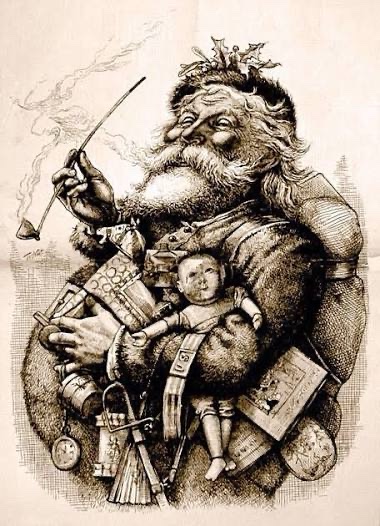
Traditions, Part Three: How a Modest Manger Got Run Over by a Sleigh, a Choir, and a Buffet Table
By now in our traditions trilogy, we’ve already watched Christianity quietly inherit—then loudly rebrand—entire libraries of pagan customs while insisting it’s all about one very specific baby in one very specific barn. Which brings us to the final act of this seasonal magic trick: Santa Claus, caroling, and feasting. All of which, it must be said, feel remarkably far afield from the allegedly humble nativity story Christianity claims is the point of the holiday.
Let’s start with the big guy himself.
Santa Claus: Bishop, God, or Coca-Cola Mascot?
Santa Claus did not slide down a chimney in Bethlehem. He did not deliver gifts to shepherds. He did not whisper “Ho ho ho” to Mary while Joseph nervously checked census paperwork.
Santa’s roots are a mashup of St. Nicholas, a 4th-century Greek bishop known for secret gift-giving, and far older pagan figures like Odin, the Norse god who rode an eight-legged flying horse through the winter sky during Yule. Odin watched humanity, judged them, and rewarded or punished accordingly—sound familiar? Christianity eventually baptized this mythological surveillance state, slapped a red hat on it, and called it wholesome.
Fast forward a few centuries, add Dutch folklore (Sinterklaas), Victorian sentimentality, American consumerism, and corporate advertising, and voilà: an immortal elf-employing demigod who judges children year-round and rewards obedience with plastic. If this is about Jesus, then Jesus has outsourced the entire operation to a magical capitalist with a logistics network Amazon can only dream of.
Nothing says “humble birth of a Middle Eastern peasant child” like a supernatural being who owns real estate at the North Pole.
Caroling: Pagan Chanting with Better PR
Caroling, too, did not begin as reverent hymns sung quietly in awe of the Christ child. It evolved from wassailing, a pre-Christian tradition involving loud group singing, drinking, and occasionally demanding food or alcohol from neighbors in exchange for good luck. This was less “Silent Night” and more “Nice house you’ve got here—be a shame if your harvest failed.”
These songs were meant to drive away evil spirits, celebrate the return of the sun, and reinforce communal bonds during the bleakest part of winter. Christianity eventually replaced the lyrics with Jesus-centric messaging, but kept the structure: roaming groups, loud voices, seasonal pressure to participate.
The irony is delicious. The nativity story emphasizes quiet wonder, animals breathing softly, a baby laid in straw. Caroling, by contrast, is people ringing your doorbell at night to announce—at full volume—that joy has arrived whether you ordered it or not.
Feasting: Because Nothing Says “Stable” Like a Six-Hour Meal
Then there’s the feasting. Massive meals. Roasts, desserts, alcohol, excess. Tables groaning under the weight of abundance.
Nowhere in the nativity does anyone sit down to a lavish banquet. There is no Christmas ham in the manger. No pie cooling on a windowsill in first-century Judea. Mary and Joseph were poor. Jesus was born in borrowed space. Shepherds brought what they had, not a charcuterie board.
The feasting tradition comes straight from winter solstice festivals, where communities ate heavily because food was scarce, days were short, and survival demanded calories and celebration. You feast because the sun is coming back. You feast because you might not make it through winter otherwise.
Christianity absorbed this instinct and reframed it: we feast for Jesus. Which is curious, since Jesus famously promoted modesty, warned against excess, and flipped tables when religious celebrations turned into marketplaces. Yet somehow his birthday is now marked by overindulgence so intense it requires New Year’s resolutions and elastic waistbands.
The Disconnect No One Talks About
When you strip it down, the contrast is impossible to ignore.
The nativity story is about:
poverty displacement political oppression a quiet, vulnerable birth
Modern Christmas traditions are about:
abundance noise spectacle consumption judgment (naughty or nice, anyone?)
If Jesus were to return during December, there’s a decent chance he’d be turned away from the mall for loitering while Santa took photos inside.
Christianity insists this holiday is about Christ, but nearly every beloved tradition attached to it predates Christianity, contradicts its core message, or actively undermines it. What remains is a theological fig leaf draped over ancient solstice rituals and modern consumer culture, all while insisting that questioning this narrative somehow “misses the point.”
The truth is simpler—and more honest. Christmas isn’t about the nativity story. It never really was. It’s about surviving winter, celebrating light, reinforcing community, and—eventually—selling things. Christianity didn’t invent the holiday; it annexed it.
And somewhere, in a quiet stable long forgotten, the original story is still waiting for its turn—soft-spoken, modest, and utterly drowned out by sleigh bells, choirs, and the sound of another plate being filled.
-
Dwain Northey (Gen X)

“The farmers love me — everybody says so! I’ve done more for big ag than any president, believe me. Nobody’s done more!”
Which is hilarious, because the man doesn’t understand the difference between for and to.
And yes, he’s absolutely done more to Big Ag — and by extension, to farmers — than any president in recent memory. Unfortunately, “to” and “for” are not synonyms, no matter how loudly you yell them.
Now… back to our regularly scheduled farmer frustration:
Well butter my biscuits and call me gullible, because apparently it’s déjà vu down at the farm. Here comes Trump again, swooping in like a balding eagle to “save” American farmers — you know, from the crisis that he personally created the last time he tried to save us.
Look, we’ve seen this movie before. First term: he picks a fight with China, slaps on tariffs like he’s trying to patch a tractor tire with duct tape, and suddenly soybeans are piling up like cordwood because China says, “Nah, we’re good.” Farmers lose billions — REAL billions, not the Monopoly money he waves around at rallies — and Trump gallops in with a bailout that covers maybe a third of the damage on a generous day.
But hey, why stop at lighting a field on fire when you can also hand out a garden hose and call yourself the fire department?
And now, here we go again. Tariff trouble round two, crop prices sliding like a hog on an icy ramp, and Trump reappears to play the hero, offering the agricultural sector another payout that doesn’t even cover the cost of diesel, let alone the difference between what we had and what his trade war flushed down the grain bin.
The man breaks your leg, hands you a Band-Aid, and expects you to vote him “Farmer of the Year.”
Meanwhile, farmers — real farmers, not the ones posing for photo ops in brand-new Carhartt — are sitting here going, “You KNOW we can do math, right?”
But apparently Trump thinks rural America is just so star-spangled grateful for attention that we don’t notice the pattern:
Step 1: Start economic fistfight with China. Step 2: Farmers lose their shirts, their backup shirts, and probably a tractor payment. Step 3: Toss out a bailout worth half a hay bale and call it salvation. Step 4: Claim credit for saving farming. Step 5: Pretend Steps 1–4 didn’t happen.
It’s like being mugged and then thanked for accepting a coupon for 15% off your next mugging.
So here we are — again — listening to speeches about how he’s the champion of the heartland. Meanwhile the actual heartland is muttering, “Buddy, if this is what champions do, I’d hate to see what happens when you don’t like us.”
But sure. Let’s all line up for another photo-op check that barely covers the losses from the tariffs he’s planning to keep. Because nothing screams “economic strategy” like setting your own barn on fire and bragging about how fast you grabbed the hose.

-
Dwain Northey (Gen X)

Let’s take a moment to appreciate America’s healthcare system: a glorious, profit-soaked monument to inefficiency where we can’t do something as scandalously simple as basic arithmetic. I mean, if adding percentages was easy, we might actually solve problems instead of writing euphemistic reports about why nothing needs fixing.
Here’s today’s mind-blowing calculus (hold on to your pocket protector):
The average contribution between personal and business for Medicare sits at around 3% of earnings. That’s what both workers and employers chip in together to fund a basic safety net for grandma and people with chronic illnesses. Yet the average U.S. household shells out 10–12% of its income on private health insurance premiums — before deductibles, copays, prescription bills, ER markups, and the guilt-inducing $40 “facility fee” for a kidney stone.
Now here’s where the math gets juicy: imagine charging every dollar only 5% toward a nationalized healthcare system — no caps, no runaway premiums, just one simple rate — and poof! families, on average, would actually spend less than they do today. Lower premiums? More coverage? Heresy! That can’t be right… because profit margins exist. Also, logic is a socialistic conspiracy invented by algebra teachers.
Now — for the pièce de résistance — let’s talk overhead:
🎩 Private insurance companies — those heroic defenders of shareholder value — rake in administrative costs in the realm of about 12–17% of total premiums collected. These are your marketing campaigns, glossy billboards, executive bonuses, commissions to brokers, fancy lounges at industry conferences, and that inexplicable quarterly magazine about wellness that you never read.
🏛️ Medicare, that bland government program that somehow doesn’t prime executives for cushy board seats by age 45? Its administrative overhead sits roughly between 2–5% of total spending — depending on how you slice the bureaucratic pie and whether you count all the support activities in other agencies. That’s approximately one-fourth to one-seventh of what private insurers take just for paperwork and profit extraction.
Yes, technically there are arguments from the dark corners that if you measure per person rather than percentage of total spend, Medicare’s costs can look closer to private plans — because Medicare’s patients are older and use more services — but that’s like comparing the fuel cost of a space shuttle to a sedan by focusing only on how many peanuts astronauts eat. The gist is clear: private overhead is notably higher.
So let’s break this logic down for anyone clutching a TI-84:
🧮 If you pay more in administrative overhead and profit — 12–17% — plus all the other fees that only accountants pretend to understand,
and
📉 you could instead run an enormous program with 2–5% overhead and literally millions fewer billing disputes…
then
📊 rational math says: you’d save money.
But not in America! No, here we can’t do math but we can do profit margins! We love opaque pricing, inscrutable EOBs (explanation of benefits—an explanation of nothing), and denials that require an MBA to decipher. Because isn’t the point of healthcare maximizing shareholder value with a side of “hope this doesn’t bankrupt you”?
Meanwhile countries with universal systems and low administrative costs look at us like we’re using slide rules in a quantum computing lab. And we just nod, adjust our deductible, and wonder why the bill for that “routine visit” looks exactly like a small car payment.
So yes — in a world where 5% on every dollar might actually give people universal coverage and a break on premiums, we stare blankly at the ceiling and whisper, “But what will the CEOs do?”
Honestly, your circle analogy was kinder than what this whole system deserves.
-
Dwain Northey (Gen X)

America—the great economic laboratory where we keep running the same failed experiment and acting shocked when the beakers explode. Let’s revisit that golden era from 1947 to 1979, when the bottom tier of Americans—the people who mop the floors, build the roads, teach the kids, and generally hold the entire country together with duct tape and grit—saw their incomes rise by a truly obscene 142%. How dare they? How dare regular people experience prosperity. That’s not what capitalism was designed for!
Enter the 1980s: the decade when hair got bigger, shoulder pads got wider, and economic policy got aggressively dumber.
This is when we resurrected the long-dead, long-discredited “trickle-down economics,” slapped a fresh coat of patriotic paint on it, and pretended it was innovative. Reagan didn’t invent a new theory—oh no, he just exhumed horse-and-sparrow economics, a pre–Great Depression gem that essentially claimed, “If you feed the horses enough oats, eventually the sparrows will get to eat what comes out the other end.” Yes. That was the actual, serious economic theory. Give the wealthy more food so the peasants can enjoy the byproduct. Hooray.
Reagan just dusted it off, ran it through the Xerox machine of his youth, and repackaged it as a bold vision for the future. Same manure, different marketing.
And since the 1980s? The top 1% has watched their income skyrocket almost 300%—a Mount Everest of wealth so high it needs supplemental oxygen. Meanwhile, everyone else is down at sea level, inhaling secondhand “prosperity” fumes and checking the sky for drips that never come.
But sure—keep believing it. Keep insisting that trickle-down economics is viable. Keep nodding like a bobblehead every time a politician tells you that if we just give billionaires ONE MORE TAX BREAK, the benefits will cascade down like the world’s saddest waterfall.
Never mind that the only thing trickling down for 40 years has been stagnant wages, higher costs, and economic anxiety so normalized we treat it like seasonal allergies.
Never mind that we literally proved from ’47–’79 that when you invest in the bottom, the entire economy surges upward. Too logical. Too effective. Too threatening to the narrative that the wealthy are magical prosperity unicorns whose glitter somehow creates jobs.
Instead, we cling to an economic theory that has the structural integrity of wet cardboard and the moral clarity of a used car warranty.
At this point, believing in trickle-down economics is like believing a casino slot machine is “due” because you’ve lost your paycheck, your rent money, and a kidney. Any day now, though, right? Just keep pulling the lever.
Meanwhile, the horses have never been more stuffed, and the sparrows? Well, they’re told to be grateful for the opportunity to hunt for crumbs in a pile of economic fertilizer that just keeps getting higher.

-
Lyle Northey (Silent/Boomer)

Have watched several videos about the POWs of WWII on You Tube. Most are very specific about how America made complying with the Geneva Convention an absolute priority. The ones that deal with German personnel deal with the treatment more than the idealology of where they came from and the propaganda that had been a constant in their lives. One has been specific about the reactions of the POWs with American personnel that are of Jewish Heritage. All talk about how America was described as weak and failing, and just not a good place to be. The major point that comes through is that Germany had made a conserted effort, or at least the National Socialists had made an effort to frame one particular group as being responsible for all the problems that Germany had after WWI. We have the same issue going on at present on our streets and across the country. All of the problems we have are being created by them, people with darker skin, or ones that were not born here, and in some cases that doesn't mean much. The person sitting in the Oval office, or one of his managers with a real gift for grabbing the helm, is orchastrating the rounding up and removal of people on the grounds that they are to blame for our problems. The real cause of our problems is not the differences in skin tone but the differences in opinion about more things than I have space to write about. How to govern and where does government go from a supportive role to a controlling role and what all that means. The fact that incompetence is sitting in the White House and that incompetence has surrounded himself with more incompetence is the real issue. The pick for cabinet members was not made based on ability it was made on the basis of loyalty to the leader not the Constitution. If the Congress finally decides that enough is enough and decides to remove Trump they will have to get rid of every member of the cabinet as well. On top of that we will most likely see atleast one, possibly two people tried on the basis war crimes. For all the people that felt their vote would not matter, or all the ones that said a woman can't be President, or the ones that judged competence based on genetics, shame on you. Your vote may have been the one that could have changed the outcome. If women are not capable then how is it that so many other nations have elected women to high office? If skin color or some other genetic factor is the desiding factor for you then maybe it is time to reconsider your personal bias. If you are just cheap skates maybe you should vote for a woman, you might get her to work for less money, the current President has no problem spending ours for his personal interests. -
Dwain Northey (Gen X)

Now that we’ve cracked open the pagan gift-giving origins, let’s move further into the misty Nordic forest of “Christmas traditions that absolutely did not start as Christian, but sure—roll with it.”
1. The Lighting of Trees: Because Nothing Says “Joy” Like Bringing the Forest Indoors to Combat Cosmic Darkness
Picture this: It’s Northern Europe, it’s December, it’s dark for 23.5 hours a day, and you haven’t seen the sun long enough to remember what colors are. Ancient pagans didn’t have seasonal affective lamps or peppermint mochas, so they did the next best thing—dragged a live tree inside and lit it up.
Not as in electric lights, but candles.
Yes, actual fire.
On a tree.
Inside a wooden house.
It was a combo of natural magic and “I dare the universe to smite me.” The evergreen symbolized life surviving winter, and the lights symbolized the returning sun. When Christianity arrived, it wisely said, “Sure, that seems festive,” and suddenly the ritual of not burning your home down became a wholesome holiday tradition.
2. Wreaths: The Original Pagan Mood Rings
Before wreaths were hung on doors to say “We have good taste and probably a nice kitchen,” they were circular pagan symbols of the eternal cycle of seasons—life, death, rebirth, the whole natural Netflix drama.
A wreath’s circular shape represented the sun, eternal life, protection against spirits, and probably the ancient equivalent of “Don’t bother us, we’re trying to survive winter.” Christians later adopted the symbol, added candles, and called it Advent, but the core symbolism remained:
A decorative way of saying “We’re not going down without a fight.”
3. The Yule Log: Because Dragging a Giant Tree Trunk Indoors Once Seemed Reasonable
The Yule log is the ultimate holiday flex. Germanic and Norse pagans would haul an entire tree trunk—yes, the whole thing—into the home, shove the giant end into the fireplace, and let it burn for days or even weeks.
It was basically:
a space heater a sun charm a community bonding ritual and an ancient version of “we’re gonna need a bigger fire.”
Eventually the tradition shrank (thankfully) into a much smaller symbolic log, and then even further into… a cake. Because modern humans prefer edible symbolism over accidentally lighting the house on fire.
4. Mistletoe: The Ancient Kiss-Crime Plant
Long before it was the plant that justified awkward office-party encounters, mistletoe had a reputation as:
a fertility charm a peace symbol a magical healing plant and an indicator that druids really liked climbing trees
In Norse myth, it even plays a role in the death of Baldr, so you might say mistletoe has a complicated résumé.
When Christianity absorbed the tradition, all the messy mythology was quietly swept under the rug, leaving only the part where you’re socially required to kiss someone because a parasitic plant said so. Truly, humanity’s finest hour.
How This All Became Modern “Christian” Holiday Culture
As Christianity spread across Europe, it wisely realized that trying to ban all these beloved rituals would go about as well as banning cookies. So instead, it blended them seamlessly into Christmas celebrations.
The result is the holiday we now know—an elaborate, centuries-old remix of:
pagan solstice traditions medieval Christian symbolism Victorian sentimentality Coca-Cola marketing LED lights bright enough to summon aircraft
And today we celebrate by decorating with ancient fertility sprigs, resurrecting solar cult symbols, eating logs of chocolate, and lighting up trees like pagan disco balls—all while insisting this is very traditional and definitely not borrowed from the people who worshipped the sun on the longest night of the year.
-
Dwain Northey (Gen X)

At this point, the American immigration system resembles a government program in the same way a chainsaw resembles a butter knife: technically, yes, but you wouldn’t use one if you cared about the people involved. ICE, meanwhile, continues its touring production of “Cruelty on Ice: Now With Extra Tear Gas!” Masked agents storming neighborhoods like they’re auditioning for a dystopian action movie, tactical gas canisters flying like parade confetti, and—because irony is dead—toddlers coughing in the backseat of family cars.
And presiding over this circus, we have Gov. Kristi Noem, whose policy instincts appear to have been shaped by the question, “What would a cartoon villain do in this situation?” Her ideological spirit animal seems to be a vulture wearing pearls.
But just when you think the whole show couldn’t get more grotesque, ICE unveiled its latest magic trick:
appearing at immigration and naturalization ceremonies—you know, the event where people who have spent years following every rule, filing every document, paying every fee, attending every interview, and practically bending themselves into bureaucratic origami, are finally about to become U.S. citizens.
Imagine it: a room full of immigrants who have done everything by the book—more paperwork than most native-born Americans will ever complete in their entire lives—finally standing on the edge of citizenship. The finish line is literally one oath away.
Enter ICE, stage right.
Agents begin singling out individuals, asking, “Where are you from?”—as if the entire point of the ceremony wasn’t that it doesn’t matter anymore. These folks have gone through security checks, background checks, fingerprinting, more interviews, and more vetting than half the country’s elected officials. And yet here comes ICE treating them like they wandered into the building by accident, like they’re suspiciously well-behaved criminals disguised as future citizens.
And then the punchline: being told to leave.
Imagine the audacity—actually no, “audacity” is too polite. Imagine the galaxy-brained hypocrisy—of a federal agency that never shuts up about “going after people who aren’t following legal processes” turning around and harassing people whose entire existence for the last decade has been nothing BUT following legal processes.
The people at these ceremonies did every single thing ICE insists immigrants ought to do.
And ICE still shows up to say, “Not you. Out. Now.”
It’s like a fire department lecturing people about installing smoke detectors and then setting fire to their houses anyway—for consistency.
But ICE isn’t done. Oh no. This is the same organization that tears up families for sport, tear-gasses children, and masks its agents as if they’re ashamed to be recognized (imagine that!) while insisting they’re defending the nation from the existential threat of… people filling out paperwork too well?
If it weren’t so horrifying, it would be slapstick.
This isn’t “enforcement.”
This isn’t “sovereignty.”
This isn’t “law and order.”
This is just cruelty, dressed up in tactical gear and supported by leaders whose moral compasses have been replaced with spinning novelty magnets from a truck stop.
When a federal agency spends more time harassing people at their citizenship ceremonies than actually focusing on criminals, we’ve officially crossed the line from dysfunction into farce.
And yet we’re supposed to keep a straight face when they insist, “We only go after people who aren’t doing things legally”? Please. They’re literally crashing the ceremony that celebrates legal immigration.
If hypocrisy were a renewable energy source, ICE alone could power the entire Midwest.

 Esoteric Meandering Shouting Into the Void
You must be logged in to post a comment.