Dwain Northey (Gen X)
Every once in a while, I find myself thinking about something so fundamental to human existence that I wonder how we all agreed to it without somebody standing up and asking a few questions.
Money, for example.
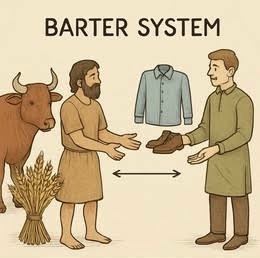
I’m still dumbfounded that we went from a barter system, where you traded something you had for something you needed, to a system where we hand each other small pieces of metal or paper and pretend they have value because somebody told us they do.
At least barter made sense.
You fixed my windows, I gave you some grain. You repaired my roof, I gave you a cow. You helped me survive the winter, I gave you something that helped you survive the winter. There was an actual connection between the work being done and the thing being exchanged.
Somewhere along the way, though, humanity decided that carrying around a cow every time we needed something was probably inconvenient. Fair enough. Cows are not particularly portable, and I imagine the early banking industry had some serious livestock-management issues.
So we invented money.
The earliest forms of money included things like grain, livestock, shells, and precious metals. Eventually, civilizations began producing standardized coins, often stamped with the image of a ruler. A king’s face on a piece of metal became a promise that this little disk was worth something.
Which, when you think about it, is a hell of a marketing strategy.
“Here is a picture of me on a piece of metal. I declare this valuable.”
And people said, “Sounds good.”
Granted, those early coins had some intrinsic value because they were made from gold, silver, or other useful metals. But even then, the value was largely based on agreement, trust, and the authority of whoever was stamping the king’s head onto the thing.
Then we moved to paper money.
Now, instead of carrying around a piece of metal that might actually be worth something, we carry pieces of paper that represent a promise. And eventually, we stopped even needing the paper. Most of the money we use today is just numbers in a bank account, moving from one computer screen to another.
I can work eight hours, receive a paycheck, deposit it into my bank account, and use a plastic card to buy groceries. No grain. No cattle. No silver. No gold. Just a series of numbers that everybody agrees means I can have food.
And the truly amazing part is that it works.
Most of the time.
We have built an entire global economy on the collective agreement that these little pieces of paper, these coins, and these electronic numbers are worth something. We use them to buy houses, pay medical bills, send our kids to college, and determine whether we can afford to retire.
We have assigned value to something that, in and of itself, has very little practical value.
A dollar bill is not particularly useful as a piece of paper. You can’t eat it. You can’t build a house with it. You can’t fix a broken window with it. You could probably use it to start a fire, but that seems like a poor financial decision.
Yet we have decided that it is legal tender for all debts, public and private.
Which is a fancy way of saying, “This piece of paper is worthless unless everybody agrees it isn’t.”
And somehow, we have all agreed.
Of course, money isn’t entirely worthless. It represents the value of goods, services, labor, and the economic activity that produces them. The dollar is useful because people trust that it can be exchanged for things they need. But the paper itself isn’t what makes it valuable. The agreement is.
And that agreement can change.
Inflation is what happens when the purchasing power of money declines. You can have the same amount of money in your pocket and discover that it buys less than it did yesterday. The paper hasn’t changed. The number hasn’t changed. The value has.
Which brings us to the part that really fascinates me.
We have created an economic system where the thing we use to measure value can itself lose value. We work for money, save money, invest money, and plan our futures around money. But money is not a fixed thing. It is a human invention that depends on trust, stability, and the continued willingness of people to accept it.
And yet we treat it like some immutable law of nature.
Like gravity.
Like the sun rising.
Like the fact that the government will eventually find another way to tax us.
I understand why we moved away from barter. Barter has limitations. What if I need a doctor but the doctor doesn’t need my windows fixed? What if I have a cow but the person selling me a car doesn’t want a cow? Money solves those problems by providing a common medium of exchange.
But I still find it fascinating that we went from trading things we actually needed to trading things that represent the value of things we need.
We don’t trade windows for grain anymore. We trade the value of fixing windows for the value of grain, which is represented by money, which is represented by paper, metal, or numbers in a computer.
And then we spend our lives trying to acquire more of it.
The whole system works because we agree that it works. And because it works, we rarely stop to think about how strange it actually is.
Humanity has spent thousands of years refining the process of exchanging goods and services, only to arrive at a system where the most important thing in the transaction is something that has no inherent value of its own.
We have built civilization around a shared belief.
Not unlike religion, I suppose, except money actually does require you to pay for things.
And unlike religion, you can’t just pray that your mortgage company will accept your good intentions as payment.
The next time I hand somebody a piece of paper with a dead president’s face on it, I’m going to try to remember how remarkable the whole thing is.
Somewhere along the way, we decided that this was better than trading cattle.
And the rest of us just went along with it.
Because apparently, once you get enough people to agree that something is valuable, it becomes valuable.
Even if it’s just a piece of paper.




You must be logged in to post a comment.