
Category: Uncategorized
-
Dwain Northey (Gen X)

So Donald is going to meet with Putin this week to negotiate the end of the Ukraine war that Putin started and Ukraine isn’t involved in the negotiations. This as fair as a crooked cop making a deal with robbers that broke into your house about how much of your property they get to keep.
I am sure that in the deal Putin will want a significant amount of Ukraines territory and probably some kind of restitution for Russian soldiers killed and injured. The rationale will be that Putin wanted the territory and Ukraine should have just given it to him …
This is a sign of the ridiculous times we are living in.
-
Dwain Northey (Gen X)

Our founders thought of a lot a contingencies have checks and balances through, congress, the executive, and the courts but the didn’t foresee this level of chaos. The GOP has spent the past 50 years slowly, quietly chipping away at the pillars of our democracy and now their wet dream is about to come true.
Because the Democrats have tucked their tails and let the GOP pass a CR on the budget that gives the Executive Branch cart Blanche to spend money how ever they see fit. For the past 4 years the Republicans have cried about raising the budget ceiling but now they want to raise the debt ceiling 3 trillion dollars, yes this is the party of fiscal responsibility… This giant cash grab by Donny and his minions is going to bankrupt the nation but will still benefit them.
The founders and spinning in their graves…

-

You might be familiar with the never-ending number π (pi), which is most relevant for studying circles. But you might not know much about the genius guy who first calculated pi: Archimedes of Syracuse, Sicily, one of the greatest mathematicians of the ancient world.
My random off comment …
Hopefully Donny doesn’t ban Pi because he likes cake more 😜😳🤣
-
Dwain Northey (Gen X)

For 4 years I saw with same sticker with Joe Biden on gas pumps and anything else the Red Hat militia morons what to blame him for . Now the shoe is on the other foot except this time we can realistically place the blame on the Mango Menace.
The sad part is that Faux News is still placing the prices and volatility in the markets on Biden not Donny’s tariff threats. Gawd know that if everything was going well, gas prices down, eggs affordable the markets trending the way they were expected if the previous administration policies were continued Donald would certainly be taking credit for everything.
Place these stickers on gas pumps in grocery stores on every shelf, in liquor stores, anywhere you can… let’s play the Red Hat childish game and see how they like it.
-
Dwain Northey (Gen X)

This travesty started in 2017 during Donny’s first occupation of the Oval Office with the introduction of the term ‘alternative facts’ and it continues with his second occupation.
The truth we all saw on January 6, 2021 was just a peaceful walk through the Capital Complex and Donald pardoned all those convicted of the crime committed on that day even for those who confessed.
Now Ukraine was the aggressor not Russia and we should side with Russia in that conflict. Canada and and Mexico, our biggest trading partners are now enemies of our country. The economy that was steadily rising under Joe Biden was somehow the worst economy ever and now that the economy is taking a turn to the negative that has nothing to do with the current occupant of the oval office.
So for the next few years, we’re gonna be living in a world of alternative facts or as what they were called when I was a kid lies.
-
Dwain Northey (Gen X)

It seems that we are in the stupidest timeline, has it been so long since the atrocities of the First and Second World Wars that those lessons have been forgotten. We have groups standing up to quite literally take rights from other people, instead of standing up for the little guy, like every movies from the 80s told us we are now on the side of the bully.
This current crop of malignant nimrods have even co-opted the teaching of the deity they profess to follow. Their version has Jesus telling the poor and sick that they should pull themselves up, that their lot in life is their own fault and that the rich and powerful are the truly blessed. Sorry I am not religious but that isn’t the message that I was taught as a child.
In a more current cinematic context they think Thanos had it right even if it did mean deleting half of everything living thing… although their version only deletes the poor, minorities and anyone they don’t agree with.
Our population has grown but there are still enough resources for all, unfortunately the rich and powerful have consolidated it into their hands. It’s time to recognize that there is enough for everyone and there will still be rich people but no one I mean no one should be cold and hungry.
-
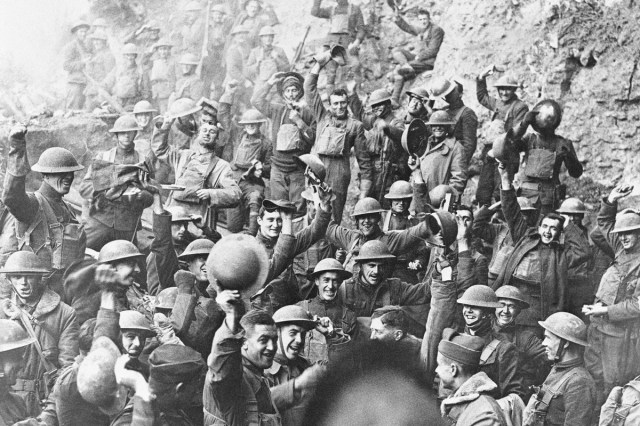
Credit: Bettmann via Getty Images Germany Began Seeking Peace by October 1918
Even with the once-impenetrable Hindenburg Line breached, the Germans largely held their ground in the fighting that continued across the Western Front. Nevertheless, the string of Allied victories, combined with deteriorating conditions at home, prompted the German high command to reach out to U.S. President Woodrow Wilson for a peaceful resolution in early October. The following month, Germany agreed to the strict terms that enabled the armistice to take hold at 11 a.m. on November 11, 1918.
All told, the celebrated Hundred Days Offensive lasted about 95 days. Yet it’s no exaggeration to say that its successful strategy and execution were crucial in bringing the First World War to a long-awaited end.
For many people, the enduring image of World War I is that of infantry troops bunkered down in a trench somewhere along the hazy battlefield of the war’s Western Front. Indeed, while stagnant trench warfare was the norm for a large chunk of the conflict in Europe, it was the transition to a mobile phase of the war in 1918 that brought about its fairly sudden conclusion, with the success of a rapidly moving offensive across late summer and early autumn that year. Here’s a look at how the Hundred Days Offensive ensured victory for the Allied forces.
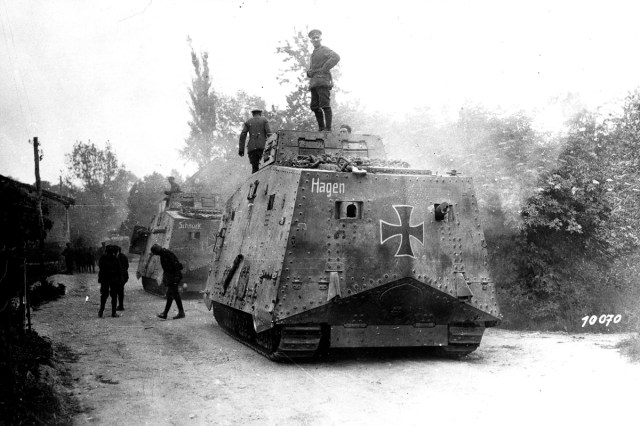
Credit: ullstein bild Dtl./ ullstein bild via Getty Images The German Spring Offensive Failed To End the War
Following Russia’s exit from the war in late 1917, German General Erich Ludendorff funneled troops to the Western Front for what became known as the Spring Offensives. Beginning with Operation Michael on March 21, 1918, the German army launched four major attacks by mid-June that brought it within 55 miles of Paris but failed to deliver a knockout blow.
The Germans struck again near the French city of Reims on July 15, commencing the Second Battle of the Marne. However, they were unable to split the French army as intended, and instead were driven back when the Allies launched a counterattack three days later.
At a conference of Allied leaders on July 24, Supreme Allied Commander Ferdinand Foch outlined plans for a rapid-fire series of strikes against the exhausted and stretched-out German army. These attacks formed what later became known as the Hundred Days Offensive.

The Tide Turned With the Battle of Amiens
The Allied surge began with a surprise attack at Amiens on the morning of August 8, 1918. Following a barrage of gunfire at 4:20 a.m., the combined French, British, Canadian, and Australian forces overwhelmed the outnumbered German defenses along the river Somme. Upon losing some 26,000 of his troops on that day alone, Ludendorff referred to the disaster as “the black day of the German army.”
When their advance slowed by the third day of fighting, the Allies continued hitting the Germans along various points of the front. As part of what is sometimes called the Second Battle of the Somme, the combined British and Australian forces drove the Germans out of Albert, France, on August 22, and a New Zealand corps helped wrest control of the town of Bapaume a week later.
Having only recently entered the war, the U.S. First Army was given the task of eliminating the St. Mihiel salient (a protuberance of German territory along the line) in mid-September. It was an easy victory for the newcomers, as by that point the Germans had largely retreated to the Hindenburg Line, a nearly 100-mile-long series of heavily defended trenches, tunnels, and fortifications across northeastern France.
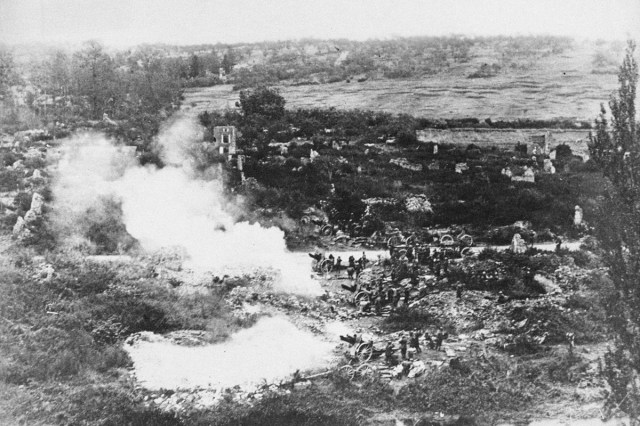
Credit: FPG/ Archive Photos via Getty Images The Allies Broke Through the Hindenburg Line
In late September 1918, the Allies pressed their advantage with the launch of a four-prongedattack. On September 26, a combined American and French force invaded the Meuse Valley to commence the Battles of the Meuse-Argonne, also known as the Meuse-Argonne Offensive. On September 27, the Canadian Corps led the charge across the Canal du Nord in the Battle of Cambrai. The following day, a Belgian force joined the British in an attack on the battle-scarred terrain outside Ypres in Flanders.
The main target of this offensive was the St. Quentin Canal, which formed part of the Hindenburg Line. Following a massive fusillade of shells from more than 1,600 guns, the Allies launched their ground assault on the morning of September 29.
On one end, the American and Australian corps struggled to pass the German defenses at Bellicourt Tunnel. However, the British were well prepared to cross the canal to the south with their rafts and life preservers. Aided by the dense fog, they overtook enemy positions on the steep eastern bank and thwarted the detonation of the Riqueval Bridge. By the start of October, the St. Quentin Canal was effectively in Allied hands.
Credit: Bettmann via Getty Images Germany Began Seeking Peace by October 1918
Even with the once-impenetrable Hindenburg Line breached, the Germans largely held their ground in the fighting that continued across the Western Front. Nevertheless, the string of Allied victories, combined with deteriorating conditions at home, prompted the German high command to reach out to U.S. President Woodrow Wilson for a peaceful resolution in early October. The following month, Germany agreed to the strict terms that enabled the armistice to take hold at 11 a.m. on November 11, 1918.
All told, the celebrated Hundred Days Offensive lasted about 95 days. Yet it’s no exaggeration to say that its successful strategy and execution were crucial in bringing the First World War to a long-awaited end.
-
Lyle Northey (Silent/Boomer)

The remark keeps being made about what the democrats are going to do to stop Trump. As the house and senate are both heavy in favor of the republican party the real question is what are they going to do about it. Our democracy is not or should not be party specific. The idea that challenging the guy at the top may be greeat if you are working for someone that is paying your wages. Elected officials are being paid by the public and that is the boss that members of congress should be concerned with.
So what if Trump has a melt down over being challenged, even he and his rich friends can not control the career of every person that points out problems with what is happening. Doing the right thing should be the bench mark for reelection, not ass kissing the person in the oval office. Even bosses can be taught as power often seems to destroy civility and common sense. My personal experience with that on one occasion was having the head of the company curse me on the phone because I did not follow a verbal instruction that he had given to my assistant manager on my day off and I did not get the message. The cursing ended when I hung up on him. My direct supervisor called me and asked if it was true that I had humg up and I confirmed that is was and why. A few days later I had reason to be in the big bosses office and our conversation was very pleasant. Others in the office could not believe that I had not been fired or at least had my ass chewed.
The point is that doing your job should be the measure of your rating no matter what you may do career wise. With members of congress they should base their expectation of reelection on the opinion of the voting public not on the whims of the President and a few of his rich friends. A smart move would be to point out that the opposition coming from the top should be proof that you are doing your job and taking care of your constituants. So having a backbone is not just a problem for the party that is not in power, it is a requirement for all that were elected to serve the people.



You must be logged in to post a comment.