For about 37 years of its history, the U.S. has been without a second-in-command. Before the passage of the 25th Amendment in 1967, there was no procedure for filling the role if a commander in chief died in office. Instead, there just wasn’t a VP if that happened — at least not until the next presidential election. Thanks to this legislative quirk, John Tyler, Millard Fillmore, Andrew Johnson, and Chester Arthur (all VPs under a President who died in office) served their entire presidential terms without a Vice President.
Other Presidents have gone without VPs for at least part of their terms, whether through resignation (two) or because their veeps died in office (seven). The first VP vacancy occurred in 1812, when George Clinton, President James Madison’s running mate, died in office. Strangely, Madison’s VP pick for his second term also died in office, after serving only about 20 months. The last executive shuffle occurred during the Nixon administration in 1973–74, when Spiro Agnew and Richard Nixon both resigned (Agnew about nine months before Nixon, amid tax evasion and corruption charges). Nixon nominated Gerald Ford to replace Agnew, and after Nixon himself resigned in August 1974 following the Watergate scandal, Ford became the first and only President never elected by the U.S. people. Ford left the vice presidency vacant for several months until Nelson Rockefeller finally filled the position on December 19, 1974. Since then, the U.S. has never been without a veep.
In the wake of World War II, new ideological borders were drawn across the European continent. Vast cultural and economic differences formed a deep divide between the democratic nations of Western Europe and the communist regimes of the Soviet Union and its allies in the East. Throughout the Cold War era, these two distinct factions were separated by a symbolic boundary that cut through the continent, known as the Iron Curtain.
The term “Iron Curtain” was first used in reference to the Cold War in 1946; nations that were considered “behind” the Iron Curtain were those under Soviet and communist influence, as those regimes maintained a firm grasp on power. As time progressed, cracks formed in the Iron Curtain as former communist nations embraced democracy, ultimately leading to the political reunification of Europe. But for as long as it existed, the Iron Curtain served as a philosophical barrier between two vastly different worlds. Here are five fascinating facts from behind the Iron Curtain.
Photo credit: Icon and Image/ Michael Ochs Archives via Getty Images
The Term “Iron Curtain” Was Popularized by Winston Churchill
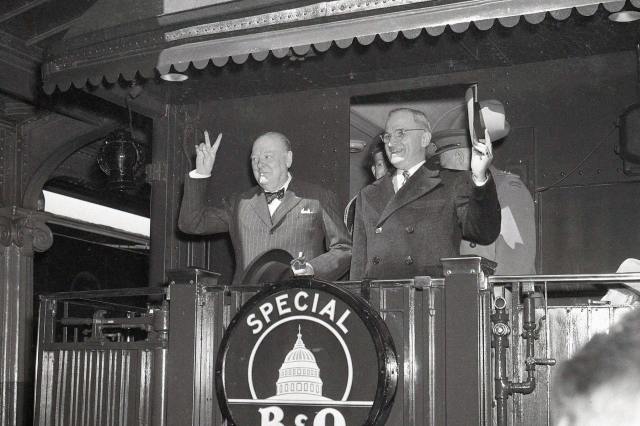
Long before the term “Iron Curtain” was coined in reference to the Cold War, the words referred to a fireproof safety mechanism that separated the audience from the stage in theatrical productions. In 1945, author Alexander Campbell borrowed the term in his book It’s Your Empire to describe censorship related to World War II-era Japanese conquests. “Iron Curtain” was first used in the context of communist Europe during a speech by British Prime Minister Winston Churchill on March 5, 1946. Appearing with President Harry Truman at Westminster College in Fulton, Missouri, Churchill stated, “From Stettin in the Baltic, to Trieste in the Adriatic, an iron curtain has descended across the continent.” Churchill sought to warn the audience of the threat posed by the Soviet Union, and the term “Iron Curtain” resonated, remaining popular for decades after. Around the same time as Churchill’s speech, another great wordsmith used the phrase “Cold War” for the first time — author George Orwell in his 1945 essay “You and the Atom Bomb.” Two years later, Truman adviser Bernard Baruch formally coined the term “Cold War” to describe the cooling relationship between the United States and Soviet Union.
Complaining is a pointless act, if you don’t like something change your situation or take action to make it more amenable. I truly believe that there is no reason to moan and complain because I always have a choice to change myself or the situation.
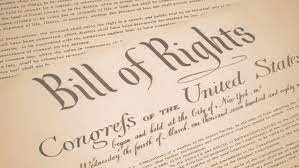
The U.S. Constitution is among the most important and esteemed texts in American history. Since its ratification on June 21, 1788, this living document has served as the groundwork for the country’s government on both the federal and state levels. It’s also constantly evolving: The Constitution has been amended 27 times over the years, beginning with the certification of the first 10 amendments, known as the Bill of Rights, in 1791. Here’s a closer look at each of those first 10 amendments to the U.S. Constitution.
The First Amendment Was Introduced by James Madison
Long before he assumed the role of commander in chief, America’s fourth President, James Madison, introduced the Bill of Rights to Congress, starting with the First Amendment, which protects freedom of speech, religion, the press, assembly, and the right to petition the government. Madison drafted the Bill of Rights in 1789. A representative of Virginia, he based the First Amendment’s text on the Virginia Declaration of Rights, as well as the English Bill of Rights and the Magna Carta.
The Second Amendment Was Agreed Upon as a Compromise
The right to bear arms as defined by the Second Amendment has been a controversial topic for ages, even dating back to when it was first agreed upon. Like much of the Bill of Rights, the final text was a compromise between pro-government Federalists and rival Anti-Federalists, who argued over whether an adequately armed population could deter potential government oppression. Anti-Federalists fought for a Second Amendment that preserved the right of the people to fight back against government oppression, while Federalists maintained that those fears were overblown.
The Third Amendment Has Never Been Argued in Front of the Supreme Court
While many constitutional amendments have been the subject of heated judicial debate, the Third Amendment has never been the focus of a U.S. Supreme Court case. The amendment forbids the government from forcing citizens to house soldiers in their private homes without their consent during peacetime. It is one of the more universally agreed-upon elements of the Constitution.
Photo credit: Nadinlargo/ iStock via Getty Images Plus
An Exemption to the Fourth Amendment Was Created for Cars
The Fourth Amendment was ratified in 1791, establishing rules against warrantless searches by law enforcement. Given that the amendment was ratified long before cars existed, it wasn’t until the 1925 case Carroll v. United States that vehicle searches were first debated on a judicial level. The case ultimately established an exemption to the Fourth Amendment that permits warrantless vehicle searches, provided there is probable cause to suspect there is contraband inside.
A
“Due Process” Was Added to the Fifth Amendment at New York’s Request
The “due process” clause — which guarantees fair treatment under the law — is an integral component of the Fifth Amendment, which protects those accused of criminal activity against self-incrimination and prohibits “double jeopardy” (being prosecuted twice for the same offense twice), among other protections. In essence, the concept of due process ensures that every American will be treated fairly in court, but it may never have existed if not for a request made by delegates from the state of New York, which had a similar concept included in its own Bill of Rights Statute. The request led James Madison to draft due process into the Fifth Amendment.
The Sixth Amendment Didn’t Include State Court Cases for 172 Years
The Sixth Amendment protects the rights of those facing criminal charges, such as the right to a fair and speedy trial by an impartial jury, as well as legal representation. It has provided the right to a free defense counsel on a federal level since its ratification in 1791, but it wasn’t until 1963 that the amendment was expanded to include felony cases facing state prosecution. The expansion was a result of the landmark decision in the case Gideon v. Wainwright, in which the court ruled that states must provide attorneys to any criminal defendant unable to afford their own counsel.
The Seventh Amendment Still Applies to Cases That Exceed a Value of Just $20
The Seventh Amendment guarantees the right to a trial by jury in federal civil cases, but only regarding issues where the value exceeds $20 — a stipulation that’s still in place today. The amendment was ratified in 1791, so in modern terms, that $20 would be roughly equal to around $650. However, the text of the amendment still reads “twenty dollars.”
The Eighth Amendment Was Taken Nearly Verbatim From the English Bill of Rights
The Eighth Amendment — which reads, “Excessive bail shall not be required, nor excessive fines imposed, nor cruel and unusual punishments inflicted” — was taken nearly verbatim from the English Bill of Rights of 1689. While many other amendments from the Bill of Rights were influenced by the British Constitution, the Eighth Amendment is notable for its highly similar wording.
The Ninth Amendment Doesn’t List Any Specific Rights
While the first eight amendments clearly define the rights they’re meant to protect, the Ninth Amendment is significantly more abstract in nature. It was put in place to reaffirm that rights shouldn’t be denied solely because they aren’t explicitly stated in the Constitution. The entirety of the amendment reads, “The enumeration in the Constitution, of certain rights, shall not be construed to deny or disparage others retained by the people.”
The 10th Amendment Has Never Been Invoked to Protect Individual Citizens
The 10th Amendment essentially establishes the concept of states rights, and underscores the limits of the federal government as restricted to the powers enumerated in the Constitution. The text reads, “The powers not delegated to the United States by the Constitution, nor prohibited by it to the States, are reserved to the States respectively, or to the people.” Though the 10th Amendment has been invoked many times with regard to protecting state’s rights, it’s never been invoked by an individual citizen in a case against the federal government.
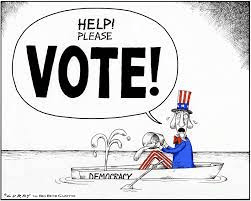
The election of 2024 could very well be the last one we ever get if the wrong person wins. Hopefully the generations that have the most at stake will go to the voting booth and pull the handle that keeps our democracy alive.
There are rumors of all sorts flying around about both major candidates and when it comes to health issues we can only speculate as to the truth. The age thing is possible in both as neither man is a spring chicken. Age does not make you sit on the bench as much as whether your whole being is broken would require you to stop playing in the sand box. Trump is reported to have an STD and with his lifestyle it is believable and his hero was sick when he died. His mental well being has been questioned but anyone that consumes McDonalds all the time would be lucky not to have brain issues.
A call to send National Guard troops from other republican led states to challenge federal authority on the southern border of Texas is not a bright move. If I were a guardsman in one of the states I would refuse to go to Texas as it is not my state that I am assisting, and it is an attempt to overthrow the US government. Crossing the border is a mistometer not a felony. Seeking asylum is not a crime. What the governor of Texas is doing is according to the Supreme Court. May be time to send forces to Texas and make arrests and removal of criminal elements
At present one of our greatest difficulties as a nation is the fact that we are not using duplex communication devices. By that I mean we are speaking into a radio that is broadcasting and never listening to anything or anybody in response to any issue. If we start to use telephones and take time to listen to a response when we make a point, and I mean listen not just hear a response we may be able to fill the potholes in our political highway..
Please use your better judgement and let this Democratic Republic have a 250th Anniversary.
If my chance I were to win a lottery no one would know I won. First I would receive the winnings under a LLC and the proceeds would instantly go into a trust that would pay out to me a set amount every month. I would not quit working or start buying expensive toys. I would in the words of a friend have ‘Fuck You’ money and have to ability to just walk away from a bad situation without thinking twice about it.









 Esoteric Meandering Shouting Into the Void
You must be logged in to post a comment.