A dding to the rich legacy of Easter Island, archaeologists have uncovered full bodiesunderneath each structure. (But breathe easy: The bodies, like the heads, are made out of stone.) Known as moai, the figures were built by the Indigenous Rapa Nui people between 1100 and 1600 CE, but as time took its toll, the statues’ lower halves became increasingly hidden by sediment and rock.
Located in the southeastern Pacific Ocean, Easter Island is one of the most isolated places in the world, and managed to escape colonization until the first European explorer arrived in 1722. The island itself was formed by three extinct volcanoes, which explains why the moai are carved from volcanic stone. The statues were built to temporarily contain the spirits of Rapa Nui chiefs, who were believed to become divine after death. The structures also sit on stone platforms called ahu, and some moai are adorned with circular red stones (pukao) that sit on their heads and represent topknots of hair. Excavationists have also found cremated and buried human remains at some ahu, suggesting they were a place of Rapa Nui death rituals.
The moai bodies were initially discovered by archaeologists in 1914, and in 2010, the Easter Island Statue Project began excavating two of the bodies. Since Easter Island is a UNESCO World Heritage Site, the moai are protected from humans, though the monoliths still battle erosion, rising sea levels, and the effects of forest fires.
You get to build your perfect space for reading and writing. What’s it like?
The perfect space is one you create in your mind, if the story is engaging you can lose yourself in the pages, I have to be in my own head to successfully write the exterior environment doesn’t matter.
Received a Christmas card, Hallmark card, that has one of the best messages I have ever read on it. The message is “Everytime a hand reaches out to help that is Christmas, Every Time a person chooses peace, that is Christmas, Every Time we forget our differences and remember the love that connects us, that is Christmas”. This should not be the message that applies only at Christmas, it is a message that we all need to remember all the time. It and the standby “Do unto others” message should be how we are conducting business. Unfortunately we have all the other baggage to drag along, our fear and distrust, greed and self importance that makes being thoughtful and caring almost impossible for many. The idea that we are capable of living together and supporting one another seems too good to be true. It works in other countries, why not here? There is the battle to stay well, paying for high priced medical insurance that is picky about what they will or won’t cover. The effort to get an education beyond high school and the debt that is incurred with that. Homelessness and unemployment, drug usage and gun violence. We in the US have all of these and other problems to deal with on a daily basis and the bottom line reason for so much of it is the greed of a few that want to keep the money flowing into their accounts even if it bankrupts everyone else. Other countries have education opportunities to the age of 26 at no cost. They have health care that does not cost them everything they make. They have very little in the way of homelessness and unemployment. Drug problems are dealt with as an illness more often than as a crime and gun violence is minimal as gun laws are in place that make sense. What will we become if a Dictator is put in place? Will he deal with our problems in a just and humane way? Drug dealers and users in one country are open game to execution with complete approval of the government. Will the gun laws change to keep us safe or will everyone have a gun so we can shoot however offends us? We will not have to worry about voting, probably will not have to concern ourselves with vacation or upkeep on national parks. We will most likely have no ability to honor anyone but the master and to keep the money rolling into his coffers. Will he have one of his sons groomed to become his replacement, as they do in North Korea? Have the people that have said they think it is a good idea even thought about the consequences of having a dictator? This move will not be a trip through the tunnel of love that is for certain.
Not a big engine muscle car but the Mini Mark1 hold a special place in my heart. Would love to acquire one and convert it to full electric just as a run about grocery getter.
The term derives from Middle English Cristenmasse, meaning ‘Christian mass’. Christmas is celebrated to remember the birth of Jesus Christ, who Christians believe is the Son of God. The name ‘Christmas’ comes from the Mass of Christ (or Jesus). A Mass service (which is sometimes called Communion or Eucharist) is where Christians remember that Jesus died for us and then came back to life.
The Catholic Church puts great reverence on Christmas even though the events surrounding Jesus’ birth are taken from two Gospels: Matthew and Luke. Each book was written during different times and in different locations. This event isn’t mentioned any other time in the gospels.
The common Christian traditional dating of the birthdate of Jesus was 25 December, a date first asserted officially by Pope Julius I in 350 AD, although this claim is dubious or otherwise unfounded. Because Dec. 25 was the date in the imperial Roman calendar on which the solstice occurred, some Christians living in Rome asserted that Jesus must have been born on the shortest day of the year, as a sign of his great humility. Other dubious assertions of Dec. 25 came from Hyppolitus (170-235 CE), a prominent theologian of the Catholic Church in Rome, mentioned the date of Jesus birth in his 204 CE work, “Commentary on Daniel”. He stated Jesus was born “in Bethlehem, eight days before the calendar of January [December 25], the 4th day of the week [Wednesday]”.
Almost certainly the December 25th date was derived from existing pagan celebrations. The winter solstice (shortest day) had always been celebrated by primitive peoples as the beginning of hope for the arrival of spring. This continued into classical times. The Romans celebrated the festival of Saturnalia between 17th and 25th December. Many Christian celebrations not so coincidentally coincide with previous pagan festivals.
The Roman calendar is supposed to represent year one as the start one the year of Christs birth although date of birth of Jesus is not stated in the gospels or in any historical sources, but most biblical scholars generally accept a date of birth between 6 BC and 4 BC, the year in which King Herod died. The change from BC to AD, AD meaning Anno Domini is Latin for “The Year of the Lord”. If anyone tells you it means “After Death”, THEY ARE WRONG!! Hey, if B.C. means ‘Before Christ’, and A.D. meant ‘After Death’, it would mean after Christ’s death, RIGHT? Tradition has it that Christ lived for 33 years. True believers would say that Christ never died, he was Crucified and rose from the tomb 3 days later.
As for the December 25th date many biblical scholars more appropriately place the birth in the spring more than likely around the month of April not in the winter. My guess is that when Pope Julius I deemed the day to be in December that it was a political move as to not correlate the birth, crucifixion and subsequent resurrection all into the same month of the year. Again, this is just my assumption.
I could go on about how the holiday has been bacterized and commercialized for corporate profit but I will save that rant for next Christmas.
Anyone who writes a blog has some level of creativity I feel I’m creative, and that my brain wants to create content that may inspire others. I continually have creative business ideas on how to help other people and that’s how I feel. My creativity is most beneficial.
J ingle Bells” is one of the most recognizable songs in American history, and the jaunty tune is as much a part of the Christmas season as twinkling lights and shiny ornaments. Take a closer look at the lyrics, though, and an interesting detail emerges: The song doesn’t mention the holiday at all. That’s because “Jingle Bells” wasn’t actually written for Christmas.
Even with its undeniable ubiquity, “Jingle Bells” has a rather murky history. We know that in 1857, the song’s composer, James Pierpont, copyrighted the tune under the title “One Horse Open Sleigh” while living in Savannah, Georgia. But various theories about the song’s meaning have surfaced over the years: One suggests it was simply written in the style of other popular sleighing songs at the time; another says the song was written for Thanksgiving. A plaque in Pierpont’s childhood hometown of Medford, Massachusetts, even claims “Jingle Bells” was composed in a local tavern, years before its copyright date. (Research into the latter two claims has concluded that neither origin story is likely.)
“Jingle Bells” features no direct mention of any holiday, nor even the month of December, but the song nonetheless became a Christmas staple following its release. In December 1943, Bing Crosby and the Andrews Sisters released a record featuring renditions of “Jingle Bells” and “Santa Claus Is Comin’ to Town,” cementing the song’s status as an inescapable Christmas classic.
I have had many mentors and have taken aspects from all of them and have also read books and gone to self improvement seminars with all that I have learned that I have to follow my own path no one can lead to your light.
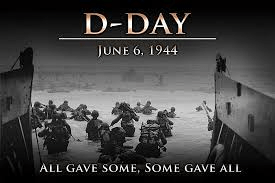
Not long after the United States entered World War II in December 1941, Allied leaders Winston Churchill and Franklin D. Roosevelt — along with commanding Allied general Dwight D. Eisenhower — began to plan an invasion of Nazi-occupied France. Opening a new front was vital to defeating the Nazis, so plans were set in place for Operation Overlord — the codename for the Normandy landings on June 6, 1944. The massive operation began the liberation of France and other parts of Western Europe, ultimately turning the tide of World War II and bringing about the end of Nazi Germany. Here are five facts about that fateful day, now commonly known as D-Day.
Allied leaders originally set a date of June 5, 1944, for D-Day. But something very British managed to delay the invasion: the weather. Foul weather over the English Channel meant that it was too rough for ships to sail, so the invasion was postponed until the day after. It was a nervous, pensive wait for everyone involved, not least for the soldiers waiting to cross the Channel. Then came news from the meteorologists, who forecast a brief window of calmer weather for June 6. There were a limited number of dates with the right tidal conditions for an invasion, so if the operation didn’t go forward during the break in the weather on June 6, it would have had to wait until June 19-21 (when, as it turned out, there was a storm that would have made invasion impossible). The green light was finally given, and D-Day took place on June 6.
The Germans Weren’t Expecting the Invasion to Be at Normandy
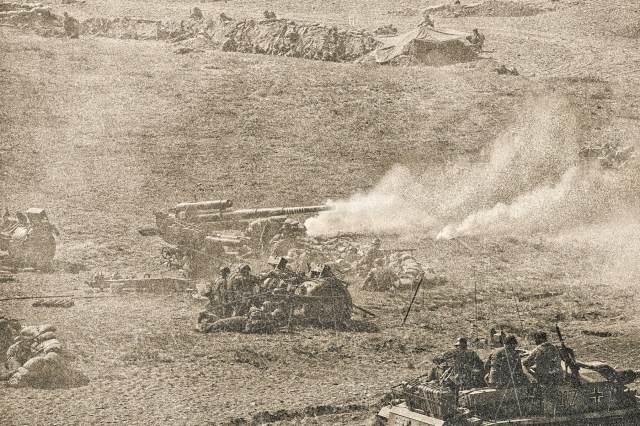
The Germans knew that an Allied invasion of Nazi-occupied France could turn the tide of war, and had planned to counter such an invasion. But they didn’t consider Normandy as a particularly likely landing point. Instead, they believed the Allies would invade further north, at the French port city of Calais, which sat just a little more than 20 miles across the English Channel from Dover. The German army installed three massive gun batteries along the Calais coast in order to counter this threat. That’s not to say that Normandy was an easy target. It was defended by the Atlantic Wall, a 2,000-mile-long chain of fortresses, mines, gun emplacements, tank traps, and obstacles. It was an impressive piece of defensive engineering, but it wasn’t enough to stop the Allied invasion.
Spies and Misinformation Played a Major Part in the Success of D-Day
The Allies did all they could to convince the Nazis that an invasion would not take place at Normandy. Leading up to D-Day, nearly every German spy in England had been captured or turned into a double agent, and the double agents were told to inform their Nazi handlers that the invasion was indeed planned for Calais. At the same time, the Allies sent out fake radio traffic to further convince the Germans that Calais was the plan. This deception was all part of Operation Fortitude, which aimed to dupe the Nazis with misinformation, including creating an entirely fake army. This fictitious force, known as the First U.S. Army Group (FUSAG), was made up of thousands of fake tanks and airplanes, as well as decoy buildings, all placed on England’s southeast coast and supposedly commanded by General George S. Patton. The Allies let German reconnaissance planes photograph the site of the dummy army, further convincing the enemy that a military buildup was being made for an invasion of Calais. What’s more, the Allies by this time had cracked the Nazis’ Enigma code, so they could monitor the success of their misinformation campaign by tapping into German communications.
D-Day Was the Largest Amphibious Invasion in History
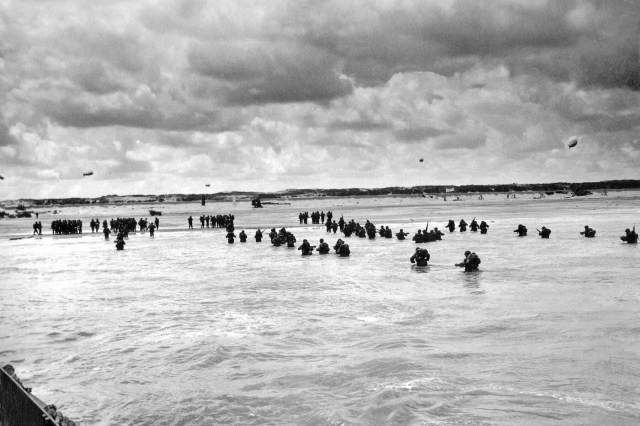
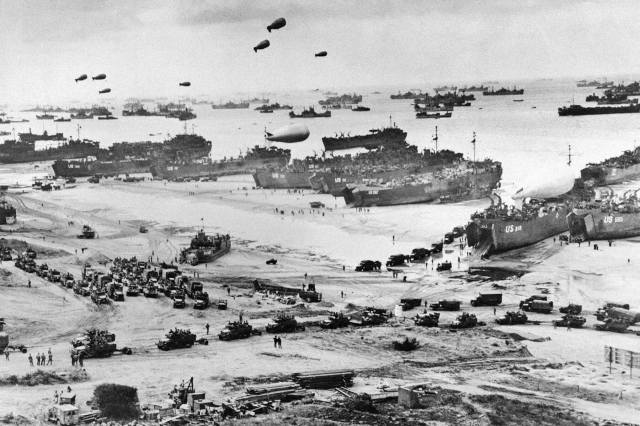
The Allied invasion of Normandy was the largest single-day amphibious invasion in history. The scale of the assault is hard to even imagine, as the numbers are mind-boggling. In the months and days leading up to the invasion, 7 million tons of supplies, including 450,000 tons of ammunition, were brought into Britain from the United States, and war planners created around 17 million maps to support the operation. In the hours prior to the beach landings, 11,590 Allied aircraft flew 14,674 sorties to support the invasion, and 15,500 American and 7,900 British airborne troops parachuted into France behind enemy lines. Then came the beach assault by 132,715 Allied troops, consisting of 75,215 British and Canadian forces and 57,500 Americans. Between them, they stormed the beaches of Normandy, the Americans fighting their way ashore at Utah Beach and Omaha Beach, the British at Gold and Sword beaches, and the Canadians at Juno Beach.
Eisenhower Wrote a Secret “In Case of Failure” Message
The success of D-Day was in no way assured. In the days before the invasion, General Eisenhower secretly wrote a statement now known as the “In Case of Failure” message, to be released if the invasion failed. In the letter, Eisenhower took full blame for any such failure. “My decision to attack at this time and place was based upon the best information available,” he wrote. “The troops, the air, and the Navy did all that bravery and devotion to duty could do.”
But D-Day was a military success that paved the way for a German surrender less than a year later. The invasion, however, came at a terrible cost. Historians are still investigating the actual number of deaths that resulted from the chaos of D-Day, but we know that at least 4,414 Allied soldiers, sailors, airmen, and coast guardsmen lost their lives, with at least 10,000 total casualties. On the German side, meanwhile, estimates suggest between 4,000 and 9,000 killed, wounded, or missing, with around 200,000 Germans captured as prisoners of war. Today, just a few thousand D-Day veterans may still be alive, the youngest now in their late 90s. On June 6, 2023, around 40 World War II veterans gathered at Normandy to mark the 79th anniversary of D-Day and pay tribute to the lives lost that day.
The Supreme Court has refused to have a hearing about the immunity issue with the idiot. Just goes to show the cowardice that resides on the court. They will play this tune for long enough to keep from having a trial before the next election and if Trump wins, God forbid, then he will pardon himself and that will be the end of trying him for insurrection. If he loses then Biden should take up having the justices removed and possibly tried for failure to do their duty.
If they are afraid that the mob will come after them if they do the right thing by the Constitution then they need to be removed today. They are probably looking for a loophole to let him off the hook as he appointed ⅓ of them and they do not want to be on the wrong end of his temper.
The people who are so stupid as to convene threats, especially death threats need to be arrested and jailed. Get around to a trial in 5 or 6 years from now and let them rot. It should not matter who is threatened if someone’s life is put in danger then that should be considered a criminal act.
An article in the paper claims that Colorado’s action is wrong because Trump has not been found guilty of insurrection yet. So let’s take a look at the facts.
The situation on Jan 6 at the Capitol was created by Trump because he summoned people to be there and told them to arm themselves. This is not a protest, this is going to be a fight. At the moment he told them to go to the Capitol and “fight like hell” his involvement went from being the leader of a peaceful gathering to being an insurrectionist. His actions prove his guilt and no further evidence should have been needed to take him into custody and jail him on that day, He was no longer the President he had made himself into an anarchist.
If he had called for intervention they would have gone to protect the proceedings and the Capitol and he could not have them fighting his rebel troops as they attempted to stop the vote. In any other country in the world he would have been at a minimum jailed before the day was over and in some he would have been dead so that his followers knew they were being hung out to dry.
Justice still needs to be administered in this case. If the protests cause one death then that charge should also appear on the docket as part of his crimes. He should already have the deaths that did occur on the current charges. Is that excessive? No not really as this individual has the hope of turning this nation into to his private litter box so he can shit on everything and everyone that doesn’t give him what he wants and make him feel like he is some sort of God.








 Esoteric Meandering Shouting Into the Void
You must be logged in to post a comment.