I’m confused is this person you want to speak to alive or dead or is it they’re just not close to you. If you really want to talk to them soon and they are among the living then you have multiple avenues to contact them via cell phone Skype, regular landline phone, so I’m confused by the question.
Saw a piece on Tom Harman this morning where they were talking about the decline in intelligence scores on tests since about 2008. The last few years prove that it is not limited to the US but is a worldwide issue, everyone seems to be getting dumber. Stupidity is the only way to justify the crap we are seeing in the people that are being voted into high office.
Every country in the world seems to have a share of stupids that are entrusted with making decisions for the citizens of the various nations and most of these people cannot make a decision as to what to have for breakfast, IHop, McDonalds or road kill. We are having the ignorance effort pushed to the limit with book banning and burning, the demands of misguided political people trying to establish school curriculum based on their faith or opinion.
Schools are being closed because of a lack of teachers. When too many involve themselves in places they should stay out of things do not get better. The guidance to educators should be established before classes begin and then let the teachers run with it. Coming in with new requirements in the middle of a year is not productive.
What is written here is an opinion and yes I am aware that opinions are like a–holes, everyone has one and from time to time they all stink. That being said, keep in mind that education is the one commodity that keeps one ahead of another and we as a nation do not need to be in the trailing category when it comes to education. Just because a word or phrase from the past may upset a small number of people that should not make it a target to eliminate an entire book or portion of historical knowledge from school curriculum.
The language of yesterday may seem crude today but it is no more offensive than some of the language we hear today and at some point what we use as common verbiage may be totally offensive to the generation of tomorrow. Knowing the terminology of the past may give you a leg up someday if only to solve a crossword puzzle.
The ignorance that is prevalent is very much in evidence when we have so many people in positions of power that seem to be illiterate on multiply levels. They cannot write and make sense, they cannot speak without profanity or complete lack of knowing which word to say to convey a message properly, and they cannot answer questions that have not been rehearsed. Moral codes do not exist for these people, it is take as much as you can and turn down no offer if it enriches your bank account even if it destroys your country.
The U.S. Supreme Court was established by the Judiciary Act of 1789, creating the third coequal branch of government and a high court to which all others are inferior. Notably missing from that federal statute: any stipulation that the highest court in the land should have nine justices. In fact, the bench has ranged from as few as five to as many as 10 justices over the last two and a half centuries. As you might expect, the process by which that number has changed hasn’t exactly been apolitical. The Supreme Court had six justices when George Washington signed the act into law on September 24, 1789, and that was almost reduced to five in 1801 before being increased to seven in 1807 — two changes that were motivated by legislators hoping to either weaken or strengthen the President’s power to appoint judges.
After that, SCOTUS was comprised of seven justices for three decades before being expanded in 1837, allowing President Andrew Jackson to add two more people to the bench. Its membership then increased by one during the Civil War to ensure that majority decisions would be written by justices who were pro-Union and anti-slavery, before being restored to the current number, nine, after Ulysses S. Grant was elected President in 1868. Court expansion has been a hot topic at several points since, most notably when Franklin D. Roosevelt tried and failed to expand the Supreme Court as part of the New Deal.
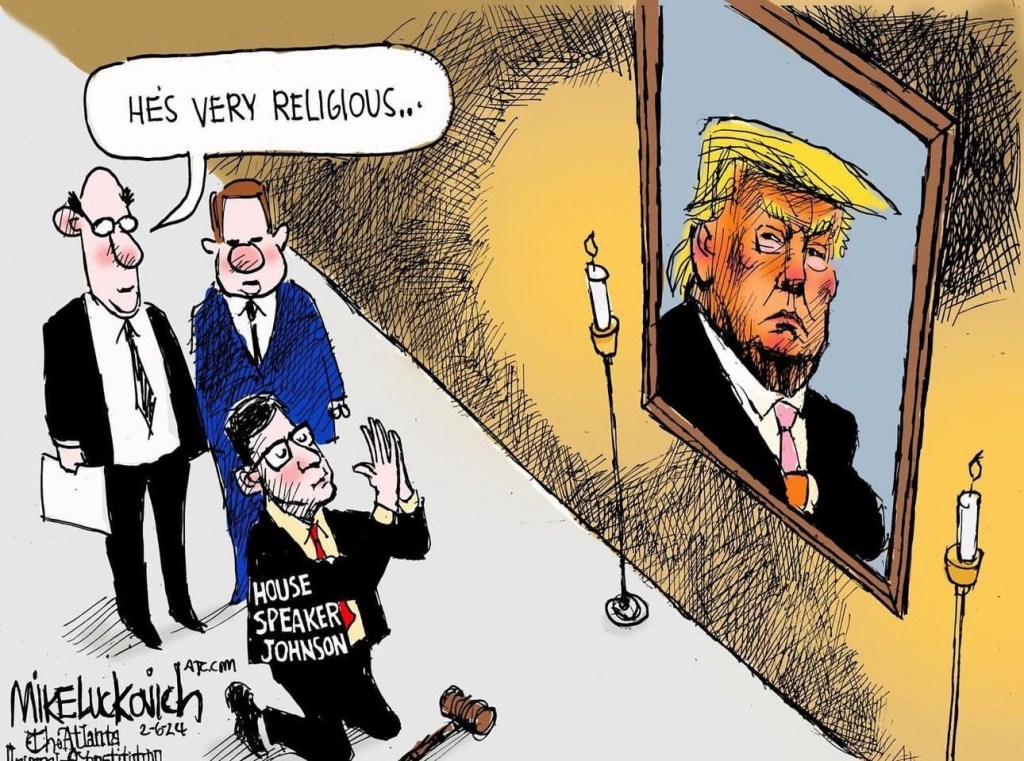
We have a political party that have deified a malignant narcissist, who takes full credit for having taken rights away from women that they had for more than 50 years. My honest question is if this wanna be authoritarian dictator gets back into office and his sycophants get their way what rights will be gone next ? Will he get more justices on the Supreme Court and the Oberafeld decision be reversed so same sex unions will once again be unrecognized, will the Loving decision be reversed outlawing interracial marriages. Just how far back in time will the ‘So called’ religious right want to take us? Slavery and child labor would absolutely be on the table in a corporate autocracy where profits are the only thing that matters.
I don’t know about you but I have no desire to go back to a world a small group of men can tell everyone what they can and can’t do and pull every string.
I don’t own anything that has any significant value as far as heirlooms or anything like that. I did hold onto my wedding ring, even 10 years after being divorced, but recently lost it and realized it was just an object that really had no significant value.
I have moved too many time to want to collect things. I will admit I have boxes of college books that for some reason I haven’t divested myself of, but I can’t in any way justify those as collecting .
I just hope to collect memories as long as my brain continues to function normally.
In everyday vernacular, the words “ocean” and “sea” are often used interchangeably. But in geographical terms, the two are quite distinct. While oceans are referred to as the large bodies of water that take up much of the globe, seas are much smaller entities, a term geographers use to describe the location where the land meets the ocean. For example, the Bering Sea is part of the Pacific Ocean, but since it is located between the landmasses of Alaska and Russia, it is classified as a sea.
Although there is no way to know the Earth’s exact age, scientists have calculated it to be roughly 4.54 billion years old, give or take 50 million years. But how did they arrive at this number? Although scientists have pondered this question for centuries, more recent technological advances have made it easier for researchers to understand the Earth’s age. Above all else, radiometric dating has been the most helpful in figuring out the Earth’s birthday because it allows scientists to pinpoint the age of rocks. The oldest rocks on Earth — 4.03 billion years old — were found in Canada, while Greenland, Australia, and Swaziland are home to rocks that range from 3.4 to 3.8 billion years. To top that, scientists have discovered stardust that’s a staggering 7 billion years old, which means the Earth is relatively young in comparison to the rest of the universe.
As a veteran of the US Army I am annoyed by those that fly the flag and tell me that I am a traitor because I am a Democrat. My father who served for 30 years is unsure if he should fly a flag because the people that absolutely dishonor its symbol have co opted it for their means.
I am an American that proudly served my country and I whole heartedly believe that everyone has a right to their opinion but I do not believe you have the right to disgrace our flag or claim it to be solely one the repents your vision.










You must be logged in to post a comment.