Today we invoke Martin Luther King Jr.—the man who asked a nation to do something radical and apparently still controversial: judge one another by the content of our character, not the color of our skin. The I Have a Dream guy. The preacher who believed equality wasn’t a slogan, but a moral obligation.
It’s worth remembering that King was not celebrated in his own time. In the 1960s he was surveilled, smeared, harassed, jailed, and ultimately murdered—not because he was violent or dangerous, but because his ideas threatened a comfortable status quo. He insisted that dignity was not conditional, that justice applied to everyone, and that laws without morality were just another form of oppression.
That history matters, because it exposes a painful irony. The values King preached—fairness, equal treatment, protection of the vulnerable—are still treated by those in power as disruptive, suspicious, or subversive. If King were alive today, or if anyone spoke with his moral clarity and insistence on universal human worth, there’s little reason to believe he would be welcomed. More likely, he’d be labeled a troublemaker, an agitator, a threat to “order.” He’d be watched. Targeted. Maybe even flagged as someone to be silenced or removed—not for breaking laws, but for challenging injustice.
King’s legacy isn’t meant to be a safe quote trotted out once a year. It’s meant to be uncomfortable. It asks whether we actually believe everyone deserves equal treatment—or only when it’s convenient. And it forces us to confront a sobering truth: a society that claims to honor Martin Luther King Jr. while punishing the principles he lived and died for hasn’t learned his lesson at all.
All Hail the Return of the King (We Never Asked For)
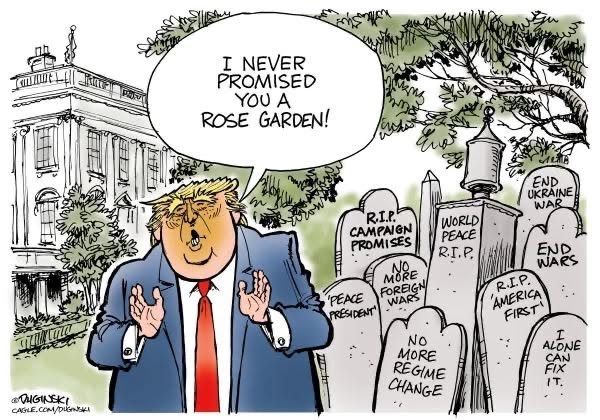
Today marks the sacred anniversary—the near-holy day—when Dear Lord King Donald the First was inaugurated for the second time, bravely reclaiming the throne from the terrifying specter of… economic stabilization. And truly, we must pause, bow our heads, and give thanks. Because he did exactly what he promised. Exactly. Word for word. Like a prophecy carved into a gold-plated teleprompter.
Thank you, Donald Trump, for saving us from the unbearable nightmare of Biden’s economic “recovery.” Who among us could have survived such horrors as slowing inflation, steady job growth, and the faint possibility that a recession caused by Trump’s own spectacular economic face-plant might not return? That was a close one. A nation nearly doomed by competence. Thankfully, you were there to rescue us from that cliff by driving us straight off another—this time with confidence, volume, and a parade of self-congratulation.
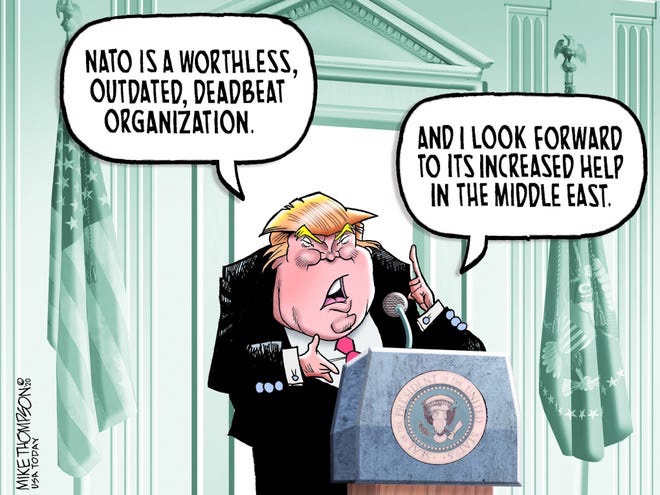
And how successful you’ve been. Once again, America stands tall—alone—on the world stage. A beacon of something. Not leadership, not trust, not stability, but definitely attention. Allies squint at us the way one squints at a raccoon holding a lit match: fascinated, concerned, backing away slowly. Treaties are optional. Diplomacy is for the weak. Subtlety is for losers. Why work with the world when you can antagonize it and then demand applause for your bravery?
You promised us chaos, and by God you delivered. Markets jittery? Check. Institutions strained? Check. Norms shredded like classified documents in a Mar-a-Lago bathroom? Check. America once again reduced to a cautionary tale told in international relations classes: “And here we see what happens when grievance becomes governance.”
But let’s be fair. You didn’t just bring us back to chaos—you brought us back to a familiar chaos. The warm, nostalgic chaos of daily outrage, late-night constitutional crises, and waking up every morning wondering which ally we insulted, which law we bent, and which group we blamed before breakfast. It’s comforting, really. Like returning to a hometown you escaped, only to remember exactly why you left.
And the tone—oh, the tone. Regal. Vindictive. Perpetually aggrieved. A king who must always be praised, never questioned, and constantly reassured that everyone is being very unfair to him. A ruler whose greatest achievement is convincing millions that accountability is oppression and loyalty is patriotism. Long live the monarchy, where elections are suspicious, judges are enemies, and the press is treasonous unless it’s clapping.
So thank you, Donald Trump. Thank you for bringing us back to a world we always feared but somehow never quite wanted. A world where America is louder but weaker, prouder but smaller, and endlessly consumed with protecting one man’s ego at the expense of everything else. A world where “greatness” is measured not by how well a nation functions, but by how often its leader appears on screen.
Today, we mark the anniversary. Not with celebration, but with recognition. You kept your promise. And now we all get to live with it.
Once upon a time—back when the Constitution was still treated like a governing document and not a collectible trading card—American politics involved an almost quaint idea: you voted for someone, not forgave them for everything forever. Presidents were leaders, not messiahs; flawed humans, not action figures still sealed in ideological plastic.
Yes, Franklin Delano Roosevelt won four elections, but let’s recall a few inconvenient details. The country was clawing its way through the Great Depression and then fighting World War II. Americans weren’t swooning; they were clinging to continuity while the world was literally on fire. That wasn’t a cult of personality—it was a foxhole election.
Abraham Lincoln? Half the country hated him so much they seceded. The other half mostly tolerated him because the alternative involved dissolving the nation. If Lincoln were alive today, cable news would brand him “divisive,” and some think tank would accuse him of “weaponizing the Emancipation Proclamation.”
Teddy Roosevelt was wildly popular, charismatic, larger than life—a genuine American superhero who wrestled history into submission with his bare hands. And yet, people still voted against him. Imagine that. Liking a president and still opposing him. A concept so radical today it would cause a panel discussion meltdown.
John F. Kennedy inspired hope, youth, and idealism. He was admired, criticized, challenged—and tragically assassinated before even finishing one term. No golden statues. No “JFK can do no wrong” yard signs still haunting lawns sixty years later. Just history, complicated and unfinished.
Fast-forward to Barack Obama. Democrats liked Obama—some loved him—but when he messed up, we complained. Loudly. Liberals criticized drone strikes, immigration policy, Wall Street bailouts. There were protests. There were op-eds. There were arguments. No one insisted that reality itself had to bend to protect his ego.
Republicans, of course, had Ronald Reagan—Saint Ronnie of the Blessed Tax Cut. And yes, criticism of Reagan was often treated like heresy, but even then, Republicans eventually admitted things like “Iran-Contra was… awkward.” George W. Bush was adored until Katrina, Iraq, and reality showed up like an uninvited guest. Then—remarkably—they let him go. The party moved on.
And then came Donald Trump.
Somewhere between reality television and grievance cosplay, American politics crossed the Rubicon into full-blown personality cult. Trump didn’t just demand loyalty; he demanded submission. Facts became optional. Institutions became enemies. Criticism became treason. Losing an election became impossible by definition, because the Leader cannot fail—he can only be betrayed.
This wasn’t conservatism. It wasn’t populism. It was fandom with nuclear codes.
In this new political religion, Trump is never wrong. If he contradicts himself, it’s strategy. If he insults veterans, judges, journalists, or democracy itself, it’s “telling it like it is.” If he loses, it’s fraud. If he wins, it’s destiny. The movement does not adapt; it calcifies. Former allies become heretics. Facts become conspiracies. Loyalty tests replace policy.
This is not how democracies work. This is how strongman myths work.
America used to elect presidents. Now a portion of the electorate has chosen a brand, complete with merch, slogans, and a persecution narrative that explains away all evidence. It’s no longer “Is this leader good for the country?” but “How dare you question him?”
That’s the tell. That’s the moment politics stopped being civic duty and became identity.
Democracy requires disagreement. It requires disappointment. It requires the ability to say, “I voted for you, and you screwed this up.” The moment a leader becomes untouchable, democracy becomes theater—and the audience is told to clap no matter what’s happening on stage.
So when did American politics become a cult of personality?
The moment loyalty mattered more than truth.
The moment criticism became betrayal.
The moment one man mattered more than the system itself.
And history, inconveniently, has seen this movie before. It never ends well.
It’s truly inspiring to watch the Moral Right practice its favorite Olympic sport: pretending not to notice things. Specifically, pretending not to notice that ICE only seems to discover “invasions,” “crises,” and “lawlessness” in places that voted blue. What an astonishing coincidence. California! Minnesota! Illinois! Seattle (yes, the entire city apparently counts as a sovereign menace now). All crawling with “terrible illegals doing terrible things,” according to the breathless cable-news whisper-scream.
Meanwhile, Texas and Florida—those red, white, and righteous strongholds—remain curiously protest-free, outrage-free, and largely ICE-swarm-free, despite housing millions of undocumented immigrants themselves. Millions. As in: the same people, doing the same jobs, living the same lives, mowing the same lawns, rebuilding the same hurricane-destroyed neighborhoods. But don’t worry, they’re different immigrants. You know—invisible ones.
Because apparently undocumented people become exponentially more dangerous the moment they cross a city limit where the electorate prefers Democrats.
Isn’t it fascinating how the Moral Right never asks why there aren’t ICE theatrics outside Mar-a-Lago-adjacent construction sites, or why meatpacking plants in deep-red counties don’t get nightly live coverage of agents in tactical gear? Why there aren’t candlelight vigils for “law and order” in the Florida strawberry fields or Texas oil towns? Why the moral panic GPS always reroutes itself directly to liberal cities?
The answer, of course, is simple: this has never been about immigration.
It’s about permission. Permission to punish political enemies while calling it patriotism.
If this were truly about crime, the data would be inconvenient. So it must be ignored. Historically, immigrants—documented or not—commit less violent crime than native-born citizens. That’s not a liberal talking point; it’s an empirical nuisance. But facts are terribly rude when they interrupt a good scapegoating session.
If this were about “the rule of law,” then enforcement would be boring, evenly distributed, and tragically lacking in made-for-TV moments. Instead, we get performative crackdowns in cities that dared to vote the wrong way—complete with press releases, militarized optics, and a carefully curated villain of the week.
And if this were about morality—actual morality, not the cosplay version—there might be some self-reflection. Some recognition that exploiting undocumented labor for decades and then criminalizing its existence is not righteousness; it’s a racket. A racket that requires selective blindness and very loud shouting.
So when the Moral Right asks, “Why are there protests?” the better question is:
Once upon a time—specifically April 1861—state troops fired on federal troops at Fort Sumter, and America discovered that the phrase “It can’t happen here” has always been more of a vibe than a plan. Cannons boomed, flags were lowered, and what followed was a civil war so catastrophic that we still can’t agree on how to teach it without starting arguments at Thanksgiving.
Fast-forward a century and a half, and we are told—again—to relax. This time, it’s not state troops firing on federal troops. No, no. That would be dramatic. Instead, it’s federal forces bearing down on civilians, wrapped in acronyms and tactical gear, assured by very serious men on cable news that this is all perfectly normal and definitely not something future textbooks will describe with phrases like “foreboding” or “grim turning point.”
After all, these aren’t soldiers, we’re told. They’re “enforcement.” They’re “homeland” something. And if the word homeland rings a bell, well, that’s probably just your imagination being historically literate again.
So what’s the endgame?
Because history teaches us that governments do not accidentally point guns inward. That is not a whoopsie. That is a choice. And when a government starts treating civilians like enemy combatants, the question is no longer if something breaks, but what breaks first: the law, the states, or the illusion that this is still a republic operating in good faith.
One can’t help but wonder—purely hypothetically, of course—whether the desired outcome is escalation. Wouldn’t it be convenient if state authorities finally snapped, if a governor said “enough,” if state forces confronted federal ones? Wouldn’t that create just the sort of “emergency” that ambitious men adore?
Enter the Insurrection Act, that dusty old lever in the glass case labeled Break Democracy In Case of Power Lust. Suspend elections. Declare order. Centralize authority. Explain, patiently and repeatedly, that freedom must be postponed for its own safety. Kings have always loved that line. It saves time.
And Donald—our would-be strongman with a persecution complex and a monarch’s appetite—surely knows his history well enough to recognize the pattern. Chaos justifies control. Conflict justifies crowns. And nothing says “temporary emergency powers” like powers that never quite go away.
The truly depressing part is that this isn’t even original. Every aspiring autocrat reaches for the same playbook, dog-eared and blood-stained, muttering that this time it’s different because this time they’re the hero.
But here’s the catch history keeps screaming at us from the margins: escalation only works if people take the bait.
The Civil War began when restraint failed—when rhetoric became cannon fire. Today, the danger is not just in the uniforms or the weapons, but in the invitation to overreact, to meet provocation with exactly the kind of chaos that authoritarians require to finish the job.
So no, we should not fall for it. We should recognize the pattern, name it, and refuse to audition for a tragedy we already know the ending to. America has already paid once to learn how this story goes.
It would be nice—just once—if we didn’t need a war to remember it.
Apparently, we are living through a thrilling new chapter of Christian theology—one not found in the Gospels, but apparently revealed via cable news chyrons, rally stages, and red baseball caps. In this revised edition, Donald Trump is not merely a deeply flawed man with a fondness for gold toilets and grievance-fueled monologues; he is The Chosen One. The anointed. The Messiah, but with worse hair and a much looser relationship with the Ten Commandments.
These self-styled “Christians” assure us that nothing about this is strange. It is perfectly normal, they insist, to worship a man who lies as easily as he breathes, who revels in cruelty, who boasts about wealth as virtue and vengeance as justice. After all, didn’t Jesus famously say, “Blessed are the ruthless, for they shall own the libs”?
And ICE—oh, ICE—is simply law and order doing its wholesome, God-fearing work. Families torn apart? Children caged? People disappeared into detention centers with no meaningful due process? Totally fine. Completely natural. Definitely not reminiscent of anything ugly from history. How dare anyone mention Germany in 1933, or Hitler’s brown shirts, or a state apparatus that used “security” and “homeland” rhetoric to justify terror against the “undesirable.” That’s different, they say. This is Homeland Security, which is obviously just about safety and apple pie, not nationalism wrapped in fear and uniforms.
The word homeland, we’re told, has no historical baggage whatsoever. Pure coincidence. No echoes. No warning signs. Just an innocent term used by a government increasingly obsessed with purity, loyalty, and enemies within. Anyone who hears alarm bells must hate America—or Jesus. Possibly both.
What makes this theological gymnastics routine truly Olympic-level, though, is how completely it ignores the actual story of Jesus Christ. You know, the undocumented Middle Eastern Jew. The one born into poverty. The one whose family fled state violence. The one arrested by an occupying empire, denied due process, publicly humiliated, and executed—with enthusiastic cooperation from his own people who preferred order and comfort over inconvenient compassion.
By modern standards, Jesus would be stopped at the border, detained, interrogated, and deported—assuming he wasn’t first labeled a threat to public order. He preached love for the stranger, mercy over law, and care for the least among us. Which, in today’s political theology, makes him dangerously woke.
The irony, of course, is so thick it could be spread on communion bread. The very people who claim to worship a crucified refugee see no resemblance between Rome’s treatment of Jesus and America’s treatment of undocumented immigrants. None at all. To suggest otherwise is “offensive.” History, after all, is only relevant when it flatters us.
So here we are: a movement that drapes itself in crosses while cheering policies that would have nailed their own Messiah to one. A faith that preaches love, wielded as a club. A Christianity so unrecognizable that if Jesus himself showed up, they’d call ICE—and congratulate themselves for defending the homeland.
Here we are, folks, standing ankle-deep in the Upside Down, staring at the sky and wondering when gravity quietly filed for divorce.
Once upon a time—cue the grainy parchment and powdered wigs—George Washington did the unthinkable. He won a revolution, could have crowned himself King George the First (American Edition), and instead said, “Nah, two terms is plenty,” then went home. He didn’t tweet about it. He didn’t threaten Mount Vernon with martial law. He just… left. This single act of restraint set the tone for a republic built on the radical idea that leaders are temporary and the country is permanent.
Then came Abraham Lincoln, who quite literally held the nation together with words, grit, and an almost supernatural patience while half the country tried to tear itself apart. The Civil War ended, the Union survived, and for a brief, shining moment, the lesson seemed clear: division is expensive, stupid, and deadly.
Teddy Roosevelt barreled into the 20th century like a mustachioed force of nature, busting trusts, backing unions, and suggesting—wildly—that maybe the government should protect people from being ground into dust by monopolies. Woodrow Wilson stumbled us through World War I, imperfectly and often awkwardly, but still managed to get us out the other side intact. Then came FDR and Truman, guiding the country through World War II and its aftermath, leaving the United States with something resembling moral authority and global credibility. Eisenhower, the general who knew exactly what war costs, warned us about the military-industrial complex while keeping the Cold War from going thermonuclear. Kennedy, LBJ—flawed men, certainly—but still operating within the shared assumption that democracy was the point of the exercise.
Even Nixon, bless his deeply crooked heart, at least had the decency to resign when caught red-handed. The system worked, if only because shame was still a thing that existed.
Fast-forward to 2008. The United States elected its first Black president. History was made. Progress was visible. And for a certain segment of the population, this was apparently the final straw. Somewhere, the ghosts of Confederate generals perked up and said, “The Civil War isn’t over yet, boys.” From that moment on, reality began to bend.
Enter Donald Trump, a man who looked at democracy and said, “This seems inefficient. Have we tried me instead?” A man who treats the Constitution like a suggestion box and elections like a personal insult. A man who flirts openly with autocracy while insisting—hand on heart—that he alone represents “freedom.” In this Upside Down, the president doesn’t just challenge norms; he suplexes them through a table and calls it leadership.
And now we arrive at the truly surreal chapter, where the United States, once the awkward but dependable anchor of NATO, is apparently alarming its own allies to the point that Germany, Canada, and other NATO nations are sending troops and warships to protect Greenland—from us. Greenland. The giant icy place we once tried to buy like it was a slightly used hotel. Somewhere, Eisenhower is spinning so fast he could power the Eastern Seaboard.
We’ve gone from “peaceful transfer of power” to “is he the president of Venezuela now?” From alliances to threats, from norms to tantrums, from “government of the people” to “government of the ego.” Up is down. Truth is optional. Autocracy is marketed as patriotism. And democracy is treated like a nuisance that keeps getting in the way of greatness.
So yes, we are living in the Upside Down—a place where restraint is weakness, loyalty to one man is confused with love of country, and history is something to be rewritten with a Sharpie. The scariest part isn’t that the rules are broken. It’s that a large chunk of the country is cheering while they shatter, convinced that this time, somehow, gravity won’t matter.
The Incredible, Gravity-Defying Art of Cognitive Disconnect
There is a special kind of intellectual yoga happening in this country right now, the kind that should require a waiver and a spotter. It’s the sort of mental contortion that allows someone to say, without irony or shame, that Renee Good deserved to get shot, because reasons—while simultaneously clutching pearls about “law and order” and the sanctity of American justice.
Because obviously, in this version of reality, bullets are just consequences with better marketing.
Let’s admire the logic on display. Renee Good, a U.S. citizen, ends up dead after an encounter with federal agents, and the immediate reaction from a certain crowd is not “What went wrong?” or “Why did this escalate?” but instead:
“Well, she must have done something wrong.”
Of course she did. Someone always must have. Otherwise we’d have to admit that the system—our system—can be reckless, brutal, or wrong. And that would be uncomfortable.
Now, here’s where the cognitive disconnect really earns its merit badge.
We’re told, repeatedly and loudly, that all undocumented people are drug dealers, murderers, and existential threats to the republic. Not some. Not a statistically demonstrable portion. All. Every nanny, farmworker, dishwasher, and construction worker is apparently running a cartel in their spare time. And therefore, they should be “dragged out by their hair,” expelled, or worse—because cruelty, when branded as policy, suddenly becomes patriotism.
And if an American citizen gets “wrapped up in that”?
Well… that’s just the way it is.
Collateral damage, baby. Freedom isn’t free, but it is apparently very cheap when the wrong person is paying.
But now—now—enter the plot twist that short-circuits this entire moral universe:
The man sitting in the White House is a 34-count convicted felon, found guilty by a jury of his peers. You know—that jury system everyone claims to revere. The cornerstone of justice. The sacred process.
Funny how that works.
When a jury convicts someone you don’t like, it’s “proof the system works.”
When a jury convicts someone you worship, suddenly the courts are rigged, the jurors are corrupt, and reality itself is fake news.
It’s almost as if “law and order” was never about law or order at all.
And here’s the truly magical part:
If you’re a Democrat, or if you’re Brown, or—God forbid—both, you’re automatically a demon. No trial required. No nuance allowed. You’re a threat, a parasite, an invader. Deportable. Executable. Disposable.
But if you’re powerful, wealthy, loud, and politically useful?
Thirty-four felonies are just “technicalities.” Sexual assault verdicts are just “opinions.” Accountability is just “persecution.”
The same people who scream that undocumented immigrants don’t “respect the law” will bend themselves into philosophical pretzels to explain why their guy should be exempt from it. The same people who justify death over alleged wrongdoing will suddenly discover the concept of mercy when it benefits them personally.
This isn’t hypocrisy anymore. Hypocrisy implies shame.
This is moral bankruptcy with a flag sticker slapped on the bumper.
And so we arrive at the final conclusion of this twisted logic maze:
Some people deserve due process.
Some people deserve bullets.
And which category you fall into has less to do with what you’ve done and more to do with who you are, how you vote, and how much melanin you have.
If that makes you uncomfortable, good.
It should.
Because a society that can justify killing a citizen while excusing criminality at the top isn’t confused—it’s revealing itself. And what it’s revealing isn’t strength, patriotism, or justice.
It’s fear. Wrapped in slogans. Armed with excuses.
And desperately hoping no one notices the disconnect.
At some point in every national meltdown, a person has to ask themselves a very simple, very American question: Is there at least one silver lining in this flaming dumpster being pushed downhill by clowns? Because if there isn’t, we’re all just doom-scrolling ourselves into an early grave.
Let’s recap the highlights of the current shit show. U.S. citizens getting murdered. Others being abducted like we’re auditioning for a low-budget geopolitical thriller. The Orange Menace in the White House casually announcing—between rage posts and capitalization errors—that he is now, apparently, the de facto president of Venezuela. Because sure, why not. That’s how sovereignty works now: you just call dibs. And if that weren’t enough, there’s the ongoing, obsessive, toddler-at-Target fixation on acquiring Greenland. Not for science. Not for diplomacy. Just vibes. Big “I saw it on a map and want it” energy.
It’s exhausting. It’s absurd. It’s dangerous. And it’s all happening at a volume so loud and constant that it’s become background noise—like a smoke alarm we’ve collectively decided to ignore because, technically, the house hasn’t fully collapsed yet.
But here’s where I cling—white-knuckled—to the idea that something good might come out of this mess.
Maybe, just maybe, people are finally waking up.
Because it turns out that “bad government” isn’t some abstract civics-class concept you can shrug off with “well, politics doesn’t affect me.” Bad government doesn’t stay politely contained in C-SPAN hearings and talking-head panels. It shows up in real bodies, real borders, real lives disrupted or ended. It shows up when chaos becomes policy and cruelty becomes branding.
And suddenly, that smug little comfort phrase—it doesn’t affect me—starts aging like milk.
Good government, on the other hand, is boring in the best possible way. It fixes roads. It prevents wars instead of inventing them. It treats human lives like something more than expendable props in a strongman fantasy. It doesn’t make the entire planet wake up every morning wondering what unhinged announcement is coming next.
Bad government makes everyone’s life miserable. Not just “those people.” Not just someone else’s kid. Everyone. Markets jitter. Allies recoil. Laws bend until they snap. And the rest of us are left standing there, staring at the wreckage, being told this is actually strength.
So yes—through the murders, the abductions, the delusions of imperial grandeur, and the international hostage-taking masquerading as leadership—I am choosing to hope. Not because things are fine (they very much are not), but because the mask is finally off.
This isn’t theoretical anymore. This isn’t partisan sport. This is the cost of incompetence, ego, and authoritarian cosplay playing out in real time.
If there is any good news at all, I hope it’s this: that enough people finally understand that government matters. That competence matters. That decency matters. And that shrugging while everything burns is not neutrality—it’s surrender.
Let this be a wake-up call. Because the snooze button has already cost us enough.
Here we go again. I hate that I even have to write this. I hate that it feels like I’m “harping,” as if repeatedly objecting to someone being shot to death is some tedious personality quirk, like always bringing up the check too early at dinner. But yes—let’s harp. Because Renée Nicole Good was shot in basically cold blood, and the reaction from the right has been a master class in moral gymnastics so advanced it deserves its own Olympic event.
Miss Good was a 37-year-old mother of three. Past tense. Three kids who will now grow up with an empty chair at birthdays, graduations, and holidays. That should be the beginning, middle, and end of the story. Full stop. Except somehow—somehow—it isn’t.
Because when the victim doesn’t fit the approved ideological mold, the script flips instantly.
When anyone so much as quoted Charlie Kirk’s own words back to him—Charlie Kirk, a noted professional agitator whose entire brand is poking bears with a microphone—people were immediately told to calm down. “Watch your tone.” “Don’t inflame tensions.” “Violence is never okay.” Suddenly everyone was a monk of nonviolence, clutching pearls so hard you’d think they were being paid by the rosary.
But now?
Now a woman is dead, and the same crowd has decided we’re no longer talking about a human being. We’re talking about a label. An “agitator.” A troublemaker. A person who, by some deeply warped logic, apparently opted into being shot the moment she failed the ideological purity test.
Funny how that works.
She is no longer Renée. No longer a mother. No longer a daughter, a friend, a coworker, a person who woke up that morning not planning to die. No, now she’s a convenient noun—agitator—which, in this moral universe, functions like a magic spell. Say it out loud and suddenly bullets become understandable. Regrettable, maybe, but understandable. Almost… inevitable. Tragic, sure—but in the same way a house fire is tragic when someone forgot to blow out a candle.
And let’s be very clear about what’s happening here:
This is retroactive justification of violence.
It’s the quiet, cowardly kind. The kind that doesn’t pull the trigger but shows up afterward with a thesaurus and a shrug. The kind that says, “Well, you know how things are these days,” as if “these days” naturally include people being executed for being on the wrong side of a political mood swing.
We are told, yet again, not to be emotional. Not to politicize it. Not to “rush to judgment.” But judgment seems to come awfully fast when the deceased isn’t useful as a martyr. Then suddenly everyone’s an armchair prosecutor, eager to explain why empathy should be withheld this one time.
And no—this is not about agreeing with everything Renée Nicole Good ever said, did, or believed. That’s the laziest dodge of all. Basic human worth is not a subscription service you cancel when someone annoys you.
A woman is dead.
Three children lost their mother.
And the response from a certain corner of the political universe is to argue—out loud—that she essentially earned a bullet.
If that doesn’t horrify you, then spare me the lectures about civility, law and order, or the sanctity of life. You don’t get to cosplay as defenders of morality while tripping over yourselves to explain why someone’s death is acceptable.
So yes, I’ll keep harping on it.
Because the moment we stop harping is the moment this kind of thinking becomes normal.
And once that happens, the question isn’t who deserved it.
You must be logged in to post a comment.