I hope you’re taking a moment to breathe, smile, and feel proud. The last election cycle brought some real victories—proof that when people show up, speak out, and believe in better, change can happen. You earned the right to celebrate that.
But—and I know this sounds like a contradiction—don’t get too comfortable. The work isn’t done. Not even close. “Demolition Don” and his crew are still lurking in the halls of power, doing their best to roll back progress, twist the truth, and convince the world that chaos is leadership. They may have been shaken, but they haven’t been stopped.
That’s why we can’t lose momentum now. Every conversation, every vote, every act of civic courage still matters. The future doesn’t protect itself—we protect it, together.
So celebrate, but keep your sleeves rolled up. The road ahead is long, but we’ve proven that we can walk it—and win.
Just when America thought it was safe to turn on the lights again after Halloween, cue the eerie violin strings — because he’s back. That’s right: Miller the Little Nosferatu, the pallid phantom of policy, has once again risen from the bureaucratic graveyard to terrorize the halls of the Executive Office.
You thought the garlic-scented press releases and the holy water of public outrage would keep him away? Ha! You fool. You absolute naïve optimist. Every time you think he’s been vanquished, the door creaks open, the shadows lengthen, and there he is again — clutching another stack of sinister memos, eyes gleaming like cold printer toner.
The setup is pure B-movie gold:
Fog rolls down the corridors of power. Somewhere, a lone staffer drops a stapler and gasps. The camera pans to the darkened conference room where Miller is already there, whispering his latest “ideas” to a trembling aide. “It’s… just… a draft,” the aide stammers. But Miller only smiles that faint, soul-draining grin and replies, “It’s policy now.”
No matter how many sequels the nation endures — “Miller II: The Agenda Awakens,” “Miller III: Bureaucracy Boogaloo,” or the critically panned “Miller Forever: The Filibuster Rises” — the plot never changes. He feeds on fear, thrives in low light, and somehow always gets a new access badge.
Critics say the franchise has gone stale, that the jump scares are predictable. Yet every time we think we’ve reached the end, there’s one last scene: the camera zooms in on an office door marked “Adviser,” a faint scratching sound echoes from inside, and a voice hisses, “I have a new draft for 2025…”
Can holiday cheer survive the sequel? Will Christmas make it to the third act? The jury’s still out — but if history is any guide, the credits will roll right as Miller’s hand claws its way out of a filing cabinet, clutching another grim proposal.
So this is America — land of the free, home of the brave, and apparently the battleground for deadly deli warfare. In a world where mass shootings, political corruption, and corporate crimes barely raise an eyebrow, our ever-vigilant ICE enforcers have found a new menace to public safety: sandwiches. Because nothing screams “domestic threat” quite like a rogue BLT flying through the air.
The story practically writes itself. Some poor soul gets accused of assault — not with a gun, not with a knife, not even with a rolling pin — but with a sandwich. And not just a quick, laugh-it-off moment of bad judgment. No, our nation’s “tough and ready” ICE-inspired justice crusaders wanted it treated as a felony. Because, you know, bread and turkey slices are basically weapons of mass destruction. Somewhere in a secret government bunker, there’s probably a PowerPoint slide titled “Lunchmeat Lethality: The Hidden Danger.”
Luckily, someone in the system must have realized how absurd this was, because it was ultimately reduced to a misdemeanor. But then — because apparently common sense is too boring — they took it to a jury trial. A jury. Over a sandwich. Twelve citizens of the United States, summoned from their daily lives, forced to sit there and listen to arguments about the physics of ham-based aggression and whether lettuce counts as “intent to harm.”
By the end, even the jury couldn’t take it seriously. The whole courtroom must’ve felt like an SNL skit that forgot to end. You can almost hear the foreman saying, “We find the defendant… guilty of poor aim, maybe, but otherwise not guilty.”
In the grand theater of American justice, this was a masterclass in misplaced priorities. We live in a country where corporate polluters get slaps on the wrist and political grifters walk free, but heaven forbid someone weaponize Wonder Bread. The whole episode proves one thing: when bureaucracy loses perspective, even lunch can be treated like a crime scene.
So next time you make yourself a sandwich, beware. Somewhere out there, an overzealous officer might be watching — ready to declare your lunch a lethal weapon.
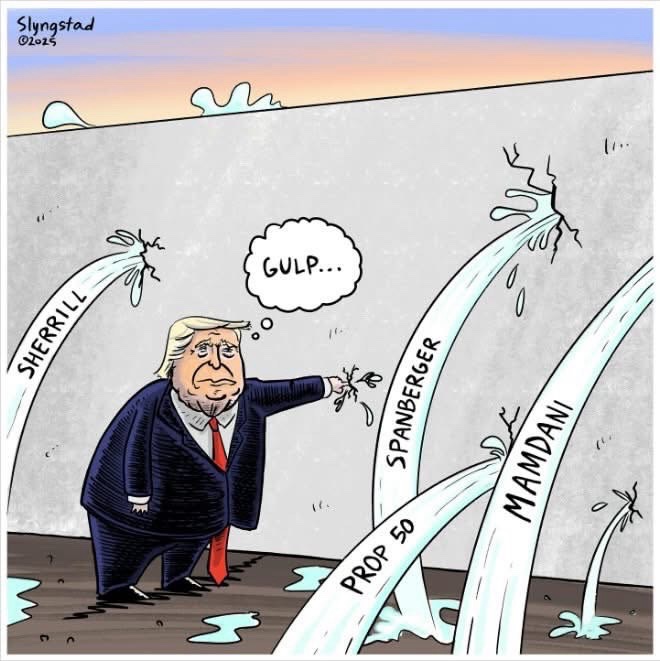
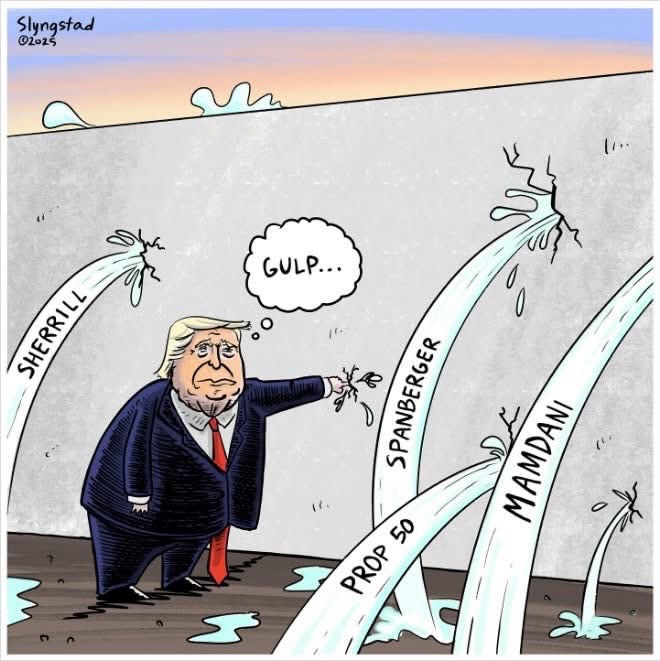
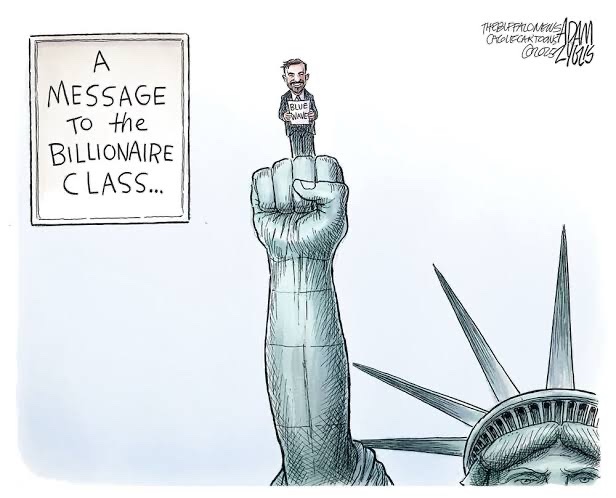
Well, well, well — look who just got a reality check wrapped in a tsunami of blue ballots. Yes, folks, the “massive red wave” that Donald Trump and his loyal GOP disciples promised us turned out to be more like a red puddle — and not even a deep one. Meanwhile, Democrats surfed in on a blue wave so big it should’ve come with FEMA warnings and free sandbags for the Republican National Committee.
Now, you’d think after getting politically body-slammed by the voters, the GOP might pause, take a breath, and say, “Hey, maybe our message isn’t landing!” But no. That would require something that’s apparently harder for Donald J. Trump to do than admitting he lost an election — namely, facing facts.
According to Donny, the losses weren’t really losses. Oh no. It was the shutdown’s fault. Or the media. Or low turnout. Or Mercury being in retrograde. Anything, really, except the possibility that Americans are tired of cruelty as policy and delusion as leadership.
Republicans are out here trying to explain away an electoral face-plant while insisting voters are the problem. Meanwhile, Trump, in his usual reality-optional fashion, continues to act like his political genius is unquestioned. After all, how could a man who “won by a lot” in 2020 possibly be responsible for losing anything? Clearly, it’s rigged — again — by the vast conspiracy of people who can count.
Let’s be clear: this wasn’t just a loss; it was a wake-up call the size of a church bell. Voters shouted, “We care about the cost of living! We care about healthcare! We care about functioning democracy!” And the GOP responded with, “But what about drag queens and Hunter Biden’s laptop?”
Trump’s followers are now performing post-election autopsies without ever touching the actual corpse. “It’s fine!” they say. “We just need Trump on the ballot next time!” Sure. Because nothing screams “winning strategy” like doubling down on the guy who already lost the popular vote twice, oversaw midterm losses, and inspires turnout — for the other side.
The truth is simple, if you dare to look: voters want leaders who solve problems, not just perform tantrums. But Trump and company are too busy rearranging the deck chairs on the S.S. MAGA to notice that the iceberg of public opinion has already torn a hole in their hull.
In the end, the blue wave didn’t just knock over the GOP’s sandcastle — it exposed the foundation of delusion holding it up. And while the rest of the party is finally rubbing its eyes, bleary from the shock, Donny is still hitting the snooze button on reality, insisting that the alarm clock is fake news.
They say a picture is worth a thousand words — which might explain why Donald Trump and his loyal band of dimly lit disciples are flooding the nation with a thousand pictures that completely betray every word they speak. If irony could be photographed, we’d have an entire gallery exhibit by now, sponsored by Truth Social and curated by whatever intern still hasn’t quit in disgust.
Take, for instance, their self-proclaimed crusade to “round up criminals and child predators.” Sounds noble enough until you actually see the pictures — mothers clinging to their sobbing children as federal agents drag them away under floodlights, families separated like contraband, toddlers screaming as they disappear into the bureaucratic night. Those aren’t criminals; they’re collateral in a moral panic dressed up as “law and order.” The administration tells us they’re saving America, but the photos tell another story — one of state-sponsored cruelty, documented in high definition.
Then there’s Donald himself, the self-declared builder. “I’m rebuilding this country better than ever before,” he boasts — as if words alone could wallpaper over the decay. Meanwhile, the literal and figurative demolition continues. We watch the East Wing of the White House being torn apart, both in metaphor and (apparently) in practice. It’s a fitting image: the house of democracy gutted from within, stripped down to its studs while he insists it’s never looked better. It’s like watching someone torch their home while bragging about the warmth.
And as for “freedom of speech”? Trump and his GOP chorus love to clutch their pearls about the “silencing of conservative voices” — all while the cameras show peaceful protesters being shot with rubber bullets and choked by clouds of tear gas. The same people who claim they’re defending the First Amendment are the ones turning it into target practice. The right to protest, once a cornerstone of democracy, is treated like an inconvenience — something to be dispersed, subdued, and erased. Freedom, it seems, is only sacred when it flatters them.
Even his talk of “strength” and “defense” conjures visuals no PR team could salvage. When Trump muses about restarting nuclear testing — as if the world didn’t already have enough problems — those of us who grew up in the Gen X era can’t help but see the flickering images of mushroom clouds from Cold War documentaries. The flash, the blast, the fallout — these aren’t metaphors. They’re memories, and they’re terrible optics for a man who insists he’s bringing peace through power.
This is the paradox of the Trump era: words and images are in open rebellion. His rhetoric paints a paradise; his imagery depicts a dystopia. He says “America First,” and the cameras show America fractured. He says “freedom,” and we see protesters bleeding in the streets. He says “unity,” and the only thing uniting us is collective nausea at the daily news cycle.
What’s worse, many of these images are real — and the ones that aren’t might as well be. Because Trumpism is as much psychological theater as it is political movement. Even when we imagine the images — the stormtrooper-like ICE raids, the bombastic parades of authoritarian pageantry, the orange glow of his rallies — they feel real because they could be. He’s trained us to expect the worst and then tells us to call it patriotism.
A picture may be worth a thousand words, but in the Trump era, it’s also worth a thousand lies. Each snapshot exposes the chasm between what they say and what they do — a dystopian scrapbook of deceit, denial, and destruction. If history is written by the victors, then this chapter will be illustrated by the victims — the faces in the photographs, the ones whose stories don’t match the slogans.
In the end, the images will outlast the speeches. Words fade, but pictures haunt. And when the history books close on this dark chapter, it won’t be Trump’s slogans people remember — it’ll be the photos: the crying children, the demolished walls, the protesters gasping through smoke, the clouds rising on the horizon. The truth, frozen in pixels, will speak louder than any lie ever could.
What a glorious time to be alive in America—the land where compassion goes to die on the steps of the Capitol. Once again, the government is closed for business, and Speaker Mike Johnson and his merry band of GOP absolutists are proudly standing in front of the locked doors, polishing their halos of “fiscal responsibility” while sharpening their knives of cruelty. Because, you see, cruelty isn’t a side effect anymore—it is the policy. It’s the message. It’s the whole aesthetic.
Let’s be honest: the Republican Party hasn’t exactly been shy about its priorities. Feed hungry kids? Nah. Fund nutrition for struggling families? Maybe later. But shut down the government to make a point about how mean they can be to the people who need help the most? Now that’s the stuff of true conservative valor! They’re not negotiating, they’re staging performance art. The cruelty is the canvas, the suffering is the brushstroke, and Mike Johnson is out here painting his masterpiece titled, “Fiscal Sanctimony in Red, White, and Starve.”
Their “offer” to reopen the government is a thing of beauty. They’ll release SNAP benefits—money that’s legally owed to families who are already living on fumes—if Democrats will just take them at their word that they’ll talk about maybe, possibly, at some unspecified future date, doing something vaguely related to extending ACA benefits. You know, that same Affordable Care Act they’ve been trying to kill since before it even took its first breath. The one that originated from their own think tank, the Heritage Foundation, back when the GOP still pretended to have ideas instead of just grievances. The plan that Obama took, scrubbed off the conservative branding, and actually made functional—an unforgivable sin in Republican theology.
So here we are, watching the same movie for the hundredth time: the GOP holds the country hostage, demands that the Democrats “negotiate,” and then defines “negotiate” as “agree to defund everything that keeps poor people from dying.” And if Democrats dare say no? Well, Mike Johnson and friends will gladly let children go hungry, let families miss rent, and let basic services grind to a halt—all while assuring the American people that this is for their own good. It’s like being mugged by someone who tells you they’re teaching you a valuable lesson about fiscal discipline.
But it’s not about money. It never has been. It’s about cruelty as proof of conviction. In this new moral order, empathy is weakness, compromise is sin, and governance is just another form of extortion. Every press conference is a sermon about “personal responsibility,” as if a 6-year-old trying to eat dinner on $2 a day should really just bootstrap harder. Meanwhile, Mike Johnson sits in his office, Bible open, chin lifted to heaven, apparently confident that God’s plan includes starving the poor to save the rich from mild inconvenience.
So yes, the government remains closed—not because it has to be, but because they want it to be. Because the pain is the point, the suffering is the strategy, and the cruelty is the calling card.
And when the lights finally flicker back on in Washington, don’t expect an apology. Expect a victory lap. After all, in today’s GOP, there’s no greater proof of “strength” than watching the weakest among us fall—and calling it freedom.
The White House cleaning staff must be on double overtime again, poor souls—armed with rubber gloves, mops, and trauma from years of tomato-based temper tantrums. With blue wins spreading like common sense across the nation, one can only imagine the scene inside the executive dining room: the current occupant of the White House (you know, the one with the spray-tan hue that could double as a Cheeto warning label) furiously hurling condiments against the wall as democracy once again refuses to play along with his delusions.
America, it seems, has dared to speak—again—and the message couldn’t be clearer: we’re tired of being held hostage by a gang of performative patriots whose only consistent policy is cruelty with a smile. But here we are, still trapped in the worst hostage negotiation in modern history, with the government shut down while the GOP swears on a stack of imaginary Bibles that if we just sign their “clean” continuing resolution, they’ll graciously consider reopening the country.
They’re calling it a negotiation, but it’s more like being mugged and then thanked for your cooperation.
The Republicans, led by the ketchup-thrower-in-chief, promise that once Democrats cave, they’ll “release the funds” for things like SNAP benefits—basic food assistance for families who don’t have private chefs or golden toilets. How kind! How benevolent! Except… they legally have to do that anyway. It’s been in the rulebook longer than Trump’s been dodging tax returns. But the GOP is pretending it’s some grand gesture, like they’re freeing political prisoners instead of just doing the bare minimum required by law.
Then, in their most magnanimous tone, they claim they’ll discuss continuing the ACA subsidies—as if that’s a prize to be won and not a life-saving policy they’ve been trying to strangle since 2010. It’s almost adorable, watching them dangle something they have no intention of actually supporting. The entire Republican caucus talks about the ACA like it’s the devil’s own invention, conveniently forgetting it was their brainchild to begin with.
Yes, the Affordable Care Act—the great socialist nightmare that lets your grandma afford her insulin—was born not in the dark halls of Marxist fantasy, but in the beige boardrooms of the Heritage Foundation. A Republican idea. A conservative framework. And it was successfully implemented in Massachusetts by none other than Mitt “Corporate Ken Doll” Romney. The only real difference? Obama got it passed nationally—and added patient protections that made it something more than a corporate gift basket for insurers.
And that, of course, is the unforgivable sin. Obama didn’t just steal their idea—he improved it. He made it work for ordinary people, and not just for the donors who keep the GOP’s campaign coffers fat. Ever since, Republicans have been on a decade-long vengeance tour, trying to erase any memory of the fact that once upon a time, they stood for something other than grievance and performative outrage.
So as the nation watches the lights of democracy flicker during this self-inflicted government shutdown, we’re left with one undeniable truth: this isn’t governing—it’s hostage-taking with bad lighting. The GOP isn’t negotiating in good faith. They’re holding the American people for ransom, demanding concessions on programs they’ve never supported, all while pretending to be the reasonable adults in the room.
Meanwhile, in the White House, somewhere between the third Big Mac and the fifteenth “unfair” post on social media, a bottle of Heinz takes flight. And the cleaning crew sighs, reaches for another roll of paper towels, and mutters the same thing most of America is thinking right now:
“Can we please just get the adults back in charge?”
Donald John Trump has made one thing absolutely clear—he never intended to be the President of the United States. No, no—he wanted to be the President of Donald John Trump, a sovereign nation of one, surrounded by a loyal handful of subjects whose primary job is to clap, nod, and tell him he’s the greatest ruler the world has ever seen. The “United States” part is just a technicality, something written on the letterhead of his golf club stationery.
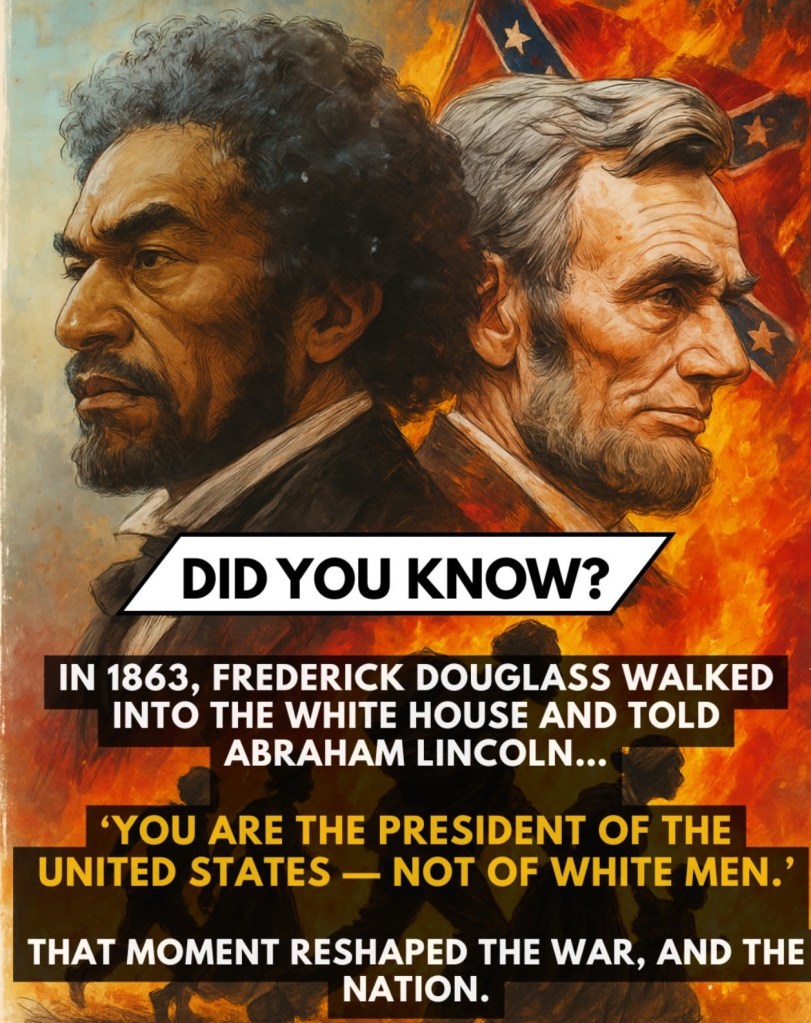
You can almost picture him staring at a portrait of Abraham Lincoln, wondering why “that tall guy with the sad eyes” keeps getting so much credit. Lincoln—the man who agonized over a divided nation, who wrestled with moral questions that shaped the very soul of America—had the nerve to listen to Frederick Douglass. Imagine that: a president who actually listened to someone smarter than him. Trump would never. Trump doesn’t listen; he broadcasts.
Even Lincoln had to be reminded by Douglass that he was president of all Americans, not just the white ones, the wealthy ones, or the ones who could vote. Douglass told Lincoln, in essence, “Sir, you’re the President of the whole country.” Trump, if he ever heard that, would say, “Wrong. Fake news. I’m the President of the real Americans—the ones who own MAGA hats and eat well-done steaks with ketchup.”
And then, of course, there was that unforgettable Trump moment: “Frederick Douglass is an example of somebody who’s done an amazing job and is being recognized more and more.” As if Douglass had just launched a new line of haircare products or dropped a fire new single on Spotify. The man’s been dead for over a century, but Trump made it sound like he was about to appear on The Apprentice: Abolitionist Edition.
If Lincoln was the president who struggled with the nation’s moral compass, Trump is the president who melted it down and sold it as limited-edition “Truth Social” merch. Lincoln spent sleepless nights contemplating the future of democracy. Trump spent sleepless nights doom-scrolling his own name and rage-tweeting about toilet water pressure.
Lincoln had Douglass. Trump has Rudy Giuliani. One advised on the moral conscience of a nation; the other sweats hair dye on live television and argues with landscaping companies about their parking lot bookings.
To Trump, being president was never about governance—it was about branding. The Oval Office wasn’t a place of history; it was a stage set. He wasn’t leading a country; he was starring in a reality show called The Apprentice: American Edition. The contestants? Every American citizen. The prize? His approval, which, like most Trump properties, is grossly overpriced and structurally unsound.
Lincoln’s legacy is the Emancipation Proclamation. Trump’s is the Self-Adoration Manifesto. Lincoln sought to unite a fractured nation; Trump seeks to fracture a united one, just to see his name trending again. Lincoln gave us “a government of the people, by the people, for the people.” Trump gave us “a government of the ego, by the ego, for the ego.”
So yes, Donald John Trump has no intention of being president for everyone. He never did. He wants to be president for those who worship him, defend him, and would gladly donate their last $20 to his legal defense fund. Everyone else? In his mind, they’re fake Americans—just like Frederick Douglass, who’s “doing an amazing job” somewhere in the great beyond.
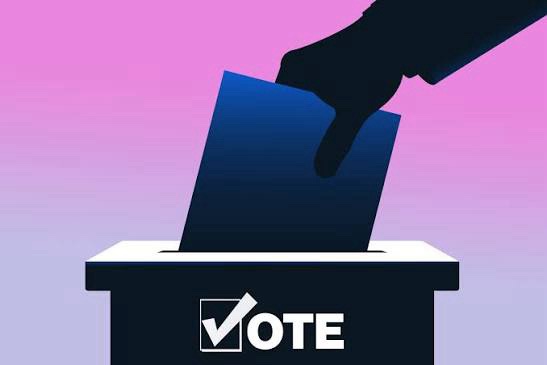
I know it’s an off year, but that doesn’t mean it’s an off moment for democracy. Across this great country, there are elections taking place that will shape our communities, schools, neighborhoods, and futures. Every vote—your vote—matters more than you might think.
I’m not here to tell you how to vote. That’s your choice, your right, your voice. I’m just here to remind you to use it. Because when you show up, you’re doing more than filling in a bubble or pressing a button—you’re standing up for the idea that we all have a say in the direction of our country.
So check your local election dates, find your polling place, and make a plan. Bring a friend if you can. Let your voice be heard loud and clear.
The name November has ancient roots that trace back to the Roman calendar. Its origin lies in the Latin word novem, meaning “nine.” This might seem strange today since November is the eleventh month of the year—but in the original Roman calendar, it was indeed the ninth.
When Rome’s early calendar was created—traditionally attributed to Romulus, the city’s legendary founder—it contained only ten months, beginning in March and ending in December. March (Martius) honored Mars, the god of war, fitting for a society of warriors; the year began with the season of campaigning. November, then, was simply the ninth month—mensis November—and it kept that numerical name even as the calendar evolved.
Later, under King Numa Pompilius (around 713 BCE), the Romans added January and February to the beginning of the year, pushing November to the eleventh position. Despite this change, the name stuck. The Romans, ever practical in some ways and stubborn in others, never bothered to rename the months to reflect their new positions. Thus, novem (“nine”), decem (“ten”), and so on, remained even though they no longer matched the months’ order.
November also carried symbolic meaning for the Romans. It was a time of harvest and preparation for winter, when the growing season ended and people turned inward, both literally and spiritually. The month was associated with rest, reflection, and the honoring of the dead, themes that survive in modern observances like All Saints’ Day and All Souls’ Day.
In short, November is a linguistic relic—a word that still bears the imprint of Rome’s earliest calendar. Its name is a reminder of an older world, when counting months began not in the chill of January but in the promise of spring.






 Esoteric Meandering Shouting Into the Void
You must be logged in to post a comment.