This idea may have been addressed before but sometimes repetition is good. With all the layoffs and the cruel havoc being created by the administration there may be some silver lining in this cloud. The president seems hell bent to involve National Guard troops, so why do the Govenors not just call up the guard and have them do what they are really trained to do, support the community. Every state has guardsman and equipment to support disasters, and if the homelessness crisis does not qualify as a disaster we are not paying attention. There are places that could serve to be emergency relief sights to at least feed and care for the sick and injured. There are other places that could be set up as shelter. That kind involvement would be a positive integration of troops in our communities. The interface of troops could help with positive action. Could this program make it easier to put active troops on the streets? Yes, and it would no doubt be exploited for that, but the guard would not be armed and the administrations idea is intimidation not assistance. Our active duty personnel must be reinforced trained with what powers they have and what the Constitution's directives are. Retrain on UCMJ and specifically what are the kinds of orders that are illegal under the law. The nation is caught in whirl wind of destruction and we need to find ways and means to calm the wind and save our democracy. This may be able to accomplish some small part of that larger goal.
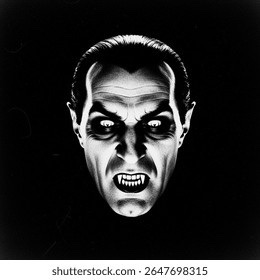
Every Halloween, when the moon hangs fat and pale and the wind mutters secrets through half-dead trees, one name inevitably rises from the grave: Dracula. No matter how many times we drive the stake, no matter how many times Hollywood “modernizes” him with slick hair and leather pants, the old Count just keeps coming back. He’s the pumpkin spice latte of horror — seasonal, enduring, and just a little overindulgent — yet undeniably irresistible.
But before he was the suave Transylvanian aristocrat in a velvet cape, he was Nosferatu, the rat-faced plague of shadows who brought nightmares to life in F. W. Murnau’s silent 1922 classic. Max Schreck’s gaunt, skeletal creature was less lover and more leper — a crawling disease that spread through Europe’s veins like death itself. Nosferatu wasn’t about seduction; he was pestilence wearing human form. That first cinematic Dracula was born not of romance but of fear — the fear of the unknown, the foreign, and the things that skitter just out of sight.
Then came Bram Stoker’s Dracula, and the monster gained a title, a home, and a taste for dramatics. Stoker’s 1897 novel married Gothic excess with Victorian repression — sex and sin draped in lace and fog. His Count was a corrupted noble, a fallen angel with an Eastern European accent, a cautionary tale about what happens when desire and decay dance too close. Dracula was both warning and temptation, a mirror held up to a society terrified of its own hunger.
And if we trace him back further — peel away the myth like so much decaying flesh — we find Vlad III of Wallachia, or Vlad Țepeș, the Impaler himself. The man who allegedly dined among forests of skewered enemies, his goblet raised in toast to the writhing symphony of human suffering he’d composed. Historians still argue whether he was a patriot, a sadist, or a little of both, but one thing’s certain: no PR team in history has ever had to work harder to rehabilitate a legacy. Vlad didn’t drink blood — he spilled it. Yet through Stoker’s alchemy, this medieval warlord became the template for every undead seducer since.
Over the centuries, Dracula has evolved — or rather, metamorphosed. From Bela Lugosi’s hypnotic gaze to Christopher Lee’s feral elegance, from Gary Oldman’s tragic romantic in Coppola’s fever dream to the reflective antihero of Castlevania and What We Do in the Shadows, the Count has worn a thousand faces but kept the same gnawing emptiness at his core. He’s not just a monster — he’s a mirror. Every generation remakes Dracula in its own image, projecting onto him whatever we fear or crave most.
In the 19th century, he embodied sexual taboo.
In the 20th, he became the symbol of corrupt power — the aristocrat feeding on the masses.
In the 21st, he’s a tragic immortal, cursed by loneliness, haunted by what eternity costs.
We pity him now. The predator has become the victim, a misunderstood soul seeking connection in a world that has long since moved past candlelight and crypts. He doesn’t stalk villagers anymore — he swipes right. His coffin’s got Wi-Fi, and even immortality can’t save him from existential dread.
Yet beneath every reinvention, the same pulse of horror beats: the fear of what never dies. Dracula isn’t scary because he drinks blood. He’s terrifying because he’s us — our hunger for control, our obsession with youth, our inability to let go. He’s the embodiment of every selfish wish whispered at midnight: let me stay young, let me stay beautiful, let me live forever.
And so, as Halloween fog curls through our streets and little vampires beg for candy under plastic fangs, remember this — Dracula doesn’t lurk in the castle anymore. He lives in the reflection you avoid when the lights are low, in that part of you that wonders what eternity might feel like if it didn’t hurt so damn much.
The Count never died. He just learned to adapt.
And somewhere, in the shadows of every October night, he’s still waiting — charming, tragic, and forever thirsty.
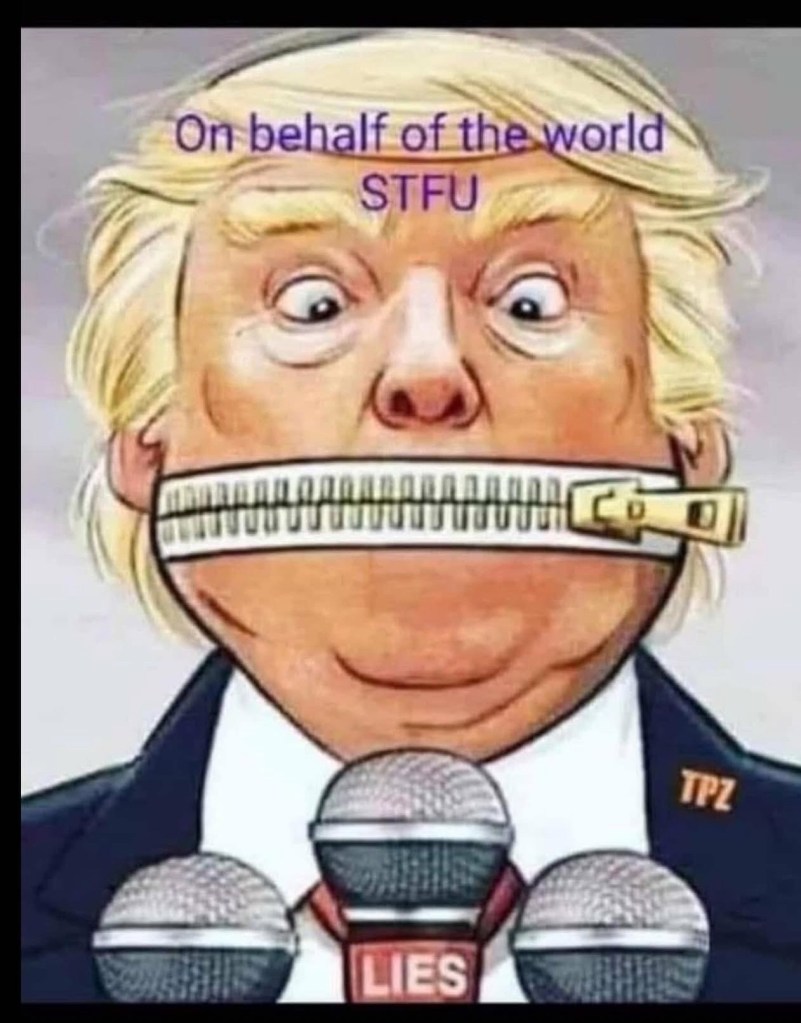
Donald John Trump. DJT. The Mango Menace. The Orange Moron currently staining the White House upholstery with bronzer and ego in equal measure. One might think that after years of public humiliation, failed coups, and an endless stream of word salads that make expired mayonnaise seem coherent, he’d have learned the fine art of shutting the ever-loving hell up. But alas, silence is for mortals. Trump, as he reminds us hourly, is something far greater: a walking, tweeting, shouting embarrassment factory running at full production.
It’s truly impressive—if you view it as performance art—that one man can manage to humiliate an entire nation before breakfast. He opens his mouth, and international diplomacy collectively facepalms. Every time a microphone approaches, allies brace, adversaries rejoice, and translators quietly resign. Somewhere in Europe, a NATO interpreter likely wakes up in a cold sweat mumbling, “What does ‘bigly’ mean?”
In the annals of history, Trump will stand as the first leader who treated international relations like a WWE promo—minus the charm and self-awareness. His global strategy seems to follow a strict rulebook: insult allies, praise dictators, mispronounce basic geography, and then demand applause. Remember when he looked lovingly into Kim Jong Un’s eyes and said they “fell in love”? The world cringed collectively so hard that the planet’s orbit probably shifted a few millimeters.
And yet, the Mango Menace trudges on—sniffing, shouting, and stapling his name onto every success that wasn’t his, from veterans’ healthcare to Middle East peace frameworks. The man has the political equivalent of Midas’ touch in reverse: everything he actually handles turns to flaming garbage, but he’ll slap a gold TRUMP on it and call it a masterpiece.
Internationally, he’s that relative who gets drunk at the wedding and insists on giving a toast no one asked for. Everyone tries to be polite, smiling through clenched teeth, while the Orange Moron launches into his speech about how he’s the best dancer in the room, the smartest man alive, and how the bride is only pretty because of him. Meanwhile, the rest of the planet stares into their champagne flutes, wondering when America will finally wrestle the mic away.
Even our closest allies can barely hide their exhaustion. When the British Parliament banned him from addressing them, that wasn’t diplomacy—it was self-preservation. When Trudeau smirked behind his back, it wasn’t petty—it was the sigh of a nation forced to coexist with a walking caps-lock tweet. And when Germany’s Merkel rolled her eyes, that wasn’t annoyance—it was history recording its disappointment.
At home, his fans treat him like a messiah with a golf handicap. But the rest of us? We’re just tired. Tired of waking up to see what fresh humiliation he’s exported overnight. Tired of watching the “leader of the free world” communicate exclusively in playground taunts. Tired of a man whose only policy position is “me good, everyone else bad.”
The truth is simple: we just want him to shut the fuck up. Not forever (though that would be a blessing), but maybe just long enough for the world to forget that America once handed its nuclear codes to a man who can’t spell “hamburger.”
So here’s to DJT, the Mango Menace, the loudest orange on the planet. May history remember him for what he truly is: an international embarrassment in a cheap suit, screaming into the void, forever convinced the echo is applause.
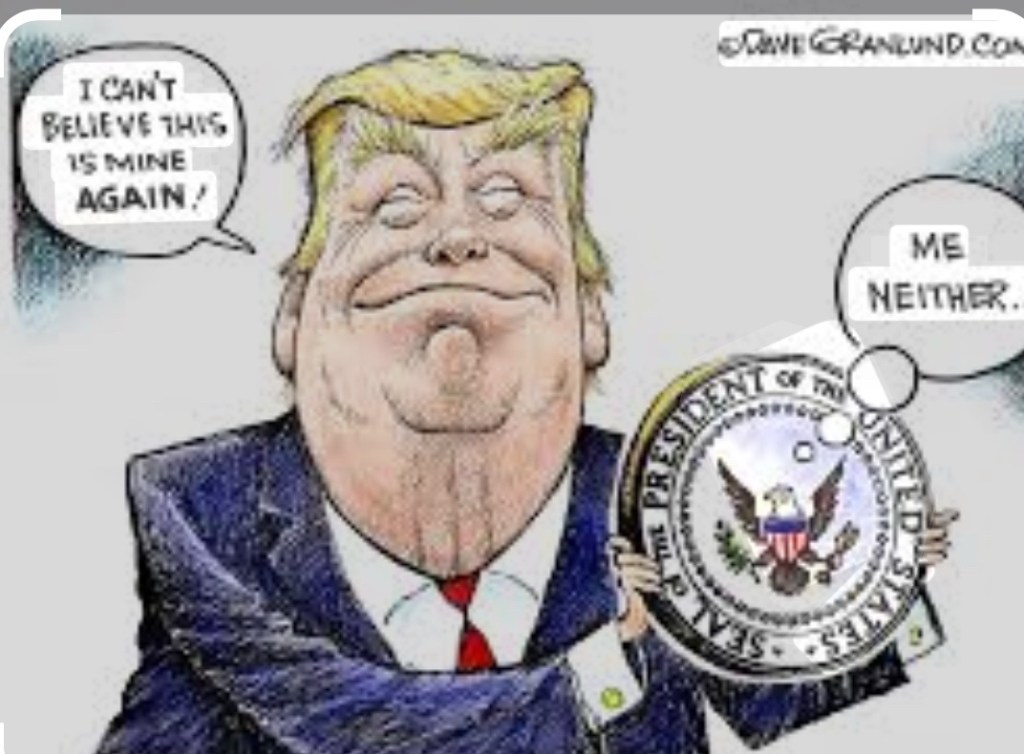
Donald Trump — the modern-day Michelangelo of marketing, the da Vinci of delusion, the Picasso of plastering his name on things he didn’t make. Truly, the man is a master craftsman of the art of the illusion. He’s not a builder; he’s a brand sticker. If the world were a refrigerator, Trump would be the magnet.
Let’s start with the myth that Donald Trump is some kind of titan of construction. The man has never so much as held a hammer unless it was for a photo op — and even then, the hammer probably had “TRUMP” engraved in gold leaf on the handle. Every “Trump Tower,” “Trump Hotel,” or “Trump Golf Course” is really the same story: someone else builds it, finances it, runs it, and maintains it — and then Donald swoops in at the last second to slap his name on it like a drunk toddler signing someone else’s homework. He’s basically the brand equivalent of a raccoon rummaging through someone else’s trash and saying, “Mine now.”
And oh, the political rebranding! It’s art, really. In his first administration, Trump stood before the cameras and triumphantly declared victory for “fixing the VA” and “helping our great veterans.” Stirring stuff — except, of course, the law he was bragging about was passed by Barack Obama. But who cares about facts when you have the power of a Sharpie and an ego the size of Manhattan? Trump didn’t build the system — he just took Obama’s policy, crossed out the signature, and said, “Look what I did, everybody! Tremendous!”
Fast-forward to today, and here we are again, watching the same sad rerun with the Gaza ceasefire deal. The framework was hammered out under Biden, but Trump, never one to let someone else get credit for actually doing work, has decided to ceremonially rub his political taint all over it and call it his own. Because that’s what he does — he shows up after the heavy lifting is done, slaps his name on the label, and then declares himself the savior of mankind. It’s like showing up at the end of a marathon, jogging the last 20 feet, and demanding the gold medal — while accusing the real runners of cheating.
But there’s a catch: if anything he actually touches goes south — say, an insurrection, an economic collapse, or a casino bankruptcy (for the fifth time) — suddenly it’s everyone else’s fault. The deep state did it. The Democrats did it. The cleaning lady did it. The dog ate the country’s homework. Trump is the only man in history who can claim to be both the omnipotent genius who makes everything great and the helpless victim who never did anything wrong — often in the same sentence.
He’s a marketing savant, no doubt. Trump can take credit for the sunrise and blame the sunset on Joe Biden. He could rename Mount Rushmore “Trump Mountain” tomorrow, and half the country would swear he carved it himself with his “very large, very strong hands.”
So yes, Donald Trump is great at rebranding. He’s built a career not on creation, but on credit-taking — a mogul of manufactured glory, the king of counterfeit achievements. He doesn’t build towers, he builds myths. And in Trump’s world, the truth isn’t something that’s constructed — it’s something that’s licensed.
If the modern Republican Party wanted to prove once and for all that it isn’t a nest of morally bankrupt degenerates shielding monsters, they’re doing an absolutely terrible job of it. Because nothing screams “we have nothing to hide” quite like holding Congress hostage to stop a vote on the Epstein files.
Speaker Mike Johnson — a man who never met a Bible verse he couldn’t weaponize — has decided that now, of all times, is the moment to play gatekeeper of congressional procedure. Arizona’s newly elected representative Adelita Grijalva waits, hand raised, ready to be sworn in. But Johnson suddenly discovers a deep love of “timing,” “recess protocol,” and “shutdown decorum.” How convenient that his newfound respect for process just happens to block the one vote that would bring the Epstein files — the full, unredacted rot — into the light.
It’s as if the GOP collectively said, “Sure, we’ll tank the government, torch the economy, and gut social programs — but God forbid anyone reads the Epstein documents.” The Republican leadership, the self-anointed guardians of “family values,” are treating those files like they’re the Ark of the Covenant. Don’t look too closely or your moral compass might melt.
Because let’s be honest: if the Epstein list were filled with Democrats, the files would have been plastered on Fox News before dawn, with Tucker Carlson narrating from a candlelit studio while Marjorie Taylor Greene reenacted scenes with sock puppets. The fact that the party is suddenly allergic to transparency tells us everything. You don’t barricade the vault unless you’re terrified of what’s inside.
So what’s in those files that’s worth stalling a member of Congress over? Is it Trump’s name, a few big-money donors, a handful of “family values” megachurch patriots? The silence from the GOP tells its own story — one of panic, guilt, and rot dressed up as righteousness.
Every excuse they offer, every delay, every procedural trick reeks of the same cowardice that defines their brand. The party that once claimed to protect children is now bending itself into moral pretzels to protect the predators. It’s not about justice, or privacy, or due process — it’s about survival.
If the Republican Party truly believed in innocence, they’d open the Epstein files tomorrow and let the chips fall where they may. But they won’t. Because this isn’t a party anymore — it’s a serpent pit, hissing in unison, slithering to cover its own trail.
The House of Vipers has chosen its hill to die on — and apparently, that hill is built on the bones of the truth.
Once upon a time, in the enchanted land of Right-Wing Make-Believe, there arose a fearsome menace called ANTIFA™ — an all-powerful, shadowy organization that apparently has offices, board meetings, a treasurer, and maybe even a seasonal bake sale. According to the fair and balanced storytellers of the realm, Antifa has HR policies, a pension plan, and an annual retreat where members gather to decide which American city they’ll “destroy” next — usually right after brunch.
Enter Pam Bondi (AKA) DOJ Barbie, standing gallantly before the cameras, hair perfectly sprayed into immovable formation, announcing that they would “tear down Antifa brick by brick!” — which is quite the heroic declaration considering there are no actual bricks, or buildings, or anything tangible to tear down. But logic never stopped a good political performance. No, ma’am. This was a crusade against a ghost — a federally funded séance to exorcise a spirit that only exists in their own talking points.
In Pam’s grand fantasy, Antifa isn’t just an ideology or a loosely connected label slapped on anyone who dislikes fascism. Oh no. It’s a full-blown global cabal. There’s probably a central office somewhere — maybe in Portland, next to the vegan donut shop — where the Antifa Board of Directors convenes. Picture them there: Chairperson of Chaos calling the meeting to order, Treasurer of Turmoil approving the budget for Molotov cocktails, Secretary of Smashing Stuff taking minutes (“motion to adjourn — seconded by Anarchy itself”).
Meanwhile, in the real world, the rest of us are scratching our heads thinking, “You do know Antifa literally just means anti-fascist, right? As in… people who think fascism is bad?” But Pam and friends are undeterred. Facts are boring. Reality doesn’t trend. What does trend is righteous indignation delivered from behind a lectern with an American flag in the background and the words LAW AND ORDER scrolling at the bottom of the screen.
So the DOJ heroes ride forth to dismantle the Imaginary Empire of Antifa — launching investigations into vapor, compiling dossiers on shadows, and holding press conferences to announce the capture of nobody in particular. It’s performance art disguised as policy — like spending millions to arrest the Tooth Fairy or subpoenaing Bigfoot.
And yet, every time the crusade is questioned, we get the same dead-serious look and the same trembling voice declaring, “We will root them out!” Root out what, exactly? Dissent? Disagreement? People who don’t think goose-stepping is cool? The absurdity writes itself.
So here’s the fairy tale ending: Pam Bondi and her Trump loyal DOJ stand proudly atop the ruins of nothing at all, declaring victory over the great invisible enemy. Confetti rains down, headlines roll, and the nation is once again saved from an organization that doesn’t even exist.
Somewhere, Mary Shelley is probably shaking her head — because this isn’t the reanimation of dead flesh. It’s the resurrection of dead logic. And it’s alive, ALIVE… at every campaign rally near you.
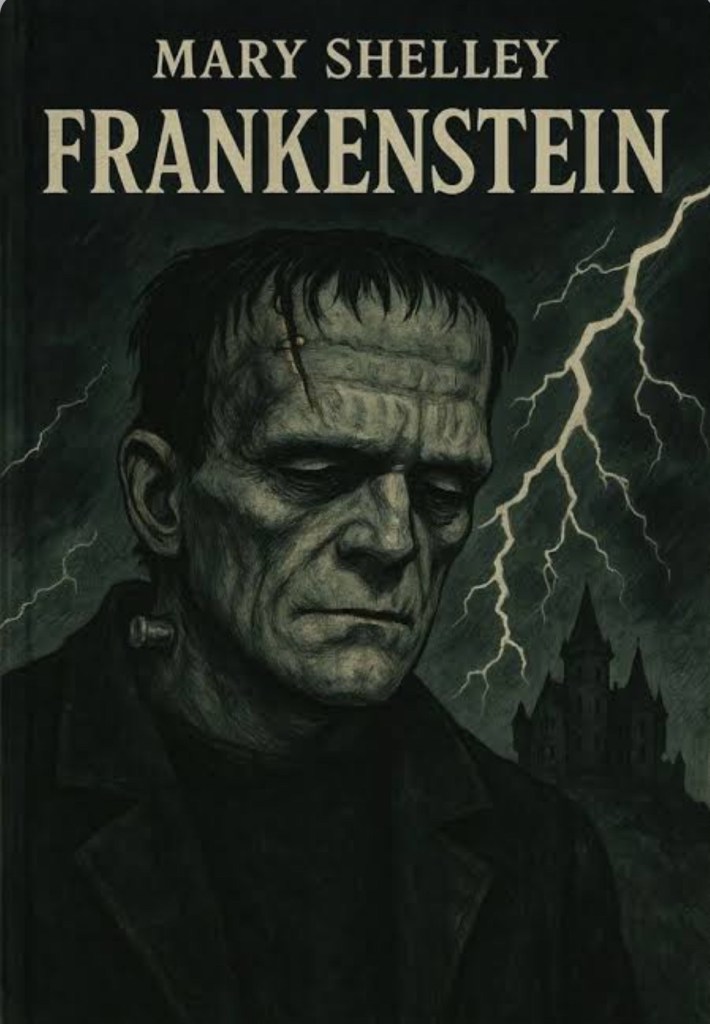
Mary Shelley’s Frankenstein; or, The Modern Prometheus was never meant to become the plastic green giant lumbering down the aisles of every Halloween superstore — yet here we are. What began in 1818 as a chilling philosophical meditation on ambition, science, and the fragile line between life and death has evolved into a cultural mascot of spooky season — complete with neck bolts, flat-top head, and a permanent look of mild confusion.
Shelley, writing in the glow (and occasional flicker) of the Enlightenment, was wrestling with humanity’s swelling ego — the idea that with enough electricity and curiosity, we might just snatch life itself from the hands of nature. Her Dr. Victor Frankenstein wasn’t a mad scientist in a crumbling castle surrounded by lightning rods; he was a young idealist, a scholar obsessed with the boundaries of human knowledge. And his creation — the “Creature,” as Shelley deliberately called him — was not the grunting monster of later films but an articulate, tragic figure who only turned violent after society rejected him. The real horror in Shelley’s story wasn’t the creature’s patchwork face; it was the mirror it held up to human arrogance and moral negligence.
Fast forward a century, and Hollywood took that elegant Gothic novel and gave it the Universal treatment — thunder crashes, villagers with torches, and Boris Karloff rising from the lab table with a moan that shook the silver screen. By 1931, Shelley’s tragic meditation had been stitched together into pop culture’s most recognizable monster. The Creature lost his eloquence but gained marketability: green skin, heavy boots, and a trademark groan that could be sold as a Halloween costume.
By the mid-20th century, Frankenstein’s Monster had gone from symbol of moral overreach to misunderstood party guest. He’s danced with Dracula, shared screen time with Abbott and Costello, and even taught children on The Munsters that being different isn’t all that bad. Somewhere along the way, Shelley’s nightmare warning about playing God became the friendly neighborhood face of “spooky but safe.” The lightning that once sparked a philosophical horror now powers inflatable lawn decorations.
Yet, in a strange way, that transformation feels fitting. Frankenstein was always about humanity’s compulsion to create — to animate the inanimate, to bring dead matter to life. In turning Shelley’s intellectual horror into a seasonal icon, we’ve done exactly what her story predicted: taken something profound and breathed artificial life into it until it lurches, glowing-eyed, through our modern world. We’ve reanimated Frankenstein himself.
So when you see that grinning green face this Halloween, maybe spare a thought for Mary Shelley — 18 years old, staring at the firelight, conjuring not a monster, but a warning. A warning that, two centuries later, we still haven’t quite learned to heed.
Day Six of yet another Trump–Republican government shutdown, and the GOP’s official position remains, with all the confidence of a toddler blaming the dog for breaking the vase: “The Democrats did it.”
Truly inspiring. The Republican Party currently controls the House, the Senate, and the White House — a political monopoly so complete it would make a Bond villain blush — and yet, somehow, in this alternate universe, the shutdown is entirely the fault of the powerless minority party that couldn’t pass a motion to rename a post office if it tried.
You have to admire the creativity, though. The GOP has turned excuse-making into performance art. “We control everything,” they say, “but we can’t possibly govern because of those sneaky Democrats who… don’t have any votes.” It’s like watching a magician saw a lady in half, forget to put her back together, and then blame the audience for “negative energy.”
Meanwhile, federal workers aren’t getting paid, national parks are closed, and the economy’s starting to wheeze — but hey, as long as the talking points sound good on Fox News, who cares? You can practically hear the press conference rehearsals: “Sure, we could end this shutdown anytime we want, but why take responsibility when we can just scream ‘Democrats!’ and ride the victim wave straight through the next election cycle?”
It’s the same playbook every time. Republicans light the dumpster on fire, then hold a press conference in front of the flames, shaking their heads solemnly and saying, “Look what those Democrats did.” Never mind that every match, every gallon of gasoline, and every memo saying ‘burn it all down’ has an elephant logo in the corner.
Of course, Trump himself insists that this is all part of a “negotiating strategy,” which is a generous way of describing political arson. The man who campaigned on being the ultimate dealmaker has now proven he can’t even make a deal with his own party — and yet somehow the Democrats, who have about as much influence right now as a folding chair, are supposedly the culprits.
This is the political equivalent of a kid eating an entire cake, getting sick, and then declaring, “Mom made me do it because she didn’t hide it better.”
And the GOP chorus line is right there behind him, nodding along like malfunctioning bobbleheads. “Yes,” they say, “it’s the Democrats’ fault for refusing to support our totally reasonable, wildly unpopular, constitutionally questionable demands.”
Let’s be clear: if the Republicans wanted to reopen the government, they could do it this afternoon. They could snap their fingers — or in Trump’s case, his Cheeto-dusted digits — and pass a clean funding bill before dinner. But that would require actual governing, which is tragically less fun than performative blame games and fundraising emails titled “STOP THE RADICAL LEFT (who don’t currently have any legislative power).”
So here we are: Day Six. The government is closed for business, the GOP is holding the keys, and they’re still insisting that the Democrats are somehow jiggling the doorknob from the outside.
If irony were currency, Washington could reopen the government tomorrow.
Ah, Stephen Miller — the human thumb that somehow learned to speak and file lawsuits — has once again blessed us with another electrifying episode of “Oops, I Said the Fascist Part Out Loud.” There he was, blinking like a confused ferret caught under a tanning lamp, proudly declaring that the president has “plenary powers.” For those who don’t speak Fluently Delusional, that means: “The President is basically God now. You may kneel.”
Of course, this isn’t exactly new territory for Pee-Wee German, the only man who can make a podium look uncomfortable. Every time he steps in front of a camera, you can practically hear the wiring in his skull sizzling — like an old toaster deciding whether to catch fire or keep pretending it’s useful. And then, without fail, out comes another declaration of absolute executive power that sounds like it was ghostwritten by Darth Vader’s intern.
Miller’s been doing this for years — blurting out the quiet part, the illegal part, and sometimes even the part that makes the Constitution start weeping softly in the background. Remember when he said the president’s authority “will not be questioned”? That’s not a political philosophy. That’s a Bond villain audition tape. And yet, there he stands, puffed up with the self-importance of a mall cop with a badge and a God complex, telling America that we should be grateful for our new benevolent overlord.
At this point, it’s less “he said the quiet part out loud” and more “he hired a skywriter to spell it over the Lincoln Memorial.” The whole administration does it — babbling their dystopian fantasies like kids at show-and-tell — but Miller does it with that special dead-eyed conviction that makes you wonder if his diet consists entirely of Red Bull and resentment.
And honestly, it’s only a matter of time before his inner monologue just gives up pretending to be human altogether. One day, mid-interview, he’s going to stop mid-sentence, his pupils will dilate, horns will sprout from his shiny dome, and he’ll glide into full Loki mode. Picture it: Miller raising his hands before a horrified press corps and declaring in that nasal monotone, “I am freeing you… from freedom! You were made to be ruled. It is your natural state.”
And the worst part? You just know half the room will nod politely, take notes, and ask if the new regime plans to offer health insurance.
Because that’s the genius of Miller’s whole schtick — he says the monstrous parts so casually, so bureaucratically, that people forget to panic. He’s like if a DMV clerk suddenly declared martial law and everyone just kept waiting in line.
So no, we’re not surprised. Not when the human embodiment of a paper cut keeps accidentally confessing the entire authoritarian playbook. Not when every “quiet part” he says out loud is basically a recruitment ad for dictatorship. Stephen Miller doesn’t “reveal” fascism; he leaks it — constantly, proudly, and with all the emotional warmth of a malfunctioning Roomba.
So go ahead, Pee-Wee German. Tell us again how the president’s powers are infinite, how freedom is overrated, and how we should all just accept our “natural state” of obedience. Just don’t act shocked when the horns finally pop through — we’ve been expecting it for years.






 Esoteric Meandering Shouting Into the Void
You must be logged in to post a comment.