Squirrel Time

Squirrel Time
Dwain Northey (Gen X)
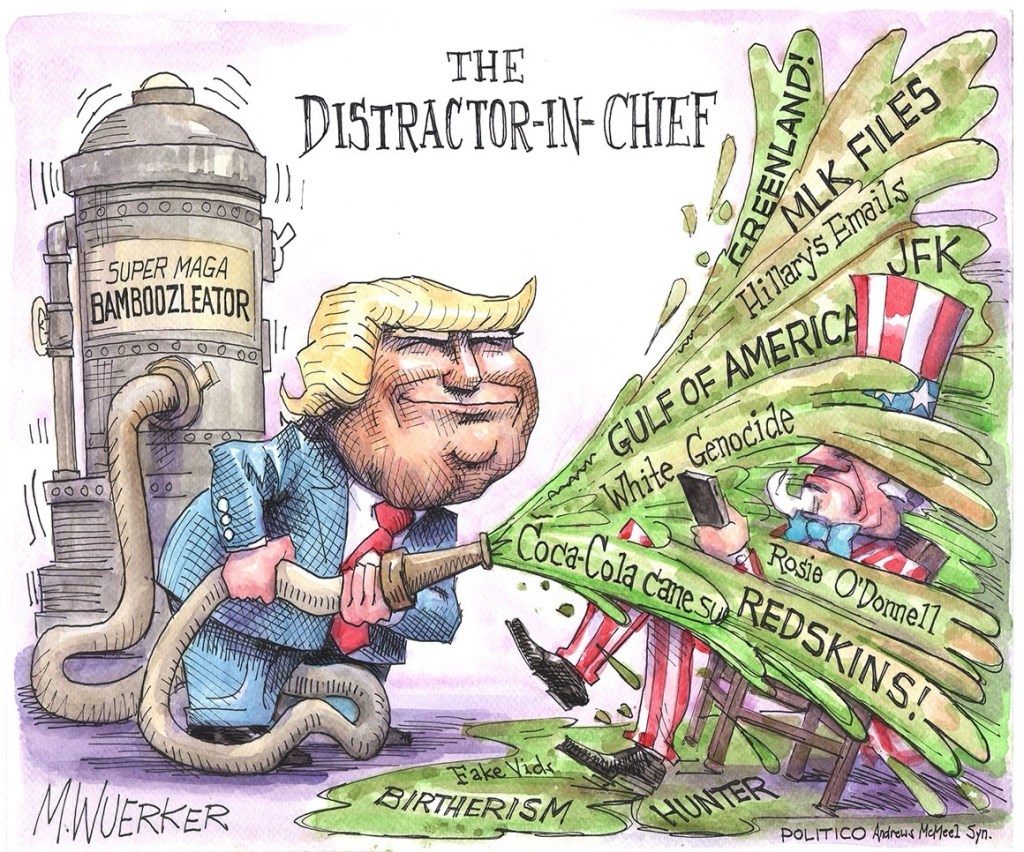
Oh, what a time to be alive! If you were worried that America had forgotten how to “win,” fear not—the current administration has turned winning into a contact sport. The scoreboard is lighting up like a slot machine in Vegas, and baby, the jackpots just keep rolling in. Forget boring old things like stability, trust in government, or a functioning economy—those are relics of a less “winning” era. Today, we’re drowning in victories so enormous you can barely breathe between all the confetti cannons of chaos.
Let’s start with the unemployment rate—a true triumph. Nothing screams prosperity quite like more people out of work. It’s as if the administration decided that having a job is too mainstream, too predictable. So, naturally, they’ve spiced it up by making millions of Americans dust off their résumés and rediscover the joys of applying to Indeed listings for “assistant to the assistant manager.” Because what’s better than gainful employment? The thrill of uncertainty! Who needs a steady paycheck when you can have the adrenaline rush of wondering how you’ll pay rent each month? That’s called character-building, and this administration is delivering it in bulk.
Then there’s inflation—oh, the crown jewel of economic strategy. The dollar is stretching like a piece of old chewing gum, and every trip to the grocery store feels like playing “The Price is Right” on hard mode. Bacon? That’ll cost you a car payment. Eggs? Might as well mortgage your house. But don’t worry, it’s all part of the grand plan. Inflation is just the government’s way of encouraging Americans to embrace minimalism. Who really needs to eat three meals a day anyway? Winning!
Of course, we can’t forget the increase in political violence. If democracy is a family, then this administration is hosting the world’s loudest Thanksgiving dinner, complete with knives being thrown across the table. Polarization? Off the charts. Threats? A dime a dozen. Public officials can’t even sneeze without someone accusing them of treason. But hey, what’s a little civil unrest between friends? After all, nothing unites a country like being at each other’s throats. Think of it as a team-building exercise, except the “team” is America, and the exercise involves Molotov cocktails. Another W in the column!
And let’s not overlook the general uncertainty that’s become the air we breathe. No one knows what’s going to happen tomorrow—will it be a stock market crash? A foreign policy blunder? Another cabinet official indicted? Who knows! It’s like living in a reality TV show where the plot twists are written by a committee of caffeinated toddlers. Sure, uncertainty makes planning for the future impossible, but who wants predictability when you can live every day on the edge of your seat? That’s excitement, folks. That’s winning.
So let’s give credit where credit is due. This administration promised “so much winning you’ll get tired of winning.” Well, mission accomplished. The unemployment rate is up, inflation is up, violence is up, anxiety is up—everything is up except, of course, national morale. But hey, you can’t have it all.
Let’s not forget, dear Donald’s latest blunder claiming that 300 million Americans died from drug deaths in the last year; that’s amazing considering that our population is only 340 million.
America: the land of the free, the home of the brave, and now, the undisputed heavyweight champion of “winning.” Too bad the prize is a flaming dumpster.
Dwain Northey (Gen X)

Since January 20, when our felon-in-chief dragged his baggage and ego into the White House, the nation has been living in a carnival of chaos. It is not just bad policy, not just laughable leadership—it’s a deliberate strategy. The appointments, the headlines, the scandals, the daily Twitter-esque explosions of nonsense—none of it is random. It’s a game of confusion, a game of control through chaos, a game designed to exhaust the public until we can’t tell up from down or right from wrong. And the longer this goes on, the more dangerous it becomes.
Look at the cabinet picks. It’s as if résumés no longer matter, experience is irrelevant, and conflict of interest is the only job qualification that counts. Want to regulate banks? Appoint someone whose career was built on exploiting loopholes. Want someone to oversee public education? Choose a person who doesn’t believe in public schools. Want environmental stewardship? Find a fossil fuel executive who treats climate science like a personal insult. It’s a circus, but not the fun kind with popcorn and clowns—it’s the kind where the animals are abused, the ringmaster is drunk, and the tent is on fire.
And yet, the media, the supposed guardians of democracy, stumble through the coverage as if this were just another administration making routine decisions. There is a bizarre obsession with “balance,” as if giving equal weight to competence and corruption somehow equals fairness. They will run story after story about the president’s “political instincts,” but barely mention the steady erosion of norms, rights, and institutions. When he lies, it’s framed as “misleading.” When he incites, it’s “spirited rhetoric.” When he tears at the foundations of democracy, the headline reads “unconventional leadership style.” The press, terrified of being labeled “biased,” has become complicit by refusing to name the damage in plain terms.
But this is the playbook: overwhelm the senses. If you flood the zone with scandal, with absurdity, with controversy after controversy, people become numb. They stop reacting, stop caring, stop keeping track. Chaos becomes normal. Yesterday’s outrage is buried under today’s firestorm, which is itself forgotten by tomorrow. It’s psychological warfare dressed up as governance. The more confused and divided the public, the easier it becomes to consolidate power.
This strategy thrives on division. Every policy, every statement, every move is designed to pit one group against another: urban versus rural, immigrant versus native-born, “real Americans” versus anyone who doesn’t fit the mold. It’s not about solving problems; it’s about creating enemies. The president doesn’t lead—he provokes. He doesn’t govern—he agitates. He knows that if people are busy screaming at each other, they won’t notice the quiet theft of rights, resources, and democratic safeguards happening in the background.
Authoritarian rule never arrives with a blaring trumpet. It creeps in while people are distracted. While we argue about one scandal, rules are rewritten in back rooms. While the headlines fixate on one outrageous quote, entire agencies are gutted. While people laugh at the latest absurd cabinet pick, the machinery of democracy is hollowed out. Control doesn’t always come through tanks in the streets; sometimes it comes through endless distraction, fatigue, and a carefully orchestrated sense of hopelessness.
And that’s where we are now. Tired. Confused. Overloaded. A country staggering under the weight of too many lies, too many scandals, too many crises piled one on top of another. People begin to tune out because constant outrage is unsustainable. That’s the danger. That’s when authoritarianism wins—not through strength, but through the people’s exhaustion.
January 20 was not just the start of a new administration. It was the start of an experiment in chaos as political strategy. We’ve been living it every day since: the unqualified appointments, the media’s timid framing, the daily whirlpool of division. And unless we recognize the strategy for what it is, unless we call it by its name—control through chaos—we will keep stumbling forward into a darker, more authoritarian future.

Dwain Northey (Gen X)
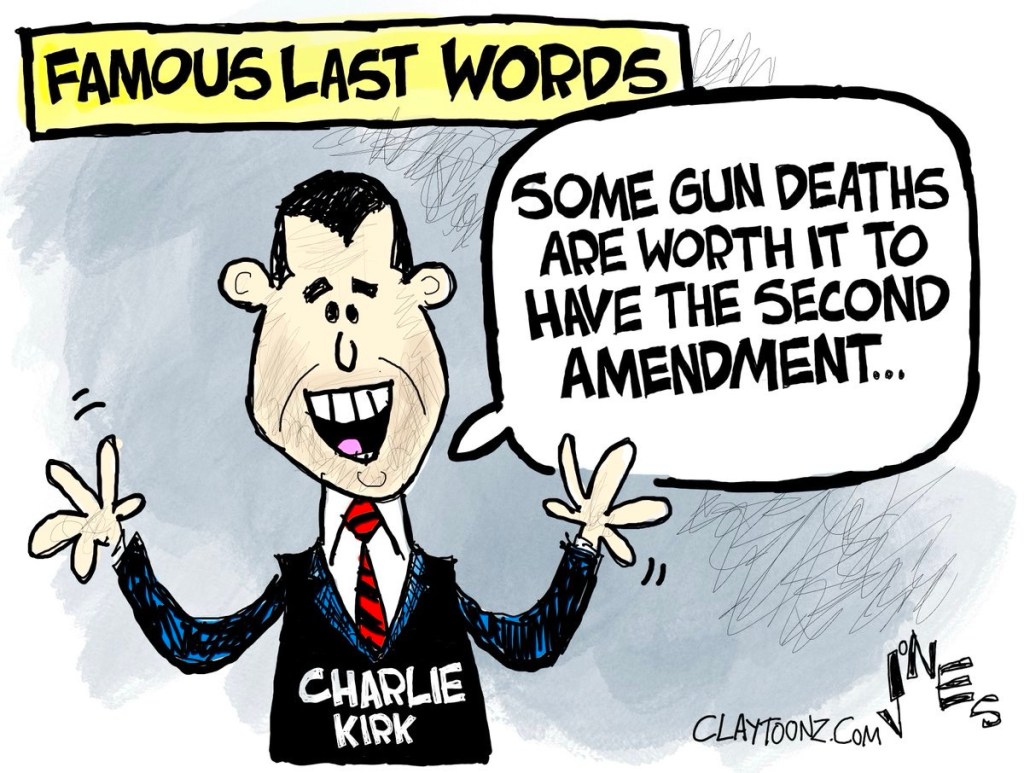
Hopefully, this is the last time I write about Charlie Kirk, because frankly, the man was a self-inflicted wound on American politics even when he was alive. But here we are, wading into the swamp of irony that his death has created. What fascinates me isn’t so much the tragedy itself—because no one in their right mind celebrates violence—but the way his supporters and the Republican establishment are about to contort themselves into rhetorical yoga poses to explain away the uncomfortable truth: his killer wasn’t some foreign “other,” wasn’t a Democrat, wasn’t Antifa, wasn’t a migrant caravan member, and wasn’t some imaginary shadow government operative. No, the shooter has been identified as the very thing Kirk and his movement spent years glorifying: a white, Mormon, Christian, Republican, Trump-supporting member of their own ideological cult.
Now, the problem for the GOP spin machine is obvious. Their entire political strategy depends on fearmongering about outsiders. They thrive on the narrative that danger always comes from “out there”—from immigrants, from urban crime, from Democrats supposedly grooming your children. If that scaffolding collapses, they’re left staring at a much harder truth: the rot is internal. The monster isn’t at the gate. It’s sitting comfortably in the pew, voting Republican, listening to the same podcasts, and parroting the same talking points. But acknowledging that? That’s poison to their brand.
So what happens now? You can already see the test balloons going up. They’ll try the lone wolf excuse, the old “mentally ill individual” dodge, as if political radicalization and violent rhetoric had nothing to do with it. They’ll paint the shooter as some rare anomaly, when in reality, this is the logical endpoint of a culture marinated in paranoia, rage, and the belief that violence is a form of patriotism. What’s more ironic is that Kirk himself fed into this toxic environment. He wasn’t shy about framing politics as a battle of survival, where compromise was weakness and empathy was treason.
But his death now forces his allies to reckon with the monster they’ve nurtured. The killer was not someone they can easily “otherize.” You can’t send ICE after him. You can’t claim it was an Islamist terrorist. You can’t point to a “woke” liberal arts college and say, “See, this is what happens.” The killer was one of their own. He belonged to the tribe. He would’ve fit in at a Turning Point USA conference without raising eyebrows. That fact alone should send chills through the GOP establishment.
Yet, I don’t expect self-reflection. What I expect is spin. They’ll bend reality until it breaks, because the alternative—admitting that the violence is homegrown and rooted in their own movement—would require honesty they don’t possess. They’ll gaslight their base into believing something else, anything else, because to tell the truth would be to admit that the problem isn’t “out there,” it’s in here.
So yes, hopefully this is the last time I write about Charlie Kirk. But his death, more than his life, exposes the hypocrisy at the core of the modern Republican project. They created a movement obsessed with enemies. Now they must grapple with the fact that one of those enemies came from within their own ranks.

Washington DC

Dwain Northey (Gen X)
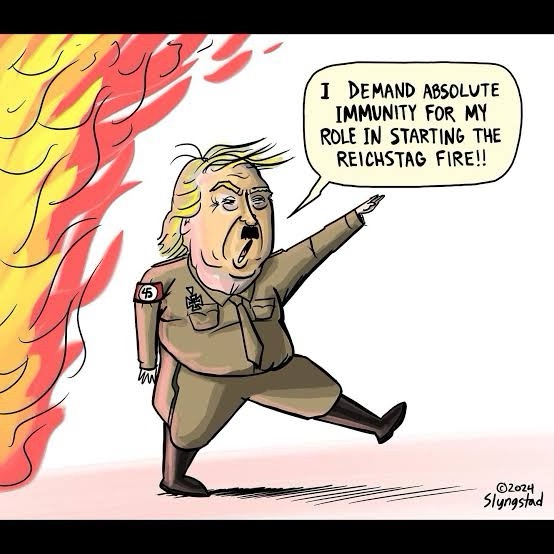
So here we are: Charlie Kirk, freshly elevated into martyrdom status, and the right wing is treating his assassination as if the heavens cracked open and dropped a halo onto his head. Forget the years of ranting, sneering, and mocking empathy—suddenly Kirk is Schleicher 2.0, a noble patriot struck down by the forces of darkness. The only thing missing is Wagner blaring in the background and torchlight parades. But give it time. They’ll get there.
The parallels to Kurt von Schleicher are almost too on the nose. Schleicher, a man who once occupied the highest seat of power in Weimar Germany, was gunned down in his own home when Hitler decided “thanks for your service, now please die.” It was tidy, efficient, and historically convenient. His death cleared the path for the Reich to become not a democracy wobbling toward the abyss, but a dictatorship in full sprint. And now Kirk, whose greatest accomplishments include telling teenagers that empathy is weakness and that mass shootings are the price of liberty, is transformed in death into a kind of political fuel. His rhetoric was toxic when he was alive, but now it’s going to be canonized as scripture.
Cue the crocodile tears from the same movement that has consistently rolled its eyes at “thoughts and prayers” fatigue, mocked victims of school shootings, and insisted that nothing can ever be done about gun violence because, gosh darn it, the Founders gave us muskets. But suddenly, with Kirk lying cold, now violence matters. Now flags must be lowered, voices must tremble with grief, and the entire machinery of outrage must roar into motion. This isn’t hypocrisy, they’ll insist. No, no—it’s patriotism. After all, Kirk wasn’t just anyone. He was their anyone.
And here’s where the sarcasm practically writes itself. The right, which has long insisted that “bodies in the street” are the acceptable price of freedom, is shocked—shocked!—to find that the bill finally landed at their own table. Who could have guessed that the culture of armed paranoia, endless demonization of enemies, and fetishization of violence might, just possibly, boomerang back? But don’t expect any self-reflection. Just as Schleicher’s death was rewritten as necessary proof of Nazi strength, Kirk’s assassination will be spun as a holy tragedy that proves the left wants to destroy America. He’ll be remembered not as the man who preached callousness, but as a symbol of purity whose blood cries out for vengeance.
And vengeance is the real prize here. Fascism loves martyrs the way fire loves oxygen. Hitler needed Schleicher’s death to seal his legend; today’s would-be authoritarians need Kirk’s corpse to supercharge their movement. He is more valuable to them dead than alive, because in death he can’t contradict the myth they’re writing. He can’t tweet something embarrassing, he can’t contradict the narrative, he can’t remind anyone that he was, at the end of the day, just another grifter in a tailored suit. No—now he’s eternal.
So congratulations, America. You’ve managed to find your Schleicher, your myth-making moment. The right will build him a shrine of rhetoric, demand unquestioning loyalty in his memory, and accuse anyone who dares roll their eyes of sacrilege. History, as always, doesn’t just rhyme—it mocks.
Dwain Northey (Gen X)

For millions upon millions of years, this planet has turned on its axis, circled its star, shifted its continents, and birthed life forms beyond our imagination. The Earth has known fire and ice, has weathered asteroid strikes, mass extinctions, and the slow grinding of glaciers. Dinosaurs once thundered across its plains, then vanished, leaving only bones and echoes. Giant ferns rose and fell, seas receded and returned, mountain ranges grew and eroded, and through it all, the Earth remained. It was never delicate, never fragile, despite how often we describe it that way. The planet does not need us—it never has. Long before humanity, it thrived, and long after we are gone, it will adapt, evolve, and continue in ways we cannot fathom.
And yet, here we are, one curious species among millions, a genetic accident—or miracle, depending on your lens—that stumbled into consciousness. Somewhere in our evolutionary past, a spark lit. We became aware not only of our surroundings but of ourselves. We could reflect, imagine, plan, and invent. This gift—or curse—set us apart. Unlike the other animals, we did not simply live within nature’s cycles; we sought to bend them, reshape them, control them. Fire was harnessed, tools were sharpened, stories were told. Civilization arose from this restless mind that could not be satisfied with mere survival.
But there’s a catch. Consciousness brought not only creativity but destruction. The same hand that painted on cave walls eventually built bombs capable of erasing cities. The same ingenuity that made medicine also engineered poisons. Our minds, capable of love and empathy, are equally capable of cruelty and indifference. From the moment we stood upright and gazed across the horizon, we were walking toward destiny—though that destiny has always been a double-edged sword.
Some would argue it is triumph: humanity, the thinking animal, has built civilizations, mapped the stars, split the atom, and unlocked the code of life itself. Others would say it is tragedy: the same species now warms its planet, strips its forests, poisons its waters, and builds machines of annihilation. Every step forward seems to carry with it the seed of collapse. We invent agriculture, then create famine. We discover fossil fuels, then choke the skies. We devise weapons for defense, then use them for slaughter. If it is destiny we walk toward, perhaps it is not progress but a slow, deliberate march to self-destruction.
And yet, it is not the Earth that trembles. We imagine that our downfall would drag the world with us, but the planet does not depend on us. If the oceans rise and drown our cities, Earth will still roll on. If the forests burn and the skies darken, new ecosystems will grow in time. If nuclear fire scorches the surface, life—of some form—will claw its way back, as it always has. Humanity may be a flicker, brilliant but brief, in the vast history of this planet.
Perhaps that is our lesson: we are temporary. The Earth is not. Our consciousness, our genius, our hubris—these are unique, but not eternal. Whether by mistake or triumph, we became a species that could think about its own end. And in doing so, perhaps we have always been walking, knowingly or not, toward it.
Dwain Northey (Gen X)

Oh, the theater of selective mourning. Republicans, masters of performative patriotism, have once again reminded us that grief is not universal—it’s transactional. When lawmakers in Minnesota were brutally murdered, the MAGA megaphones didn’t so much as whisper. No flags lowered, no moments of silence, no performative Bible verses hastily tweeted. Just crickets. Apparently, their lives didn’t count. Wrong party, wrong narrative, wrong “team.”
But now, with Charlie Kirk’s death, suddenly America must stop, weep, and genuflect. Flags are lowered, outrage is dialed up to eleven, and the GOP faithful are on the internet pounding their keyboards in righteous fury. “We must take action!” they scream. Action against whom? Oh, that’s easy: anyone who looks different, thinks differently, or dares to vote for a Democrat. Because in their world, mourning is never about the dead—it’s about finding a new excuse to target the living.
The hypocrisy here is not just obvious—it’s blinding. These are the very same people who dismissed mass shootings as the “cost of freedom.” They’re the ones who scoffed at grief from Sandy Hook, who rolled their eyes when parents begged for reform after Uvalde, who called Las Vegas just another tragedy on the endless ticker of American carnage. And let’s not forget Charlie Kirk himself, who loudly and proudly declared that empathy for victims of gun violence was weakness. Weakness! Something not to be honored, not to be recognized. But now? Now that he’s the one in the casket, suddenly compassion is mandatory.
Republicans want a national display of reverence for a man who mocked the very idea of mourning. The irony is staggering. They ignored the blood in Minnesota, dismissed the slaughter of children in schools, and shrugged off families torn apart in churches, grocery stores, and malls. But Charlie Kirk? For him, the flags must come down, and anyone who doesn’t bow low enough risks being labeled an enemy of the state.
So here we are, watching a party demand empathy for someone who preached against it, insist on reverence for someone who scorned it, and weaponize his death to fuel the same culture wars he profited from in life. It’s not mourning—it’s branding. It’s not grief—it’s strategy. And the only thing more predictable than their hypocrisy is the speed with which they’ll turn this into a license to hate even harder.

Dwain Northey (Gen X)

Gun violence in America has long been a wound that never quite heals, a constant reopening of trauma that we are asked to accept as the “price of freedom.” The irony, of course, is that the same people who have consistently waved off school shootings, grocery store massacres, church slaughters, and concerts turned into war zones as “tragic but inevitable,” are suddenly clutching their pearls now that one of their own, Charlie Kirk, has become the latest victim. For years, Kirk has said out loud what many on the far-right believe but dance around: that bodies in the streets are an acceptable cost of our Second Amendment. That freedom, they insist, requires blood. But when it is their blood, suddenly the narrative changes.
No one—left, right, or anywhere in between—wants to see gun violence unfold. Nobody truly wants to walk into a public space and wonder if it will be their last time breathing fresh air. That’s not freedom; that’s fear disguised as liberty. But America has been conditioned to normalize this cycle. A mass shooting happens. We argue for a few days. Politicians pick teams. Then we move on until the next round of lives are stolen. The cycle repeats itself endlessly. When it’s kids in Uvalde or Sandy Hook, Republicans say, “Don’t politicize it.” When it’s families at a Walmart in El Paso, the response is: “A good guy with a gun could have stopped this.” But now that it’s one of their cultural warriors, suddenly the tragedy deserves special reverence.
The hypocrisy is glaring. Republicans didn’t pause for a national moment of silence when Minnesota legislators were murdered in their own homes. They didn’t demand that America honor these public servants who were killed by the very violence Republicans so often excuse. They shrugged. They moved on. But now, with Charlie Kirk, they are framing him as a fallen soldier in the war for freedom, a martyr for the Second Amendment. It’s not about stopping gun violence—it’s about keeping score in the blood sport of American politics.
This team-sport approach to mass death has to stop. Gun violence should not be a partisan issue. The dead are not Democrats or Republicans. They are mothers, fathers, children, neighbors, and colleagues. Every time the story breaks, there are empty chairs at dinner tables and birthdays that will never be celebrated. Yet we act as though some lives deserve more outrage than others based solely on political affiliation. That rot in our national conscience is almost as dangerous as the guns themselves.
The saddest truth is that daily school shootings barely register anymore. Headlines about a teenager opening fire on classmates are now background noise. A massacre in a workplace barely trends for 24 hours. But when a conservative commentator is harmed, the story suddenly becomes symbolic, a rallying cry. If that doesn’t expose how broken our moral compass is, what will?
Gun violence is not a team sport. It should never be about “our side” or “their side.” It is a crisis of humanity, a crisis of policy, and a crisis of leadership. It must end—and not after the next tragedy or the next headline, but now. Because every day we delay, more bodies in the streets are treated as acceptable. And no human life should ever be reduced to a political talking point.
Dwain Northey (Gen X)

Every generation seems to carry a date burned into its memory, a day so dark that it shapes how people remember the world before and after. For the Greatest Generation, it was December 7, 1941—the attack on Pearl Harbor, a sudden explosion of violence that dragged the United States fully into World War II. For Millennials, it was September 11, 2001—a morning when ordinary life was shattered as planes became weapons and the skyline of New York burned before the eyes of a horrified nation. For today’s younger Americans, January 6, 2021, may stand as that date—the day democracy itself was attacked from within, when the peaceful transfer of power nearly collapsed under a mob’s rage. These days are remembered because they rewrote history in ways no one could ignore. They were, in the truest sense, defining tragedies.
But what about the tragedies that don’t make it into the permanent national memory? The ones that don’t get carved into history books or repeated in annual memorial ceremonies? In the last two decades, our country has been scarred by another kind of violence—school shootings, mass killings, and random acts of terror in our own neighborhoods. Yet unlike Pearl Harbor or 9/11, the dates blur together. No one outside of Newtown, Connecticut may pause on December 14, the day of the Sandy Hook Elementary School massacre. Few people recall the precise day in April 1999 when Columbine High School erupted in bloodshed, even though it was supposed to be unthinkable then. The Las Vegas shooting in October 2017—the deadliest mass shooting in modern American history—claimed 60 lives and injured hundreds, but even that horrific moment slips further from our collective memory with every passing year.
Why do some tragedies define us, while others fade into the background noise of a country that has almost learned to expect them? Perhaps it is because Pearl Harbor, 9/11, and January 6 felt like attacks on the nation itself—acts of war, terrorism, or insurrection that demanded a response. But what does it say about us that when the violence comes from within, when it is inflicted on children in classrooms or music fans at a concert, we allow the dates to be forgotten? Maybe it is too painful to look at squarely. Maybe forgetting is easier than acknowledging that we live in a society where mass shootings happen so frequently that none of us can keep track anymore.
That truth is a tragedy in itself. We should not live in a country where children practice active shooter drills like fire drills. We should not shrug at the news of another shooting, chalk it up to the cost of “freedom,” and move on by the next news cycle. If Pearl Harbor demanded we enter a world war, and 9/11 demanded we reshape global security, then surely the countless school shootings and mass killings demand something too. They demand change—not just in laws, but in values, in what we are willing to accept as normal.
Every generation will have its defining day, but we should not allow those days to pile up endlessly, each one marked by grief and violence. The dates we forget are just as telling as the ones we remember. It is time to make sure the lesson of all of them is not that we can endure tragedy, but that we can prevent it.
 Esoteric Meandering Shouting Into the Void
You must be logged in to post a comment.