
Category: Uncategorized
-

Except he’s pissing on all of us … -
Dwain Northey (Gen X)

The month of June is directly named after Juno, the Roman goddess of marriage, childbirth, and women. As the wife of Jupiter and queen of the gods, Juno held a powerful role in Roman mythology, symbolizing protection and domestic harmony. Her influence over marriage made June a popular time for weddings in ancient Rome—a tradition that persists today. The name “June” (Latin: Junius) is thought to honor Juno, reinforcing her connection to fertility, union, and new beginnings. Celebrations and rites held in her honor during this month underscored her status as a guardian of love and matrimonial prosperity.
Happy June
-
Dwain Northey (Gen X)

Oh, absolutely—what better choice for national leadership than someone who’s practically a walking financial cautionary tale? The economy? Who cares if it cratered under his watch—clearly, that was just creative chaos. Real visionaries tank GDPs, right? And those 34 felony convictions? Pure political persecution! Because, obviously, only the truly innocent get convicted on every single charge. It’s just the system being jealous of his “success.” Multiple bankruptcies? That’s not a red flag; it’s a business strategy! Who needs solvency when you’ve got swagger?
Besides, nothing screams “reliable economic steward” like being banned from running a charity for misusing funds. That’s just next-level fiscal innovation. And if you squint really hard while ignoring facts, logic, and history, he starts to look like a genius—albeit the kind that needs constant legal representation.
But it’s not about qualifications anymore—it’s about vibes. And nothing vibes harder than putting the national checkbook back in the hands of a guy who’s treated courtrooms like second homes. If failing upward were an Olympic sport, he’d already have a gold medal—possibly pawned, but still. Reelect him? Of course. Because what this country really needs is more reckless chaos dressed up as “tough leadership.”
-
Dwain Northey (Gen X)

It’s almost poetic—and undeniably hilarious—that Wall Street has started calling Trump “Taco” in light of his tariff-fueled stock market antics. The nickname, equal parts absurd and on-the-nose, stems from a pattern that’s become all too familiar: Trump teases tariffs (often against Mexico), spooks the markets, then walks it back just in time to benefit from the bounce. It’s as if the former president discovered a recipe for market volatility and decided to cook up some spicy profits—hence, the “Taco.”
Traders and analysts, never ones to miss a meme-worthy moment, have latched onto the name with a mix of cynicism and amusement. The humor lies in the absurd juxtaposition: a complex global economic system being toyed with like a fast-food order. It’s slapstick economics—a burrito of bluster wrapped in speculation and served with a side of populist seasoning.
Even funnier is how the markets, typically ruled by numbers and risk models, have to factor in the whims of one man tweeting about avocados. The nickname “Taco” mocks the performative nature of it all, suggesting that behind the bluster lies a carnival barker who knows just how to jiggle the market for maximum reaction. It’s Wall Street’s version of gallows humor—and it’s spicy.
-
Dwain Northey (Gen X)

Elon Musk’s 130-day tenure as head of the Department of Government Efficiency (DOGE) under the Trump administration was marked by aggressive cost-cutting measures, significant controversy, and a contentious departure.
Achievements and Claims
DOGE claimed to have saved approximately $160 billion through various initiatives, including canceling contracts and reducing the federal workforce. However, these figures were later revised down by $9.3 billion due to inaccuracies in accounting . Musk’s original goal was to cut $2 trillion from the federal budget, a target that was progressively scaled back to $150 billion before his departure.
Controversies and Legal Challenges
Musk’s approach involved mass layoffs and the dismantling of federal agencies, such as the elimination of the 18F unit, which had been instrumental in enhancing government efficiency . These actions led to lawsuits alleging violations of privacy, security, and constitutional laws . Furthermore, DOGE’s access to sensitive financial data raised concerns about potential misuse and political interference .
Impact on Federal Agencies
Health agencies, including the CDC and NIH, experienced significant staffing cuts, which disrupted operations and prompted investigations from lawmakers . Additionally, the privatization of federal assets, such as office buildings, sparked debates about the long-term implications for public resources .
Departure and Aftermath
Musk’s resignation followed increasing tensions over policy disagreements, particularly regarding Trump’s tax bill, which Musk criticized for undermining DOGE’s cost-cutting objectives . Despite his exit, the legacy of DOGE’s initiatives continues to influence discussions on government efficiency and accountability.
In conclusion, while DOGE achieved some cost savings, the methods employed and the subsequent legal and operational challenges suggest that the department’s impact was mixed, with significant ramifications for federal governance.
-
Dwain Northey (Gen X)
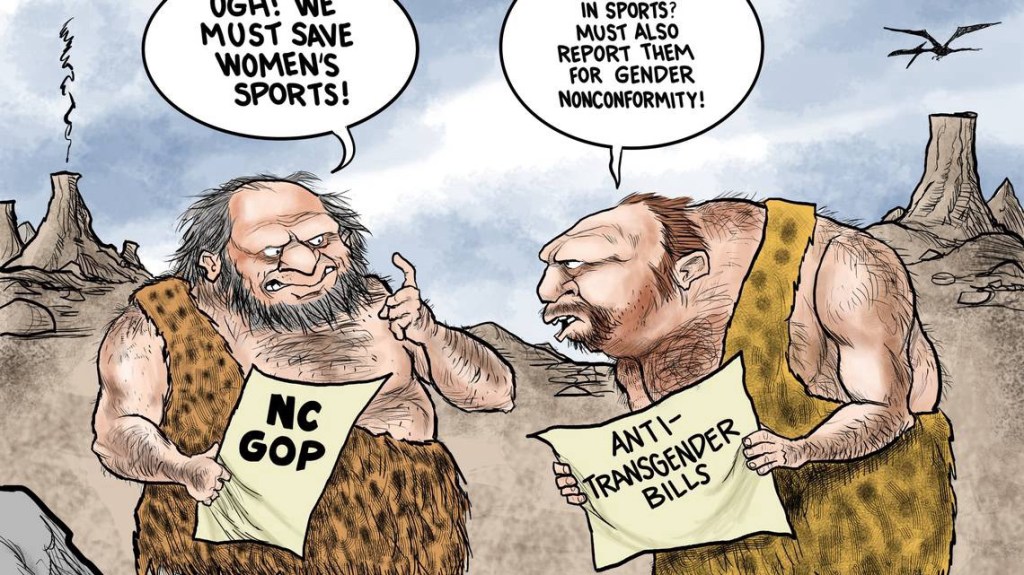
The Republican Party, led by Donny Dumb Ass, has increasingly zeroed in on transgender athletes as a cultural flashpoint, using the issue to inflame outrage and consolidate support among their base. This focus is disproportionately loud compared to the actual scope of the issue. Transgender athletes represent a minuscule percentage of competitors across all sports, yet the GOP has treated this as an existential threat to fairness in women’s athletics. The narrative is often framed in dire terms—“biological men” dominating women’s sports—but the reality is far more nuanced and less sensational.
In many cases, Republicans are pushing laws and policies that bar trans youth from competing, often despite no trans athletes even being present in the districts passing such legislation. This is not about preserving competition—it’s about leveraging fear, misunderstanding, and discomfort for political gain. The GOP has found that outrage over trans rights plays well with a certain subset of voters, and they’ve latched onto the sports angle as an easily digestible, emotionally charged way to exploit that.
What’s especially cynical is how detached this fight is from any genuine concern. These lawmakers are not involved in coaching, parenting athletes, or participating in sports policy at any meaningful level. Their obsession is performative—a culture war sideshow designed to distract from real, pressing issues like healthcare, wages, and gun violence. For a party claiming to support individual freedom, this relentless targeting of a tiny, vulnerable group reveals a deep hypocrisy and a hunger for division rather than solutions.
-
Dwain Northey (Gen X)

President Biden, President Obama, and President Trump each delivered commencement addresses at West Point that reflected their leadership styles and priorities.
President Biden’s 2024 speech emphasized unity, democratic values, and global leadership. He highlighted the importance of defending democracy at home and abroad, referencing ongoing threats and the role of military officers in preserving constitutional principles. His tone was solemn yet optimistic, calling for moral clarity and strategic alliances.
President Obama’s 2014 address focused on multilateralism and America’s role in a changing world. He emphasized diplomacy backed by military strength and the need for international cooperation. Obama challenged graduates to lead with humility and wisdom, articulating a vision of U.S. leadership based on ideals rather than unilateral power.
In contrast, President Trump’s 2020 speech was more nationalistic and apolitical. Delivered during the COVID-19 pandemic and civil unrest, Trump praised military strength and discipline, emphasizing duty, loyalty, and law and order. He avoided broader foreign policy themes, focusing instead on honoring the military tradition and the graduates’ service.
While Biden and Obama stressed global responsibility and democratic values, Trump emphasized patriotism and institutional loyalty. Each address mirrored their governing philosophies—Biden and Obama’s rooted in alliances and ideals, Trump’s grounded in strength and tradition.
-
Dwain Northey (Gen X)

For every school kid this weekend marks the first day of summer no more classes, but there is a much more reverent meaning to today.
Memorial Day is a U.S. federal holiday observed on the last Monday of May to honor and remember military personnel who died in service to their country. Originally known as Decoration Day after the Civil War, it became an official holiday in 1971. The day serves as a solemn reminder of the cost of freedom and the sacrifices made by soldiers throughout American history. Many people observe Memorial Day by visiting cemeteries, holding memorial services, or participating in parades. It also marks the unofficial start of summer, but its deeper meaning remains rooted in remembrance and national gratitude.
-
Dwain Northey (Gen X)

The demographic composition of the United States Congress does not reflect the broader population of the country in terms of race, age, and income level. While the U.S. is increasingly diverse, Congress remains disproportionately white. According to the U.S. Census Bureau, over 40% of the American population identifies as non-white. However, as of 2025, about three-quarters of Congress is white, indicating an underrepresentation of Black, Latino, Asian American, Native American, and multiracial communities.
Age disparities are also evident. The median age in the U.S. is around 39 years, yet members of Congress tend to be significantly older. The average age in the Senate is over 60, and in the House, it is in the mid-50s. This older representation often means that the perspectives and needs of younger generations—such as those related to student debt, climate change, and technology—may not be adequately prioritized or understood in policymaking.
Income is another key area where Congress diverges from the general population. While the median U.S. household income is around $75,000, many members of Congress are millionaires, with significant assets and wealth far exceeding that of their constituents. This wealth gap can create a disconnect between lawmakers and the financial struggles of everyday Americans, potentially influencing policy decisions in ways that favor the affluent.
These demographic mismatches can undermine democratic representation and reduce public trust in government. While some progress has been made in recent election cycles toward greater diversity, Congress still falls short of mirroring the racial, generational, and economic realities of the population it is meant to represent. Addressing these disparities requires both systemic changes and efforts to support a broader range of candidates seeking office.
 Esoteric Meandering Shouting Into the Void
You must be logged in to post a comment.