Are we so defeated? Have we just woefully accepted our fate?
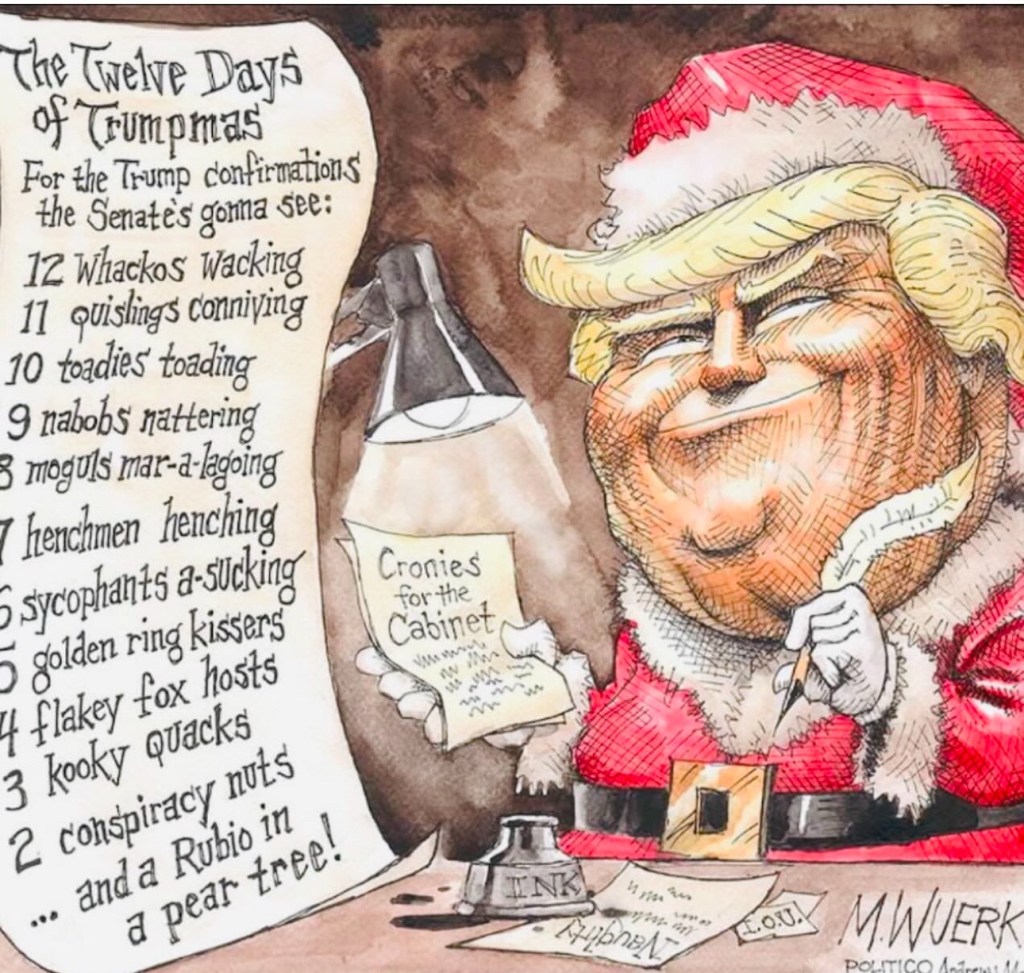
It seems we have Joe & Mika genuflected days after the election traveling to Mari logo and bending the knee to our would be dictator, Chris Ray resigned his post as FBI director, even though he was appointed in 2018 by Dear Leader but actually did the job, ABC has apologized and committed $14 million to the Trump presidential library for George Stephanopoulos calling him on air what a judge said he is, and adjudicated rapist, . I wish that was the end of what is happening millionaires i.e. Jeff Bezos and Mark Zuckerberg are donating $1 million each to his inauguration fund genuflecting to cheerleader so that they can possibly get some handouts from the new aligaracal government.
Again, I ask, have we given up? Is this the end of our democracy or are we gonna fight? Are we gonna just let this happen ? I for one haven’t given up on this nearly 250 year experiment and I hope I am not the only one.
The key is to bring more happiness sparks into your life — not by chance, but by choice.
It takes mental strength and discipline to adopt perspectives and make choices that can help bring you joy, especially when negative emotions and thoughts are hijacking you.
In times of adversity, it’s easy to focus on what’s gone. Maybe you lost time, money, or resources when something went wrong with that work project. Or you lost your identity when you got laid off. Or you lost a hangout buddy when your friend moved across the country.
Remembering to focus on what you still have makes a profound difference. Consciously practicing gratitude improves well-being, research shows.
In the situations above, for instance, you might be grateful for valuable insights, the loved ones you can spend more quality time with, and a new travel destination, as well as a friendship you can continue cultivating long-distance.
2. ‘There’s no such thing as a perfect path’
When you second guess a path you’ve chosen or lament that not everything is working out as you’d hoped, you can get stuck in a negative loop.
The truth is that there will always be unexpected twists and turns. It’s easier to find joy when you accept the imperfect path and overcome obstacles along the way.
Think of an accomplishment or outcome that made you happy. Odds are you dealt with some adversity to get there.
3. ‘Let it be’
When you’re frustrated and someone tells you to “just let it go,” that can make you more upset. It’s also bad advice, since you’ll likely be unable to ignore what happened and how it made you feel.
You can, on the other hand, tell yourself, “Let it be.” That means using a form of cognitive acceptance, which is a surer path to pulling out of a downward spiral.
Don’t try to banish an adverse event from your psyche or change what you feel about it. Let it sit there. Acknowledge and accept that your emotions are legitimate reactions and focus on how you’ll move forward in a productive way.
4. ‘Big picture, small step’
When we struggle in the face of setbacks, we can lose perspective. Small challenges may suddenly seem outsized.
Saying “Big picture, small step” to yourself does two things:
It reminds you of the ultimate goal or of the vision of the life you want to live and who you want to be. When you consider a setback in the context of the big picture, it shrinks.
It can help you identify one small thing you can do to get back on the path of progress and positivity. That first action can lead to another small step of hopefulness, which leads to another, and so on.
5. ‘Adversity creates Beliefs, not Consequences’
Think of this as your ABC phrase, inspired by the ABC model in cognitive behavioral therapy. The idea is to remind yourself that adversity doesn’t automatically mean negative outcomes.
The end result of adversity is determined by how you respond to it, and the beliefs you form because of it.
For example, will you believe that a job interview that didn’t go well was a non-recoverable disaster that clearly demonstrates you’re a failure? Or will you believe that it’s a learning opportunity and an obstacle you’ll overcome, like you have in other situations in the past?
Remember: ‘I’ll be happy when…’ is a trap
It’s easy to get caught up thinking that happiness is a destination, that if you can only make a little more money, or achieve some specific thing, then you’ll be happy.
You might tell yourself, “I’ll be happy when I finally get that promotion,” for example, or “If I could just fit into those old jeans, I’d be so much happier.” In the meantime, you let joy slip by unnoticed as you keep your head down, grinding.
Mentally strong people engage in what I call “grindfulness,” a practice at the intersection of gratitude and mindfulness. It allows you to notice and recognize your gratitude for the small positives, even in tough moments.
It encourages you to draw happiness from finding and experiencing joy in the world around you, right now, every day.
Soap is an everyday essential, but this incredibly useful (and lifesaving) cleanser hasn’t always existed. The earliest known mention of soapdates back 4,500 years, found on a cuneiform tablet unearthed from Girsu, in ancient Mesopotamia (modern Iraq). But even then — and for centuries afterward — humans likely weren’t using the slippery substance for handwashing. Bars of soap made from rendered fat and wood ash were primarily used to clean dirty clothing and raw fibers that were being prepped for weaving. Instead of soap, many ancient peoples (such as the Greeks) used scented olive oils and other substances — including coffee — to clean their bodies.
Historians believe the practice of drinking coffee originated in Ethiopia and slowly spread to the Middle East and Europe, becoming popular around the 15th century. Before then, some cultures relied on the brew not as a beverage, but as a cleanser. Around the 10th century, physicians and botanists in the Middle East began writing in Arabic about “bunk,” a compound similar to modern brewed coffee that could be used for handwashing. Surviving texts from the time credited bunk with removing strong odors from hands without drying out the skin, and recipes for the substance sometimes included spices such as cloves, cinnamon, and fruit peels. Bunk also may have been incorporated into other products, like body oils and perfumed powders. However, little is known about the compound. It appears the practice fell out of popularity as coffee became valued less for its odor-eliminating properties and more for the same thing modern consumers appreciate: that caffeinating buzz.
The English language is vast — so vast, in fact, that the average native speaker only knows about 6% of all English words, which equates to roughly 35,000 of the 600,000words in the Oxford English Dictionary. That percentage may seem small, but the fact that most of us get by just fine on a daily basis suggests the other 94% of words are fairly obscure or redundant. English has one of the largest vocabularies of any language due to its history of freely incorporating words from other languages, particularly French (the origin of at least 30% of English words). Most adults learn an average of one new word per day until middle age, when vocabulary growth tends to slow or even stop — all the more reason to keep the mind sharp with crossword puzzles and word games.
Different studies have shown slightly different stats, of course. While one estimates the average English-speaking adult’s vocabulary somewhere between 20,000 and 35,000 words, another estimates it closer to 42,000. The latter study featured 70 real words alongside 30 made-up words and asked subjects to identify which was which; however, they weren’t required to define the words. This could account for the higher estimate of known words, as participants may have recognizedsome words without actually knowing their meanings.
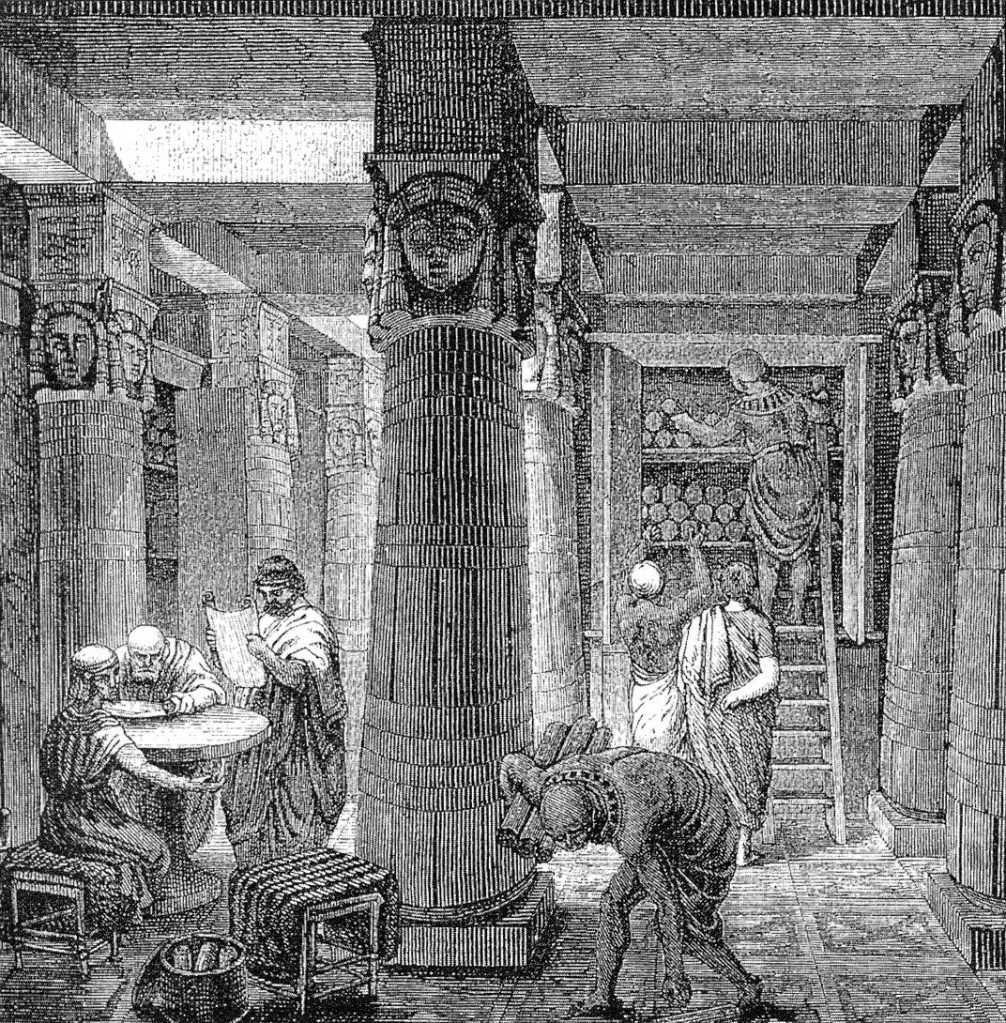
Egypt’s Library of Alexandria, possibly built around the fourth century BCE, was reputed to hold the wealth of humankind’s accumulated knowledge in the ancient world. That makes “Alexa” an inspired choice for the name of the voice-activated virtual assistant that debuted with the Amazon Echo smart speaker in 2014. Yet this was hardly the only name strongly considered by Alexa’s developers — nor even the favored choice of the company founder who pushed to bring the project to life.
As told in Brad Stone’s Amazon Unbound: Jeff Bezos and the Invention of a Global Empire, the project’s speech-science team had specific criteria for an appropriate “wake word,” a vocal signal that would bring the virtual assistant to life. This word needed to have a distinct combination of phonemes — units of sound — and be at least three syllables, to diminish the likelihood of the program being accidentally triggered by everyday conversation. Bezos, the hands-on head honcho, offered several suggestions: “Finch,” the title of Jeff VanderMeer’s fantasy detective novel; “Friday,” the helpful companion of Daniel DeFoe’s Robinson Crusoe; and “Samantha,” the enchantress played by Elizabeth Montgomery in the hit 1960s sitcom Bewitched. Bezos also came up with “Alexa,” but seemed especially attached to “Amazon,” reasoning that it could spark favorable feelings toward the company.
Despite the objections of his staff, Bezos clung to “Amazon” as a wake word until finally giving the go-ahead for the switch to “Alexa” a few weeks before the 2014 launch. As the company now proudly notes, the virtual assistant’s name “was inspired by the Library of Alexandria and is reflective of Alexa’s depth of knowledge.” Yet certain Alexa-infused products offer the option of changing the wake word, reminiscent of that great learning center of antiquity, to one of a small list of replacements that still includes the choice of “Amazon.”
It turns out that the name we use for those tiny pods that are ground and brewed into a cup of joe is a misnomer. Coffee “beans” are actually the seeds found within coffee cherries, a reddish fruit harvested from coffee trees. Farmers remove the skin and flesh from the cherry, leaving only the seed inside to be washed and roasted.
Coffee farming is a major time investment: On average, a tree takes three to four years to produce its first crop of cherries. In most of the Coffee Belt — a band along the equator where most coffee is grown that includes the countries of Brazil, Ethiopia, and Indonesia — coffee cherries are harvested just once per year. In many countries, the cherries are picked by hand.
REMARKS OF JOHN F. KENNEDY, FITTON COUNCIL, KNIGHTS OF COLUMBUS, EAST BOSTON, MASSACHUSETTS, MAY 18, 1947
The Grand Old Party of Abraham Lincoln, the rail-splitter, has just held its national convention. But in this solemn hour I would remind you that it also, and since the days of Lincoln, has been the Grand Old Party of General Grant, full of graft and inefficiency; the Grand Old Party of Harding and the Forty Thieves; of do-nothing Coolidge and impotent Hoover and the inflation of the 1920’s which hurled our country into the worst depression in our history.
All of you of voting age remember that depression. It affected every family in the United States. Ten million unemployed walking the streets. Families broken up. Men, women and children hopeless and on the verge of starvation.
And the man, who was more responsible than anyone else for the huge campaign funds which elected Harding, and Coolidge and Hoover, is the man who maneuvered the nomination of the present Republican candidate for President.
I’m talking about old Joe Grundy of Pennsylvania… Old High Tariff Joe… the man who pulled the strings and gave us the Smoot-Hawley tariff act through the votes of those Grand Old Party members of Congress elected through his largess. That act hastened the end of world trade and paved the way for Hitler and World War II. If you doubt that Old Joe Grundy is manipulating the puppets who are the front men in this campaign, look at what happened immediately after the candidates were named in Philadelphia just a few days ago. The newspapers had been filled with stories of the smooth efficiency of the organization which conducted the campaign for the nomination of the Republican candidate for President. But who is running the Grand Old Party campaign? Why, it’s no one but Old Joe Grundy’s hand-picked Congressman from Philadelphia – Hugh D. Scott, Jr. – Congressman Scott who voted against extending the Reciprocal Trade Agreements for three years and followed that up by voting for the crippling amendments to the Trade Agreement Act which have caused consternation and worry throughout the world.
Old Joe Grundy is a very interesting fellow. They had him up on the witness stand when the 1929 Depression started. They asked him how much he had raised from among his friends in Pennsylvania Manufacturers Association for the Coolidge campaign which passed the Smoot-Hawley Tariff Act. Why, about $700,000 he said. Then they asked him how much he raised for the Hoover campaign. About the same – another $700,000 he figured. Is it any wonder, ladies and gentlemen, that Old Joe Grundy’s man was named Chairman of the Republican National Committee to run the 1948 campaign? They’re expecting a million from the Grundy people this year. And they’ll probably get it. But Old Joe Grundy didn’t make his millions by collecting these huge sums for sweet charity’s sake. He knows the pay-off will come and he’ll collect, with interest. And you, the voters, are the only people who can stop him.
Old Joe Grundy is repeating just what he did in 1920. Then he was behind Boise Penrose, the Pennsylvania Senator and political Boss. But Penrose was most famous for dominating, from his sick-bed, the events in the smoke-filled room which made Harding the nominee of the Grand Old Party in that year.
When Old Joe Grundy was on the witness stand back there in 1929, after the country was plunged into the depression, he was asked about his political philosophy.
Well, he said, when it came to writing a tariff law, he would exclude such states as Arkansas and Idaho. Then he listed some other states which he called “backward.” These included South Dakota, Nebraska, Kansas, as well as Georgia and South Carolina.
When he was reminded that each of these states also has two Senators in the Congress of the United States, he made this classic remark: “That, unfortunately, is true.”
Along with Old Joe’s hand-picked candidates, the Grundy Old Party, at its Philadelphia convention, adopted a platform. It contains many nice phrases and pledges of what the Party will do if the legislative and the executive branches of government are entrusted to it for the next four years. But most of those phrases and those pledges were contained in the platform adopted by the Grundy Old Party four years ago. They were filled with hypocrisy then. There is nothing in the record of the past two years when both Houses of Congress have been controlled by the Republican Party which can lead any person to believe that those promises will be fulfilled in the future. They follow the Hitler line – no matter how big the lie, repeat it often enough and the masses will regard it as truth.
If anything stands out in the history of the Grundy Old Party during the past two years it is that its majority in Congress has waged perpetual, unending war on all fronts against the rights and the aspirations of American workers. I was there … I speak from what I have seen. The Republican members of Congress have been vicious in the passage of laws which restrict and deny fundamental rights to all those in America who have to work for a living. But meantime profits for the bosses have steadily increased. The bosses, I might add, are the members of the National Association of Manufacturers and other selfish employers who provide the treasure chest by which the candidates of the Grand Old Party seek to have you vote for them.
Not only has the Republican Majority in Congress passed laws against the interests of American workers – in cases where relief for the people demanded action they have followed the dictates of the army of lobbyists and denied action, when action was imperatively called for. This is not campaign oratory. It is all in the record. Let me cite you a few instances.
With their right hand they have increased the amount of rents that millions of Americans are compelled to pay – and with their left hand they have steadfastly refused to enact legislation which would provide housing for millions of Americans now crowded into the homes of relatives, or worse.
They have paved the way for the destruction of American unions of working men by hampering both the structure of their organizations and their traditional methods of free and equal collective bargaining. Through the passage of the pernicious Taft-Hartley Act, which I have described to you before, they have sowed the seeds of discord in labor-management relations, under the hypocritical guise of “protecting” the worker. Well, what they have done is to give protection – protection to the rugged individualists who consistently fought the provisions of the Wagner Act which compelled labor-baiting bosses to bargain with their employees through representatives of the employees’ choosing. Already the evidence is piling up. Under the Taft-Hartley Act court actions aimed at destroying unions are depleting union treasuries of the dues you pay and hampering the activities of your officers.
And these results, mind you, are when the Taft-Hartley Act is barely a year old. Rather than reducing the number of strikes, it has been directly responsible for many work-stoppages involving hundreds of thousands of workers. Six thousand cases were filed with the National Labor Relations Board in the single month of April. It has compelled the government to go into court and seek injunctions against unions, thus encouraging union-hating employers in their labor-baiting activities. Its expensive and time-consuming provisions for certifications and elections are all part of a design aimed at the ultimate destruction of unions and the loss of all the gains which labor attained through 14 years of Democratic Party control of Congress.
The perfidy of the demagogic declarations in the Grand Old Party platform of 1944 is illustrated in what the Republican majority in Congress has done to the Department of Labor since the 1946 election. The 1944 platform pledged the Party to strengthen and unify the Department of Labor. But on every occasion since the Republicans assumed control they have viciously opposed every effort of President Truman to rebuild and strengthen the Department.
Here, again, the Taft-Hartley Act was used as the vehicle to hinder and hamper the one agency in government dedicated to improve the conditions under which American workingmen and women earn their daily bread. This masterpiece of Grand Old Party legislation enacted over the veto of President Truman, took away from the Secretary of Labor the United States Conciliation Service which for a third of a century had gone along quietly and effectively settling disputes between management and labor – 90 percent of them without work stoppages where the service was called in before a strike had actually begun.
The Grand Old Party twice refused to approve reorganization plans submitted by President Truman which would have permanently kept the United States Employment Service within the Department of Labor. Why? Certainly not because bringing the right man and the right job together is not a function of the Department of Labor. No, it was because the National Association or Manufacturers wanted the Employment Service dominated by the Interstate Conference of Unemployment Compensation Commissions. Then, if a worker refused to take the first job the Employment Service offered him, regardless of the reduction in pay it meant to him, he could be denied unemployment compensation. That’s a neat way of cutting wages all along the line.
To make sure that the Democratic Congress which will be elected in November did not reverse this control, while the USES was in the Labor Department under a war-time executive order, the Grand Old Party took another step. That was to attach a rider to the Employment Service appropriation bill which required that the USES be transferred to the Social Security Board on June 30 of this year. They couldn’t take the chance of waiting for the election. Now this rider was not introduced by the Education and Labor Committee of the House, where all legislation affecting labor and education matters properly should originate. It was introduced by a sub-committee of the House Appropriations Committee. And it was jammed through Congress by the Grand Old Party of Grant and Harding and Coolidge and Hoover.
That was not the first action of the Appropriations Committee to reduce the Department of Labor to the status of a small Bureau of the Federal Government. In 1947, the Committee cut the appropriations recommended by the Bureau of the Budget by 30 percent. The result is that the Department of Labor, already the smallest executive department, in the two years of Grand Old Party control of Congress, has had its modest staff of 7,000 reduced to 3,000 employees.
It must be perfectly obvious that this is all a part of the design, and the plan of the forces which control the Grand Old Party to destroy the Department of Labor, the one agency created to protect the interests of American workers.
I have discussed briefly some of the things that the Grand Old Party by positive, affirmative action did to defeat the legitimate aspirations of American Workers. Now I want to talk about some of the things that the Grand Old Party majority in Congress did not do. Here are some of the bills introduced in the Congress which they allowed to die:
The bill which would have increased the minimum wage for workers from the present 40 cents an hour, passed way back in 1938, to 75 cents, as requested by President Truman and urged by the Department of Labor and all American unions.
An increase in unemployment compensation, old-age assistance and survivors’ benefits in keeping with the increased cost of living.
An extension of the Social Security law to include 20,000,000 workers not now covered by the Act.
The request of President Truman for an appropriation of $6,000,000 for the prevention of industrial accidents which last year exacted a toll of 17,000 dead and 91,000 permanently crippled.
The cost of living is of vital interest to everyone of us. You may remember that in large advertisements the National Association of Manufacturers and their spokesmen in Congress in 1946 assured the American people that once OPA controls were removed, the cost of living would decline.
Well, OPA was killed. I don’t have to tell you what happened. But I want to give you some of the details and leave it up to you to decide whether or not President Truman, and Democratic spokesmen in Congress, were right when we predicted that the end of controls on the vital necessities of life, such as food, rent, and clothing would start the nation on a spiral of inflation exactly like that of the Harding-Coolidge-Hover era.
Here are the Bureau of Labor Statistics figures which show how the cost of food has gone up in Boston since May, 1946, just before the Republican Congress emasculated OPA and later killed it.
Well, the average price of round steak in Boston butcher shops in May, 1946, was 45 cents a pound. In March, 1948, it was 86 cents. Hamburger cost 29 cents, and in March of this year it was 52 a pound. Butter jumped from 54 to 87 cents a pound; and eggs from 50 to 69 cents a dozen.
Pork chops in May 1946, under OPA controls, cost 38 cents a pound; in March, 1948, the average price in Boston butcher shops was 72 cents. Salt pork, in the same period jumped from 19 to 38 cents a pound. Coffee was 32 cents a pound in May, 1946, and in March of this year it cost Boston housewives 54 cents. Lard went up from 19 cents to 30 and oleomargarine from 24 cents to 40 cents.
I’m sorry I can’t give you the figures on clothing, and public utilities and rent for the same periods. The Grand Old Party majority in Congress slashed the appropriation for the Bureau of Labor Statistics so sharply that BLS can no longer make all the monthly surveys covering all the items that go into the cost of living. What happened was reported in the New Yorker magazine a few weeks ago.
“The Bureau of Labor Statistics reports on the cost of living keep going up,” this article said. “And so,” the writer continued, “Congress decided to kill the BLS.”
Well, they haven’t quite done that – yet. The latest report from BLS on the Consumers’ Price Index shows that from the middle of April to the middle of May in 1948 the cost of the essentials of living – food, clothing, and shelter – increased another 1.4 percent. That brings it up to 170.5 percent of what the same items of groceries, apparel, rent, and house-furnishings cost in 1939. In other words the groceries that cost you $1 in 1939 cost you $1.71 today. What is more important, in the three years from 1943 to 1946, under OPA, these same items increased only 8 percent – from 125.0 percent of 1939 costs to 133. And wage increases had kept your ability to purchase in line. But since OPA was killed by the Republican majority in Congress the gap between wages and prices has widened almost every month. And the end is not yet in sight.
There it is, ladies and gentlemen. The forces of reaction are at present in control of the Congress. They are the same forces dominated by the National Association of Manufacturers and other employers who for more than 50 years have sought to enslave American workingmen and women; they bitterly fought every effort of President Roosevelt and President Truman to protect your rights. They now seek to eliminate the influence of these great leaders of our country by placing their own agent, or tool, in the White House.
Ladies and gentlemen: The hour of great decision is at hand. The fate of our country – the destiny of the world – is soon to be determined. They will be determined by you – how you vote in the election in this fateful year of 1948.
If you’re ever despairing about the state of the world, you can — at least, according to some scholars — be thankful it’s not the year 536 CE. To be fair, it’s medieval scholars, not 21st-century ones, who called 536 CE the worst year to be alive. But hear them out, because it sounds pretty bad. That year, a massive volcano erupted, historians believe, filling the air with volcanic ash. Of course, the majority of people affected by the disaster had no idea what was happening — they just knew it was very suddenly very dark for a very long time. The sun didn’t shine in Europe, the Middle East, and parts of Asia for 18 whole months — or as the Byzantine historian Procopius put it, “The sun gave forth its light without brightness, like the moon, during the whole year.”
That summer, temperatures dropped more than 30 degrees in parts of Europe and Asia (it even snowed in China), so crops failed, leading to widespread famine, starvation, and economic stagnation. Many people who were literate wrote about this at the time — the sun disappeared overnight, after all — but academics didn’t take the accounts seriously until the late 20th century. In 1983, a volcanic eruption was theorized to be the source of the darkness, and researchers examining tree rings in Ireland in the 1990s noted a severe temperature drop occurred in the sixth century. In 2018, researchers published a study pointing to a volcano as the likely culprit after analyzing ice cores drilled from glaciers.
Historian Michael McCormick told Sciencethat 536 CE wasn’t just the worst year up until then, but “the beginning of one of the worst periods to be alive.” The climate still hadn’t recovered five years later when the first bubonic plague broke out, wiping out up to half the population of the Eastern Roman Empire. Two more eruptions in the 540s certainly didn’t help matters, either. The Late Antique Little Ice Age, as the period is known, lasted more than a century, clearing up between 660 CE and 680 CE, depending on the location.
The U.S. Actually Voted for Its Independence on July 2
In June 1776, the Second Continental Congress selected a Committee of Five — John Adams, Roger Sherman, Robert Livingston, Benjamin Franklin, and Thomas Jefferson — to draft a statement of independence that severed the colonies from British rule. When the draft was presented to Congress, only nine of the 13 colonies favored independence. However, the delegates largely fell into line from that point, and on July 2, Congress formally approved the resolution that proclaimed the United States of America as an independent country. Following additional edits, the Declaration of Independence was completed, adopted, and sent for printing on July 4, and on August 2, the rank-and-file delegates began adding their signatures to an engrossed version of the document.
According to historian Pauline Maier, the idea of commemorating the anniversary of independence didn’t gain any traction in 1777 until it was too late to recognize the date of July 2. However, a pair of notable celebrationspopped up on July 4 — fireworks in Boston, a military demonstration and more pyrotechnics in Philadelphia — setting forth an annual tradition.








 Esoteric Meandering Shouting Into the Void
You must be logged in to post a comment.