The White House Didn’t Have a Christmas Tree Until 1889
The 2023 holiday decorations at the White House include 98 Christmas trees, but the Executive Mansion hasn’t always been bedecked by firs this time of year. It wasn’t until 1889, during President Benjamin Harrison’s administration, that a Christmas tree first appeared on the White House grounds. Just five years later, President Grover Cleveland became the first President to swap candles for electric tree lights, and it took another three decades before Calvin Coolidge lit the country’s first national Christmas tree in 1923.
You’d think that the accessibility of acetaminophen (Tylenol) as an over-the-counter painkiller would indicate a full understanding of its medicinal properties, but Big Pharma is still trying to figure this one out. Certainly scientists know the dangers of excessive doses, but exactly how the medication works to ease pain is still a mystery. It was once thought that acetaminophen functioned in the same manner as nonsteroidal anti-inflammatory drugs (NSAIDs) such as aspirin and ibuprofen, which block the formation of pain-producing compounds in the central nervous system. However, further testing indicated that this enzyme suppression only happens under certain chemical conditions in the body. Other researchers have examined the effects of acetaminophen on neurotransmission in the spinal cord, but a definitive mechanism remains elusive.
Sweet-Toothed CarnivoreBirds do it. Bees do it. Bats do it. And, it turns out, a wolf species may join the ranks of species that pollenate plants, helping them reproduce. The Ethiopian wolf has been seen licking the fantastically named Ethiopian red hot poker, and scientists think that while it licks it gets pollen trapped on its fur and whiskers, transporting it from plant to plant.What it matters: The Ethiopian wolf is endangered, with fewer than 500 individuals, and both it and the red hot poker are native to Ethiopia’s afroalpine ecosystem, which is only found in mountains about 3,000 meters above sea level. Both climate change and the encroachment of people are endangering the ecosystem and those two species–their possible interdependence underscores how crucial it is to preserve whole habitats.What the experts say: “The conservation of these flowers may be very relevant for the Ethiopian wolf,” says Anagaw Atickem, an ecologist at Addis Ababa University in Ethiopia. — Andrea Thompson
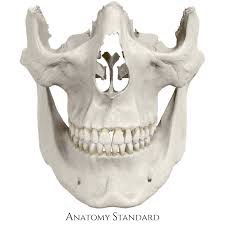
Humans have a few biological advantages compared to other species. The most obvious is our big brains, which have empowered us to become the dominant species on Earth. But another feature that is often overlooked is our chins — yes, we’re the only animals on Earth with true chins. You might be thinking, “Wait a minute, I give my cat chin scratches all the time,” or “Surely chimpanzees, our closest animal cousin, sport some kind of chimp chin,” and the answer is nope and nope (respectively). When you’re scratching the “chin” of your feline companion, what you’re really doing is scratching the mandible, i.e., the lower part of the jaw — not the chin, which is the bony part that juts out at the bottom of your face. Elephants and manatees also have chinlike protrusions in their lower jaws, but they don’t quite qualify as true chins.
The mystery of why no other animal has a real chin gets even more interesting because past human species, such as Homo erectus and Homo neanderthalensis, didn’t have chins either — instead, their faces simply ended in a flat plane. So why did evolution find the need for human chins? Scientists aren’t exactly sure. The most prominent theory is that chins help humans chew, but scientists from Duke University and the University of Florida found that chins aren’t actually much help there; they technically make chewing more difficult, as they reinforce the wrong part of the face for aiding mastication. Chins also don’t help much with human speech, which is another theory that’s been suggested, and researchers say it’s unlikely they’re a mere product of sexual selection or a protection against violence, such as punching. Some scientists think the chin might be a spandrel, a byproduct of other evolutionary changes that on its own serves no real purpose — basically, a happy accident. We may never truly know exactly why humans have these extra bony bits on the ends of our faces, but keep your chin up. After all, you’re the only species that can.
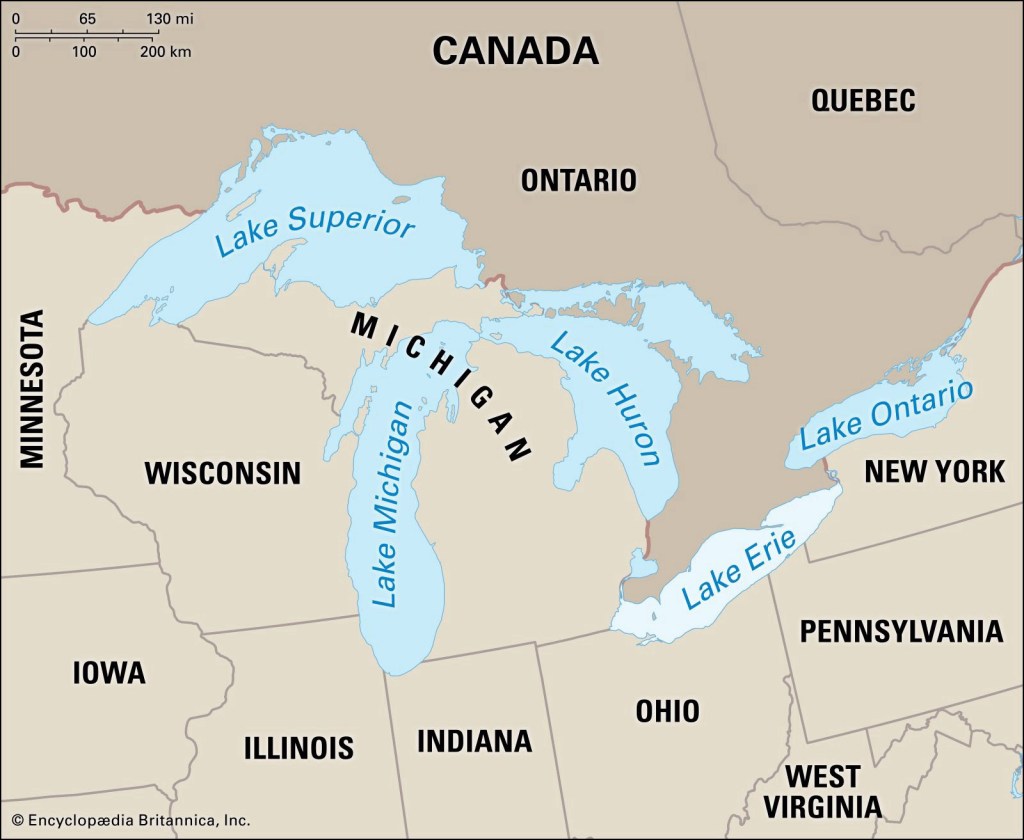
Anyone familiar with the Great Lakes can tell you there are five of them: Superior, Michigan, Huron, Erie, and Ontario. But actually, there aren’t, quite. Lakes Michigan and Huron are technically one body of water, as the Straits of Mackinac connect them to form a single hydrologic system. At 3.5 miles wide and just 295 feet deep at its deepest point, the waterway is easy to miss on a map when studying the whole system of Great Lakes. The lakes span a total of 94,250 square miles across eight U.S. states (Illinois, Indiana, Michigan, Minnesota, New York, Ohio, Pennsylvania, and Wisconsin), plus Ontario, Canada.
When taken together, Lake Michigan-Huron is the world’s largest freshwater lake by area. Even the smallest Great Lake, Ontario, is still the 13th-largest lake in the world. More than 90% of America’s surface fresh water is found in the Great Lakes, which are the primary water source for some 40 million people as well as the largest freshwater system in the world.
The GOP is pearl clutching over President Biden pardoning his son Hunter from chargers that the same GOP would never have brought against anyone unless their name was Biden, Clinton, or Obama. Faux (Fox) news will not bring to light the pardons Trump doled out when he was in office before, which included murderers, corporate thieves, I could keep going but there really isn’t any point. The party that wants every person to have a gun charged Hunter with filling out a form saying we was not on drugs when purchasing a gun, which he returned unused 11 days later. What is even worse is that they brought the charges after discovering this information from Hunters book… they didn’t find out because a crime was committed with said gun, the got the info from an admission to the egregious crime in his own book.
I really want every crime to be acknowledged and propagandized that the Trump administration takes part in by the Democrats for the next 4 years… what’s good for the goose .
When we’re younger, time tends to feel as if it drags on forever. Think of those long, lazy summers that seemed never-ending, or how it could feel like an eternity watching the clock tick away and waiting for the final school bell to finally ring. But as we grow older, many of us feel like time is moving more quickly. This curious phenomenon has nothing to do with any change in the measurement of time, of course; a minute today is the same length it was 50 years ago. According to some scientific theories, this sensation actually has to do with how our brains process the experiences around us, which changes as we age, leading.
Experiments Have Revealed How We Perceive Time Differently
In the 1960s, psychologist Robert Ornstein conducted a series of experiments leading up to the publication of his 1969 work On the Experience of Time. Two tests were particularly notable: In the first experiment, Ornstein showed subjects two diagrams — one with a complicated design and another featuring a comparatively simple pattern. Subjects were presented with each image for an identical period of time, but when asked which one had appeared for longer, test subjects chose the more complex diagram.
Ornstein also conducted a second experimentwith audio files featuring clicking sounds and basic household noises. Some of the recordings were more intricate, containing more clicks produced at a quicker frequency. When Ornstein asked his subjects to tell him which audio file was longer, they chose the more complex one with the greater number of sounds.
Ornstein concluded that across the board, people’s perception of time appeared to slow down when they were presented with greater amounts of new and complex information. He posited that our brains require extra time to process unfamiliar experiences, resulting in a feeling of time essentially moving in slow-motion.
Childhood vs. Adulthood
So what do Ornstein’s experiments have to do with time slowing down as we age? Well, when we’re young, our days are filled with first-time experiences rife with complex and often novel information that our brains work hard to process. There are countless new lessons to learn, new locations to explore, and new sensations to feel. In the context of Ornstein’s experiments, these are akin to seeing the more complex diagrams or hearing those more detailed audio files.
When we’re younger, it takes time for our brains to take in and process all the sights and sounds we’ve never experienced before. This overwhelming flood of knowledge may contribute to the sensation of time moving more slowly. As we grow older, however, we often find ourselves falling into familiar routines. Days, weeks, or even months can pass in which our lives remain largely unchanged. Our brains aren’t working as hard on a daily basis to process and analyze new experiences, so time can feel to be moving faster.
This is all subjective, of course, as some older people may actively seek out stimulating activities that keep the brain active and therefore help “slow things down.” But generally speaking, time tends to blend together more and more as we age, when it isn’t broken up by fresh, original experiences as frequently as in our younger years.
Still trying to wrap my head around those that cast their ballots based on inflation and the economy but record travel and retailers having huge numbers for Black Friday. I am really starting to believe that all the crying was complete BS.
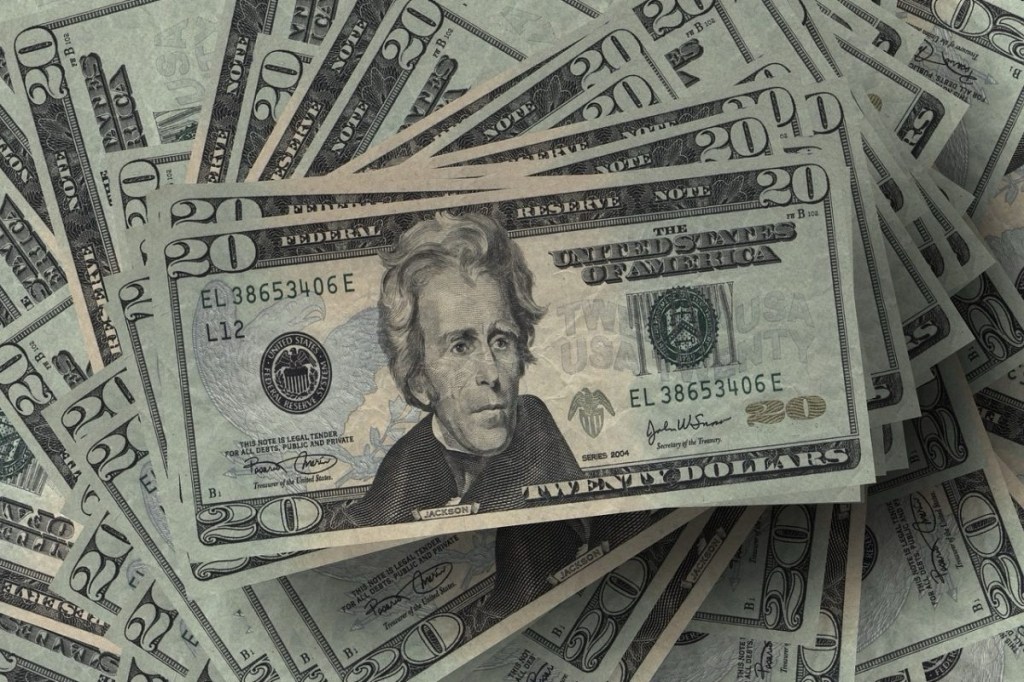
Music lovers today know that many live shows are a luxury expense or even out of reach — an average concert ticket costs well over $100. But in 1980, $20 could snag you two tickets to see some of the top acts of the day, including Peter Gabriel, Bob Seger, or the Grateful Dead. Today, meanwhile, it might be able to get you a drink at big arena shows.
For kids (or collectors), brand-new Transformers toys at the peak of their popularity in the ’80s were typically priced at about $10; for a more deluxe figure, $20 was the norm. And while $20 doesn’t go very far in the fast-food realm today, in the 1980s, it bought a lot: A McDonald’s value meal deal cost a mere $2.59, meaning $20 could feed a family of seven — or a family of five with money left over for ice cream afterward.









 Esoteric Meandering Shouting Into the Void
You must be logged in to post a comment.