It’s Election Day, I feel good about the possibility of our Democratic Republic continuing but I still have PTSD from 2016. The reality that the race is statistically so close even after the Republican Nominee is a convicted felon and adjudicate guilty of sexual assault is something I never thought possible, but here we are.
I honestly don’t trust the polls because the main stream media wants a horse race and I can’t, or at least don’t want to, admit that more than half of our voters want this experiment to end.
In 1584, the first English colony in North America was founded in what is now North Carolina. And though the 117 settlers who comprised the Roanoke Colony mysteriously disappeared three years later, ensuing waves of settlements established England’s presence on the continent for generations to come. By 1770, the total population of Great Britain’s 13 colonies in America was approximately 1.5 million. It raises the question: Since much of the population of the fledgling U.S. descended from Brits, would the American speech pattern at the time have sounded British? Could someone like George Washington, one of the most famous early Americans, have had a British accent?
Since Washington lived in an era that predates sound recordings, we don’t have a simple answer to that question in the form of audio records of the founding father’s voice. But we can determine some possibilities by piecing together factors from Washington’s life that would have impacted the way he spoke.
Washington was born in 1732 in Westmoreland County, Virginia, and spent most of his childhood near Fredericksburg. His father, Augustine Washington, and mother, Mary Ball Washington, were also born in Virginia. Indeed, George Washington’s lineage in the colony went back two more generations — it was his great-grandfather John Washington who set sail from England and established the family in Virginia. So America’s first president wasn’t from a family of recent British settlers; he was three generations removed, and the household he grew up in wouldn’t have necessarily spoken an accent that was common in England at the time.
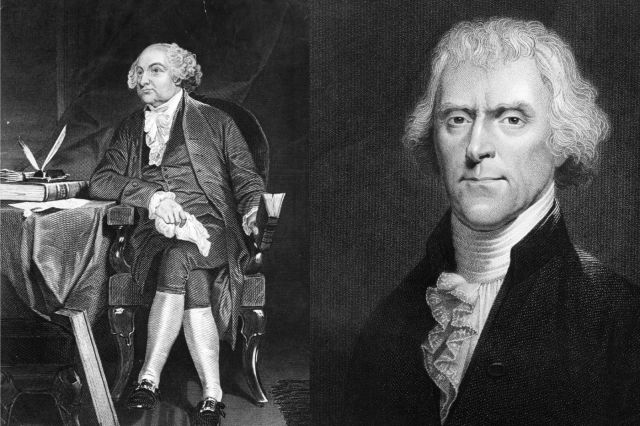
If anything proves that partisan politics and electoral machinations are nearly as old as the United States itself, it’s the election of 1800, when Federalist Party incumbent President John Adams sought reelection against Democrat-Republican Vice President Thomas Jefferson. The already-bizarre premise of opposing parties holding the presidency and vice presidency was made possible at the time by a law stipulating that the presidential candidate who earned the second-most number of electoral votes became Vice President. In the election of 1796, Jefferson lost the presidency to Adams by only three votes, and the 1800 election was a rematch between the political rivals.
That time, with another narrow margin likely, both parties turned toward influencing electors, whose votes decided the winning candidate in states where there was not yet a popular vote. Jefferson wrote of his intent to sway electors in New York, Pennsylvania, and New Jersey in a letter to James Madison. Federalist Senator Charles Carroll accused Jefferson and his supporters of also attempting to use “arts and lies” to manipulate votes in Federalist-leaning Maryland. From there, the accusations, well, escalated. Jefferson-supporting pamphleteer James Callendar claimed that John Adams was a hermaphrodite. Federalist newspapers accused Jefferson of maintaining a harem at Monticello.
When the votes were finally cast, the election ended in a tie between Jefferson and… his intended running mate, Aaron Burr. How? Each elector had two votes to cast, but there was no distinction at the time between a vote for President versus a vote for Vice President. Casting one vote for Jefferson and one vote for Burr was in effect a vote for each as President. The Constitution called for resolving this tie between the Democrat-Republican candidates with a vote in the House of Representatives, which was controlled by, you guessed it, the Federalist Party.
The task at hand was to vote on who, between Jefferson and Burr, would be President, but the Federalists saw an opportunity to seize power, either by delaying the proceedings past the end of Adams’ term, or attempting to invalidate enough votes to give Adams the majority. Others advocated for supporting Burr. Between February 11 and February 16, 35 rounds of voting took place, each ending in deadlock. Finally, after much lobbying by Alexander Hamilton against Burr, the 36th ballot resulted in Jefferson being appointed President. In the wake of the turbulent election, the 12th Amendment was ratified in order to prevent a repeat ordeal in 1804.
Famed Renaissance polymath Leonardo da Vinci left behind thousands of pages of notes and diagrams from his many pursuits in math, anatomy, botany, science, engineering, and art — he created more than 200 illustrations with notes on flight alone. Leonardo had groundbreaking ideas on everything from human anatomy to bridge design, and even the writing itself is impressive: Most of it is written from right to left, in a mirror image of ordinary European script. He only wrote left to right when someone else needed to read it. He also used his own form of shorthand.
Leonardo never directly explained why he wrote this way, but there are a few prevailing theories. It may have been simply practical: The artist was most likely left-handed, and writing left to right could get messy using a pen and ink. He also may have been trying to keep his ideas secret from potential copycats, or even trying to hide his work from the Roman Catholic Church. While Leonardo’s artwork is rich with religious symbolism, he was also a skeptic, and some of his ideas would have been at odds with the teachings of the church. After Leonardo’s death, his loose-leaf notes went to his student Francesco Melzi, an Italian painter. They were bound into several volumes, mirror writing and all, and soon began circulating among European elites as collector’s items. They are still kept in museums and private collections today.
One article said that those that believe Trump is dangerous are not taking into account that our democratic system is built with many checks and balances. This is not taking into account that the project 2025 has all the necessary instructions and intentions of destroying those checks. Trump is dangerous like any cornered animal is dangerous. He is cornered and he knows it. Getting reelected is the only way he can save his ass from being put behind bars. Pretty scary for a man his age that has spent his entire life getting away with whatever he did legally or not to be facing prison. If he is elected then he will start pardoning himself from every crime he can on the federal level. Then he will start calling on the republican governors of the states where he is having trouble to let him off the hook. As for places like New York he will withhold federal funds or some other method to make those legislators agree to let him be pardoned. There is no thought of service to the nation at this point, if there ever was one. He is interested in taking care of his favorite thing, self. His ego would not hold up behind bars even if they were in a medium security facility. The idea that we, the taxpayers, would have to supply secret service even in prison is just ridiculous. He would not be safe without that protection as it seems likely that someone he lied to would be near enough to do him harm. The other alternative is to stick him in the maximum security unit in Colorado and see how long it takes for him to go totally insane. Since he would be isolated in that unit it doesn’t seem reasonable for a full security detail to be with him. He has said that he would run for Venezuela if he does not get elected. That would put him out of the way, maybe keep fox news from talking about him. It might even mean he would no longer be a major pain in the ass to the rest of us. The fact that Venezuela would try to get an extradition agreement going seems likely, I know I would not want him in my country were I them, and I don’t want him in this one either.
The ancient indigenous people of Mexico have practiced rituals celebrating the lives of past ancestors for around 3,000 years. The celebration that is now known as Day of the Dead originally landed on the ninth month of the Aztec calendar and was observed for the entire month. In the 20th century, the month long festivities were condensed to three days called The Days of the Dead: Halloween on October 31, Day of the Innocents on November 1, and Day of the Dead on November 2.
La Catrina is one of the most recognizable figures of Day of the Dead, a towering female skeleton with vibrant make up and a flamboyant feathery hat. The Lady of Death worshipped by the Aztecs protected their departed loved ones, guiding them through their final stages of the life and death cycles. La Catrina that we know today came to be in the early 1900s by controversial and political cartoonist José Guadalupe Posada. Artist and husband of Frida Kahlo, Diego Rivera, included José’s La Catrina in one of his murals which depicted 400 years of Mexican history. His mural, “Dreams of a Sunday Afternoon in Alameda Park”, includes himself and a young child holding hands with La Catrina, who is dressed in sophisticated garb and a fancy feathered hat.
Plans for Day of the Dead are made throughout the year. Toys are offered to dead children and bottles of alcohol or jars of alote get offered to dead adults. Most families decorate their loved ones’ graves with ofrendas, which often includes marigolds. It’s said that these specific flowers attract the souls of the dead to the offerings, and the bright petals and strong scent guides the souls from the cemetery to their family’s home.
Since the 1960s, when the Mexican government declared it a public holiday based on educational policy initiatives, Dia de Muertos has been observed throughout Mexico. The tradition was added to the United Nations Educational, Scientific, and Cultural Organization’s Representative List of Humanity’s Intangible Cultural Heritage in 2008.
Myth: Daylight Saving Time was Created to Benefit Farmers
It’s a story that continues to crop up: daylight saving time was created for the agriculture industry to offer more daylight hours to work in the field, according to a History.com article. The truth of the matter is the agriculture industry lobbied against daylight saving time in 1919. Some believe it was then that farmers became associated with daylight saving time, even though they were only involved because they were against it.
The first implementation of daylight saving time occurred in Germany in 1916 as a way to conserve coal usage during World War I. The U.S. followed suit in 1918, and the implementation has come and gone over the years. It has been particularly popular as a means to conserve energy with the thinking being that if the summer sunlight lasts longer into the evening, it is one less hour of darkness that will need to be lit, cooled, or heated.
Daylight Saving Time and Farming
Many farmers and others in agriculture are still opposed to daylight saving time. What it actually does is disrupt a farmer’s carefully orchestrated schedule. For instance, if dairy cows are used to being milked at 5:00 a.m., moving the clock back an hour in the fall actually moves their milking time back an hour, and livestock cannot understand waiting another hour to be milked. Then, just as the cows get used to it, the milking schedule gets changed again in the spring. The milk truck is likely still coming at the same time per the clock, meaning dairy farmers can’t just change their milking times to keep it consistent for the animals.
Similarly, daylight saving time also affects the amount of time put in by farmworkers. If hired hands have to wait an extra hour for daylight to start working in the morning, but they still leave at the same time at night, less work is getting done. All in all, farmers would rather just use the sun and the seasons to determine milking times, planting charts, and the best time to harvest.
Ben Franklin is often credited as the inventor of daylight saving time — after all, the concept seems on-brand for the founding father who once championed early waking and bedtimes as the key to success. It’s a myth that Franklin invented daylight saving time, though he did once suggest a similar idea. In 1784, Franklin (then living in France) wrote a letter to the Journal de Paris, suggesting that French citizens could conserve candles and money by syncing their schedules with the sun. Franklin’s proposal — wittily written and considered a joke by many historians — didn’t recommend adjusting clocks; the idea was to start and end the day with the sun’s rising and setting, regardless of the actual time.
Franklin’s proposal didn’t get far, but nearly 100 years later, another science-minded thinker devised the daylight saving time strategy we’re familiar with today. George Vernon Hudson, a postal worker and entomologist living in New Zealand, presented the basics of the idea in 1895. Hudson’s version moved clocks ahead two hours in the spring in an effort to extend daylight hours; for him, the biggest benefit of a seasonal time shift would be longer days in which he could hunt for bugs after his post office duties were finished. Hudson’s proposal was initially ridiculed, but three decades later, in 1927, New Zealand’s Parliament gave daylight saving a shot as a trial, and the Royal Society of New Zealand even awarded Hudson a medal for his ingenuity.
Had an appointment this morning at the VA Hospital and watched several of the veterans come in that are in terrible shape. Some of the conditions are as advanced as they are because these individuals tended to ignore what was happening to them because they were raised during a time when only an emergency got you to a doctors office. They have been exposed to stuff that no one should be near without complete protection, and of course, they did not have that luxury. Many were probably drafted into the service and had no choice as to what path they would follow once inducted. The problems they have today are probably the result of what they were exposed to during their service. To say that there are some very sad cases is an understatement. Fortunately there are facilities to look after them, at least today. The problem may be tomorrow if the man that calls them losers gets reelected. That care may go away as he has no respect or use for them. It has been said that his attitude is that when it comes to spending on age or illness he prefers that they just die. Healthcare is expensive and the driving force behind Trump is the amassing of money, not spending it on “losers”. It is bad enough for him to take such a negative attitude with humanity in general but especially damning to target those that fought for our nation. Our calendar has several dates that are highlighted for events that address our commitment to freedom. November 5th is election day but it is not a national holiday, nor is January 6th the date of confirmation of election results, or January 20th when the transfer of power takes place. All of these dates were dates of challenge in 2020 and it appears will be again in 2024/25 because no matter the size of loss Trump has it will be challenged. The attempts to overturn the election 4 years ago may seem minor after what may go down this time. So many are explaining this with things like, “He never backs down, never loses”. At least in his mind, losing is unacceptable. No one wants to lose but not everyone can win and no matter how you dress it up someone always does. His ego must come out as the winner, this can be seen in the claims of having bigger crowds at his rallies, or winning debates even when he gets his ass handed to him. His claim that no one knows more about anything than he does is all his ego overriding the truth which he can not deal with. Our nation has been through wars before, to free ourselves from a king, to save our friends from the oppression of a dictator. We have even fought one another to overcome a barbaric practice that allowed one man to “own” another. We may have to go to war again within our borders to suppress the movement that wants to turn the clock back to a time when women could not vote, child labor was allowed, or even possibly the autonomy of the individual is put in doubt. If the babble that is escaping Trump’s lips is even close to his intentions then his reelection is a major mistake. We can not afford to be put under the boot of his or his cadre of supporters that are hungry for power. They want to be elevated to positions of authority so they can flex their desire to dominate others the way that the commanders of the death camps in Germany did in WWII. This is a luxury that we need to benign them not only for ourselves but if you believe in an afterlife, for their salvation.








 Esoteric Meandering Shouting Into the Void
You must be logged in to post a comment.