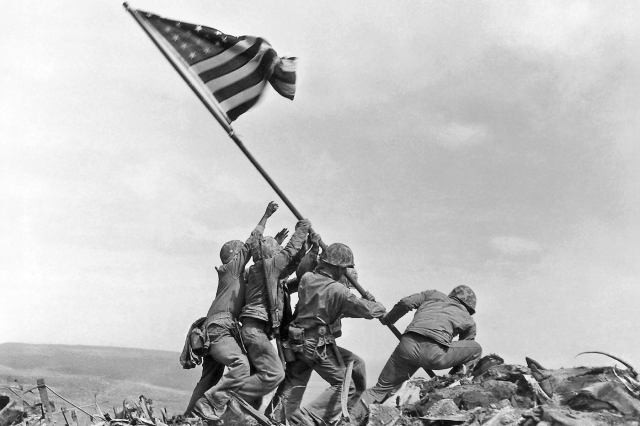
“Raising the Flag on Iwo Jima” (1945)
Joe Rosenthal was a photographer for the Associated Press during World War II whose legacy was defined by the Pulitzer Prize-winning photo “Raising the Flag on Iwo Jima.” Rosenthal captured the iconic event on February 23, 1945, on the small Japanese island of Iwo Jima, roughly 750 miles south of Tokyo in the Pacific Ocean. The picture depicts six men triumphantly raising an American flag, and commemorates an important military victory — though there’s a good deal more to the story.
The island of Iwo Jima was a strategic stronghold occupied by the Japanese. On February 19, three U.S. Marine divisions landed on Iwo Jima and began a harrowing multiday battle with Japanese forces. On February 23, Americans took control of Mount Suribachi, a geographic landmark on the southern end of the island. In celebration of their conquest, troops raised up an American flag, though not the flag seen in the famous image. It was actually a smaller flag, captured by Sergeant Louis R. Lowery in a lesser-known photograph.
Hours later, troops were ordered to replace the first flag with a larger American flag that could be seen more easily from a far distance. This caught the attention of Rosenthal, who heard the plan from a nearby radioman. Rosenthal brought his camera to the mountain, where he photographed six men (five Marines and one Navy Corpsman) raising the larger flag in what has since become an iconic image. Tragically, it took another month for American forces to take the entire island of Iwo Jima, during which three of those men were killed: Sergeant Michael Strank, Corporal Harlon Block, and Private First Class Franklin Sousley. The three others who survived the battle, and the war, were Corporals Harold Keller, Harold Schultz, and 22-year-old Ira Hayes, a soldier of Pima Indian descent who went on to meet President Harry Truman at the White House.

