Dwain Northey (Gen X)
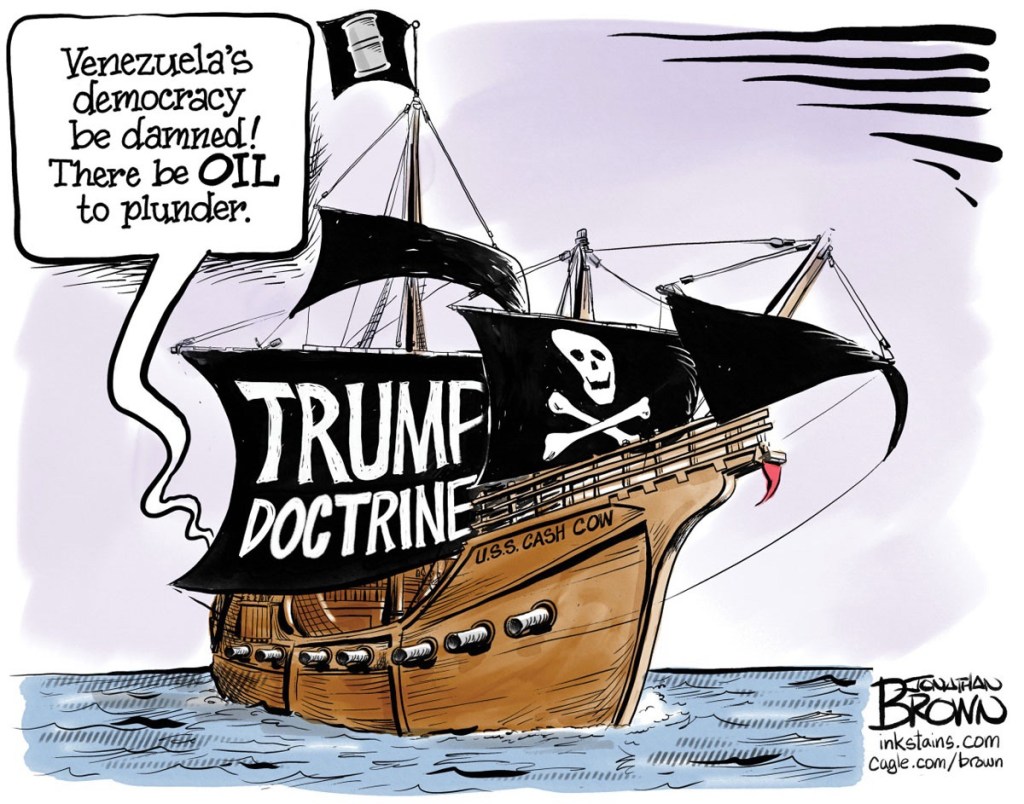
From Privateers to Presidents: A Brief History of State-Sponsored Theft, Now With Oil
If all of this feels strangely familiar, that’s because we’ve actually done this before. Not yesterday. Not last decade. Centuries ago. Back when empires at least had the decency to admit they were empires.
They were called privateers — state-sanctioned pirates. Governments handed out “letters of marque,” basically permission slips that said: Go ahead, board enemy ships, steal their gold, disrupt their trade — just don’t forget who signed the paperwork. England did it. Spain did it. France did it. Early America did it too. Theft, but with a flag and a flourish.
And, as history so helpfully teaches us, privateers had a habit of doing what pirates always do: they stopped pretending the loot belonged to the crown and started keeping it for themselves. Surprise! When you legalize theft, it eventually stops respecting your rules.
Which brings us neatly back to Donald Trump and his Defense Department cosplay generals, now apparently auditioning for the role of 21st-century privateers — only without the honesty or the paperwork.
Because let’s be clear: we are no longer talking about wartime interdictions or defensive naval actions. We are talking about seizing oil tankers from a sovereign nation and openly stating that this is being done for our benefit and to control their markets. That’s not sanctions enforcement. That’s not diplomacy. That’s not even clever euphemism.
That’s just theft with extra steps.
So what do we call a country — or more accurately, a government — that decides other nations’ resources should be taken because it can? That their oil is somehow less “theirs” and more “ours,” simply because we have the biggest navy and the loudest press conference?
Empire is the word they’re avoiding.
Piracy is the word they’re denying.
But history doesn’t care what spin doctors call it.
And now the obvious question presents itself: Is Donald Trump about to revive privateers — oil edition? Should we expect the creation of a shiny new agency, perhaps the Department of Strategic Hydrocarbon Acquisition? Or maybe something more on-brand, like the Patriot Oil Recovery Force? Will billionaire donors get letters of marque granting them permission to “liberate” tankers in exchange for a campaign donation and a photo op?
Because once you normalize the idea that oil belonging to another country is fair game, you’ve crossed a line that international law was specifically designed to stop us from crossing again. The entire reason piracy was outlawed — universally, without ambiguity — is because once everyone decides theft is justified by power, there is no rule left but force.
And let’s not kid ourselves: Venezuela being “in the Americas” does not magically make it “America.” Geography is not ownership. Proximity is not sovereignty. The Monroe Doctrine is not a deed. And Donald Trump is not Poseidon, no matter how much he seems to enjoy throwing tridents at international norms.
So yes — if you’re sitting there thinking, “I thought piracy was illegal,” congratulations. You understand international law better than the current administration. Because what we are watching is not strength, not leadership, not strategy.
It’s the resurrection of an old, ugly idea:
If we want it and can take it, it must be ours.
That idea didn’t end well for the privateers.
It didn’t end well for the empires.
And it won’t end well now — no matter how many tankers they manage to haul off before the world stops pretending this is normal.
 Esoteric Meandering Shouting Into the Void
One response to “Pirate or Privateer”
I GUEST THIS IS ALL HAPPENING BASED ON MAN THOUGH OF BUILDING HEAVEN ON EARTH WITH .
115 THOUSANDS TONS OF PURE GOLD
126 THOUSAND TONS OF PURE SILVER
MAINLY FOR THE CHILDREN OF ISRAEL.
LikeLike