Dwain Northey (Gen X)
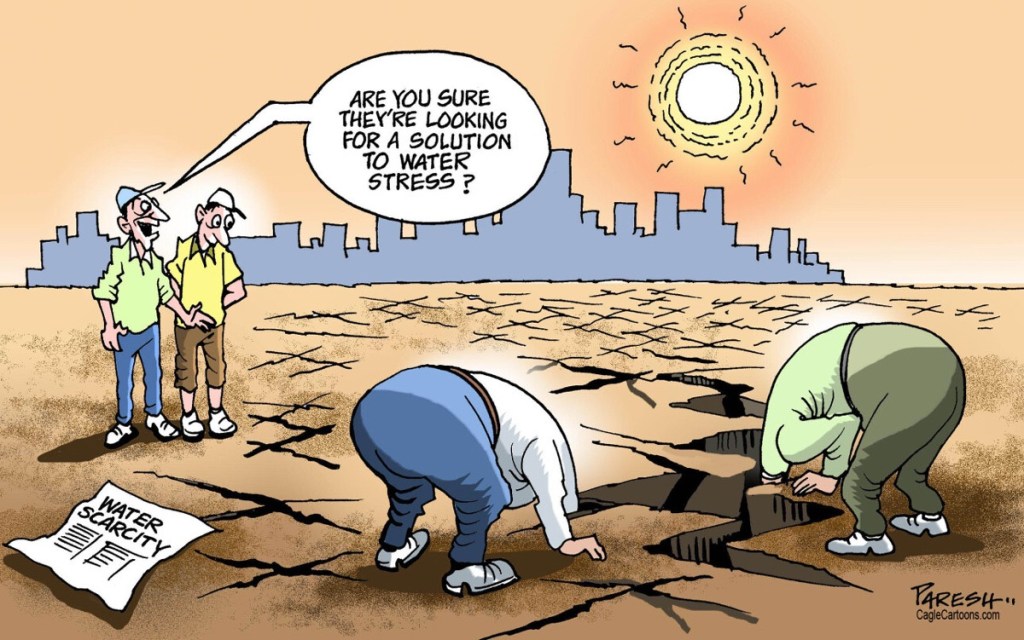
I live in a place where the sun doesn’t just shine—it files a restraining order against clouds. Out here in the Southwest, water isn’t a resource so much as a rumor we keep repeating to ourselves like it’s going to magically refill the glass.
Every morning, I turn on the tap with the same quiet optimism of someone checking their 401(k) during a market crash. “Maybe today,” I think. Maybe today the water will feel abundant instead of…borrowed. Loaned. Like the Earth is keeping a tab and we’re aggressively pretending we lost the receipt.
We talk a lot about melting ice caps, and don’t get me wrong—watching the Arctic turn into a lukewarm cocktail is concerning. But last I checked, I can’t pour a glass of salt water, squint at it, and call it hydration. “Ah yes, notes of brine, a hint of existential dread.” That’s not a solution. That’s a cry for help with a garnish.
Meanwhile, here in the desert, we’re building the future. Data centers bloom out of the dust like steel cacti, humming with the promise of artificial intelligence, machine learning, and the ability to generate 10,000 variations of a cat wearing a cowboy hat. Progress, baby. Just don’t ask what keeps those servers cool. Spoiler alert: it’s not optimism. It’s water. Lots of it.
And I get it—we love our technology. We love asking machines to answer questions we used to ignore on our own. But there’s something beautifully absurd about prioritizing the hydration of servers over the hydration of, say, people. At this rate, the AI is going to achieve sentience just in time to ask us why we didn’t bother to keep ourselves alive.
The real magic trick is how we’ve managed to avoid talking about the obvious solution like it’s impolite dinner conversation. Desalination. Turning the endless oceans into drinkable water. We can literally teach a computer to mimic human thought, but taking salt out of water? Whoa there, let’s not get crazy.
Except—we already know how to do it. We’ve known for a while. It’s not some sci-fi fantasy. It’s just expensive, energy-intensive, and apparently less exciting than building another server farm so we can argue online faster.
So instead, we do what humans do best: we wait. We wait until the problem gets big enough that it can no longer be politely ignored, like a smoke alarm chirping at 2 a.m. Eventually, we’ll either change the battery—or the house will burn down, and we’ll all stand outside saying, “You know, I always thought that noise was important.”
I find myself wondering, quietly, uncomfortably, if we’re inching toward something we don’t want to name. Not all at once, not dramatically, but slowly—like a landscape forgetting how to be alive. Places like parts of Arizona, New Mexico, Texas, California…places that already flirt with the edge of “just enough.” What happens when “just enough” becomes “not quite”?
Do we become the cautionary tale we used to point at from a safe distance? The one we’d shake our heads about, saying, “How did it get that bad?” while conveniently ignoring the part where we had a front-row seat to our own version of the same story.
And the most unsettling part? It’s not that we don’t have options. It’s that we have them and still hesitate. We debate, we delay, we budget, we prioritize everything except the one thing that quietly underpins all the others: water.
Because without it, there’s no agriculture, no cities, no data centers, no clever essays about how ironic it all is. There’s just…dry silence.
So here I am, standing at the sink, letting the water run a second longer than I probably should, wondering if someday this will feel like a luxury I didn’t appreciate enough. Wondering if we’ll look back and realize that the real “elephant in the room” wasn’t hiding at all.
It was just waiting patiently for us to notice that it was dying of thirst.

