Dwain Northey (Gen X)
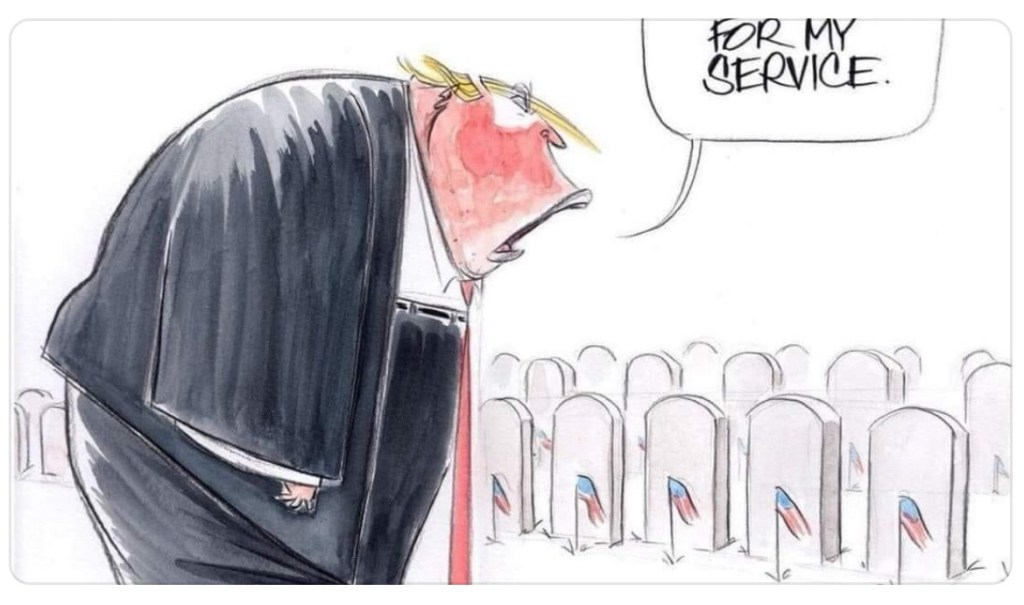
There was a time—not that long ago, though it now feels like a different geological era—when every misplaced syllable from Joe Biden was treated like a five-alarm fire in the national psyche. A verbal stumble? Breaking news. A pause mid-sentence? Panel discussion. A slightly meandering anecdote? Cue the solemn declarations: this is it, the decline, the unraveling, the end of coherence as we know it.
We were told, with the urgency usually reserved for asteroid warnings, that the Republic itself was hanging by the delicate thread of a conjugated verb. Words like “senile” and “dementia” weren’t whispered with concern—they were hurled like confetti at a particularly mean-spirited parade. Entire segments of the media ecosystem seemed to function as linguistic forensic labs, analyzing every Biden utterance like it was the Zapruder film, except instead of bullets, we were tracking dropped consonants.
And now—well. Now we live in a time of interpretive flexibility.
Enter Donald Trump, a man who can take a straightforward concept like immigration policy and turn it into something that sounds like it was assembled from refrigerator magnets during a mild electrical storm. We are told, for instance, that people are arriving on “pork visas”—which, one assumes, is either a new agricultural exchange program or perhaps a deli loyalty rewards system gone horribly wrong. Credit cards are apparently being handed out like party favors, and asylum seekers are not fleeing danger so much as escaping what he imagines to be a sort of global network of “insane institutions,” which sounds less like policy analysis and more like the plot of a low-budget thriller.
And then there was the small matter of the Jesus photo. A perfectly normal sentence to type in 2026, by the way. Presented with an image of himself styled as the Son of God—a piece of digital art so subtle it practically winked—he was reportedly told by staff that it had been doctored. To which the response was not, “Ah, I see, thank you,” but rather, “Oh well, I was a doctor.” Which is impressive, really. Not the content of the statement, but the sheer confidence with which it sidesteps reality, logic, and basic sentence structure all at once.
But perhaps my favorite subplot in this ongoing theater of selective concern is the triumphant return of the cognitive exam—specifically, the way Donald Trump brandishes it like an Olympic gold medal. The “perfect score,” we’re told. The flawless performance. The intellectual decathlon, apparently, now featuring identifying animals and remembering a short list of words.
Here’s the part that tends to get left out of the victory lap: cognitive exams aren’t handed out like raffle tickets at a county fair. They’re not a fun bonus round for people who are just too sharp and need an extra challenge. In any clinical setting—something you’d know if you’ve spent time in healthcare—they’re administered when there’s a concern. A baseline needs to be established because something has raised a flag. Stroke. Dementia. Alzheimer’s. Observable decline. That’s the context. That’s the club.
It’s not a participation trophy. It’s not even a merit badge. It’s closer to a diagnostic checkpoint—a quiet, clinical “let’s make sure everything’s okay here,” which, by definition, means someone, somewhere, thought everything might not be okay.
So the spectacle of boasting about acing one is… unusual. It’s like proudly announcing you passed a sobriety test while insisting you were never suspected of drinking. Congratulations, I suppose, on successfully identifying a giraffe and recalling “person, woman, man, camera, TV.” Truly stirring stuff. But the existence of the test itself is the part that usually matters, not the standing ovation afterward.
And yet, somehow, this doesn’t trigger the same chorus of alarm. No breathless chyrons. No wall-to-wall speculation. No anguished op-eds about fitness for office based on the ability to complete a screening tool designed to detect impairment.
Which brings us back to that lingering question: when did cognitive concern become so… situational?
Because if we’re going to treat mental sharpness as a prerequisite for leadership—and that’s a reasonable standard—then it probably shouldn’t depend on who’s talking, or how much we already agree with them. Otherwise, we’re not actually evaluating capacity. We’re just grading on a curve that shifts with our preferences.
And that’s not a medical assessment. That’s branding.

