Dwain Northey (Gen X)
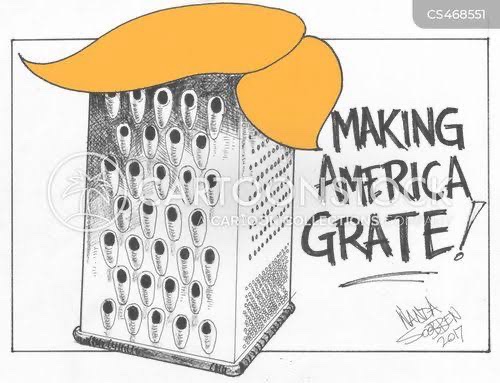
There was a time when “Make America Great Again” sounded like a slogan stitched onto a red hat. Now it feels more like a set of instructions—specifically, the kind you’d find on a cheese grater. Firmly grasp the country, drag it steadily downward, and call whatever falls off “progress.”
Because “great,” as it turns out, has a homophone. And we are living in it.
We’ve begun to grate.
Not in the inspiring, moon-landing, interstate-highway, “we built this” kind of way. No, this is the slow, grinding erosion of standards—the kind that doesn’t make a sound at first, until you realize the edges are gone. Expertise? Grated. Institutions? Grated. The quiet expectation that the people in charge should know what they’re doing? Finely shredded.
Take something as uncontroversial as the weather. The sky used to be one of the few things we could all agree on—blue meant blue, hurricanes meant “maybe listen to the scientists.” Now even that has been fed through the blade. Funding gets trimmed, agencies get hollowed out, and suddenly the same country that once led the world in atmospheric science is checking the forecast like a student copying homework.
We lean on European weather models—not because collaboration is new or bad, but because self-sufficiency has quietly slipped out the back door. It’s not a partnership when you’ve dismantled your own tools and are now hoping someone else brought theirs.
And this is where the slogan starts to sound less like nostalgia and more like performance art.
Because while we’re busy sanding down expertise at home, we’re simultaneously projecting strength abroad—loudly, theatrically, insistently. We posture. We escalate. We wrap ourselves in the language of dominance while borrowing the intellectual infrastructure we used to export. It’s a curious form of patriotism that declares independence while relying on others to double-check the forecast before we pack an umbrella.
War, or the constant flirtation with it, becomes the ultimate distraction. It’s the cymbal crash that drowns out the quieter, more consequential story: that you cannot steadily degrade the systems that make a country function and expect the illusion of strength to hold indefinitely. Eventually, the gap between what we say we are and what we’ve allowed ourselves to become gets too wide to ignore.
That’s the real hypocrisy—not just in policy, but in identity.
We still tell ourselves we’re the best. The most capable. The leaders. But leadership isn’t a declaration; it’s a maintenance job. It requires investment, humility, and the uncomfortable acknowledgment that expertise matters. That facts matter. That maybe the people studying the atmosphere, the economy, or the fragile geometry of global stability aren’t the enemy.
Instead, we’ve chosen the grater.
And the thing about grating is that it’s irreversible. You don’t get to reassemble what you’ve shredded and call it whole again. You can only keep going, convincing yourself that smaller pieces somehow add up to something greater.
So here we are—making America “great,” one thin shaving at a time.

