Dwain Northey (Gen X)
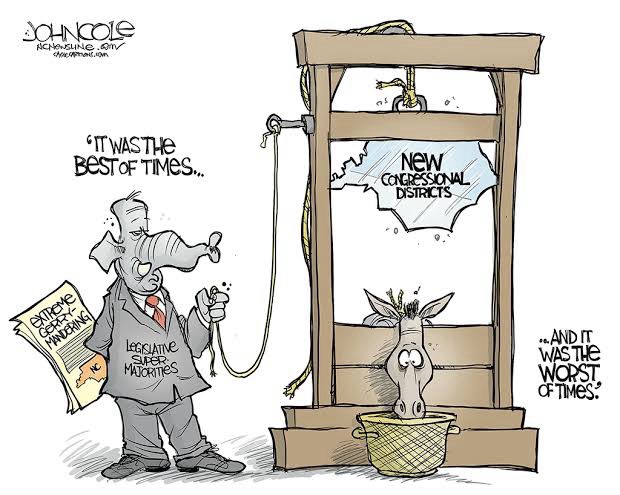
Ah yes, the ancient and sacred principle of American democracy: gerrymandering is perfectly fine—as long as we’re the ones doing it.
For years, the ritual has been straightforward. States like Texas redraw their maps with the artistic flair of a toddler with a crayon and a political agenda, carefully curving districts around inconvenient voters like they’re avoiding potholes. And when critics raise an eyebrow, the response is always the same: “This is just how the system works.” A shrug, a wink, maybe a quiet high-five.
Enter Donald Trump, who at one point encouraged mid-decade redistricting like it was a limited-time sale—“Why wait for the census when you can redraw the map right now?” And lo and behold, states complied. Democracy, but make it improv theater.
But then something truly shocking happened. States like California and Virginia decided to… also redraw districts. Through votes. With public input. You know, those inconvenient little things often marketed as “democracy.”
And suddenly, outrage.
Apparently, when Democrats engage in redistricting—especially when voters themselves approve it—it becomes a grave constitutional crisis. Cable news panels clutch pearls. Politicians gasp as though someone just suggested counting votes twice. “This is unfair!” they cry, as if fairness had ever been invited to the gerrymandering party in the first place.
Now, to make the outrage even more theatrical, let’s rewind to For the People Act of 2021—also known as H.R. 1. Among its many provisions was a proposal to curb partisan gerrymandering nationwide by requiring independent redistricting commissions. In other words, a radical, dangerous idea: maybe politicians shouldn’t be allowed to pick their own voters like they’re assembling a fantasy football team.
And how did Republicans respond to this horrifying concept of neutral map-drawing? With unanimous opposition. Every single one said “no thanks” to the idea of banning partisan gerrymandering at the federal level.
Which makes today’s outrage feel less like a principled stand and more like a plot twist nobody bothered to proofread.
The argument now seems to be: “We absolutely oppose banning gerrymandering… but also, how dare you gerrymander.” It’s a bold strategy—simultaneously defending the practice and condemning it, depending entirely on who’s holding the pen.
It’s a bit like a football team rewriting the rulebook mid-game, then throwing a tantrum when the other team reads it.
Of course, none of this is actually about principle. If it were, we’d have seen consistent outrage when districts started resembling abstract art installations. No, this is about control—about who gets to tilt the board and by how much. And for a long time, one side had a comfortable lead in that particular game.
Now that the other side has picked up the same tools, suddenly the tools themselves are the problem.
Curious how that works.
So here we are, watching a political class argue that democracy is only legitimate when it produces the “correct” outcomes, and that voters having a say in redistricting is somehow more suspicious than politicians drawing their own favorable maps behind closed doors.
It would be funny if it weren’t so surprising—except, of course, it isn’t surprising at all.
But at least we can all agree on one thing: gerrymandering is a terrible, undemocratic practice that must be stopped immediately… right after we finish using it one last time.

